
By Yousef Ramazani
In the wake of the US-Israeli war of aggression against Iran and the subsequent maritime banditry and piracy, the Islamic Republic is reportedly moving to assert its long-dormant sovereign rights over the submarine internet cables that traverse the waters of the Strait of Hormuz.
This strategic reorientation – as confirmed by some reports – promises to generate hundreds of millions of dollars in annual revenue while fundamentally reshaping the legal and economic architecture of global data transmission.
The unprovoked military aggression against Iran, which halted with a ceasefire on April 8, 2026, has fundamentally altered the strategic calculus of the Persian Gulf.
During the 40 days of aggression against Iran, a previously overlooked dimension of the country’s sovereign territory emerged as a critical vulnerability for the global digital economy.
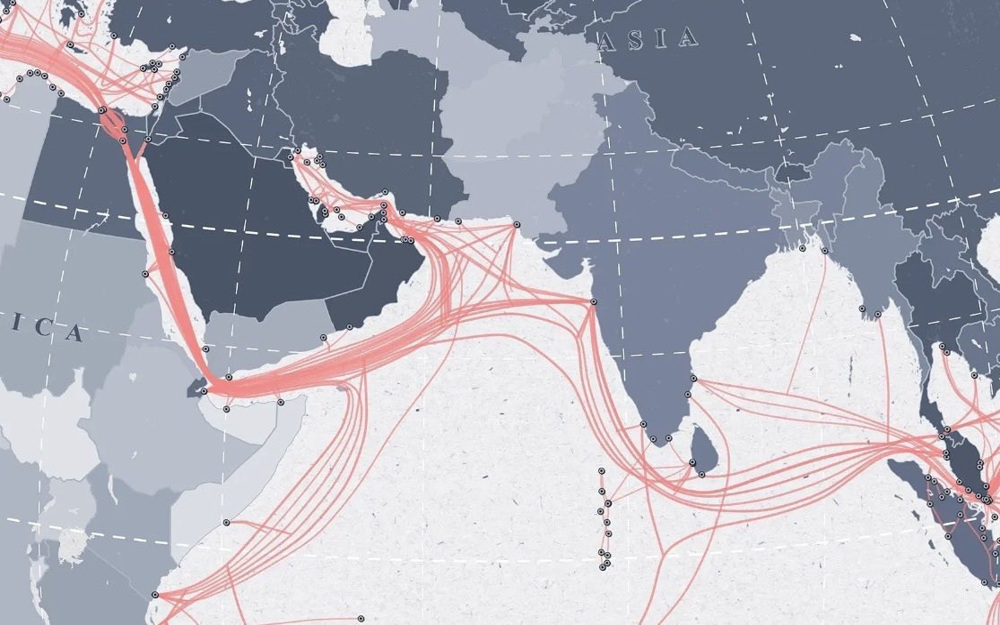
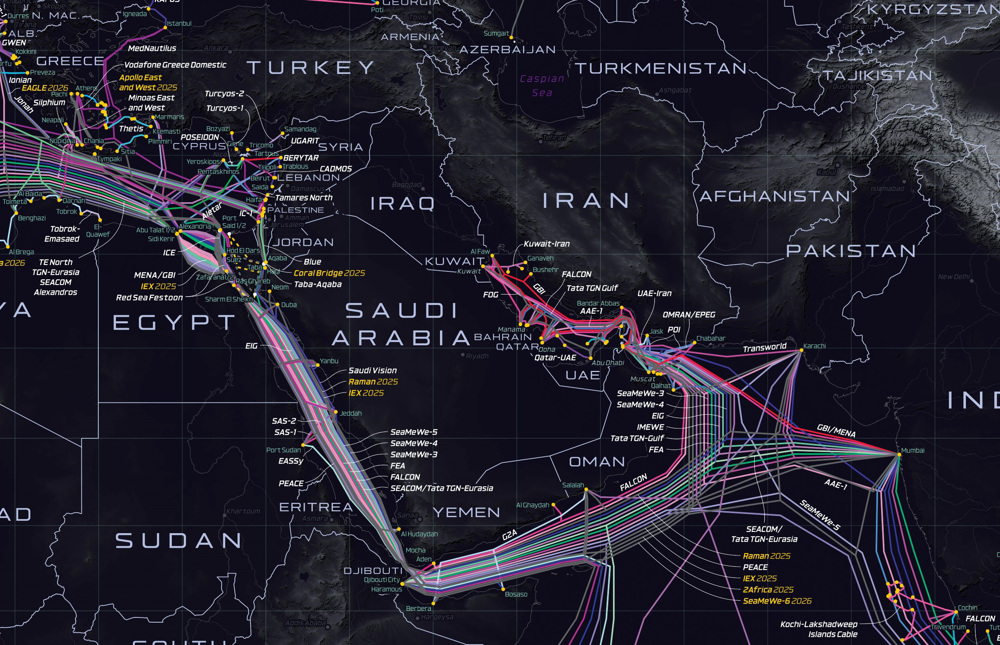
Beneath the waters of the Strait of Hormuz, where Iran's territorial sea extends 12 nautical miles and overlaps completely with Omani jurisdiction, leaving no high seas whatsoever, lie at least five major submarine fibre-optic cable systems.
These cables carry approximately 99 percent of all intercontinental internet traffic and an estimated 10 trillion US dollars in daily financial transactions.
Now, in the aftermath of the aggression, which came in the middle of nuclear talks, Iran is moving to exercise its full and legal sovereign authority over this hidden infrastructure.
The plan is increasingly centered on a comprehensive governance model that would include permit requirements, transit fees, Iranian legal jurisdiction over foreign technology companies, and exclusive Iranian control over cable maintenance and repair operations.
Forgotten dimension of the Strait of Hormuz
For decades, international discourse surrounding the Strait of Hormuz focused almost exclusively on traditional dimensions: freedom of navigation for oil tankers, security of energy flows, and the legal regime governing the passage of commercial and military vessels.
This narrow framing, however, systematically ignored one of the most vital emerging dimensions of this strategic corridor: the fibre-optic communication infrastructure and submarine data transmission cables that lie on the seabed of Iran's territorial waters.
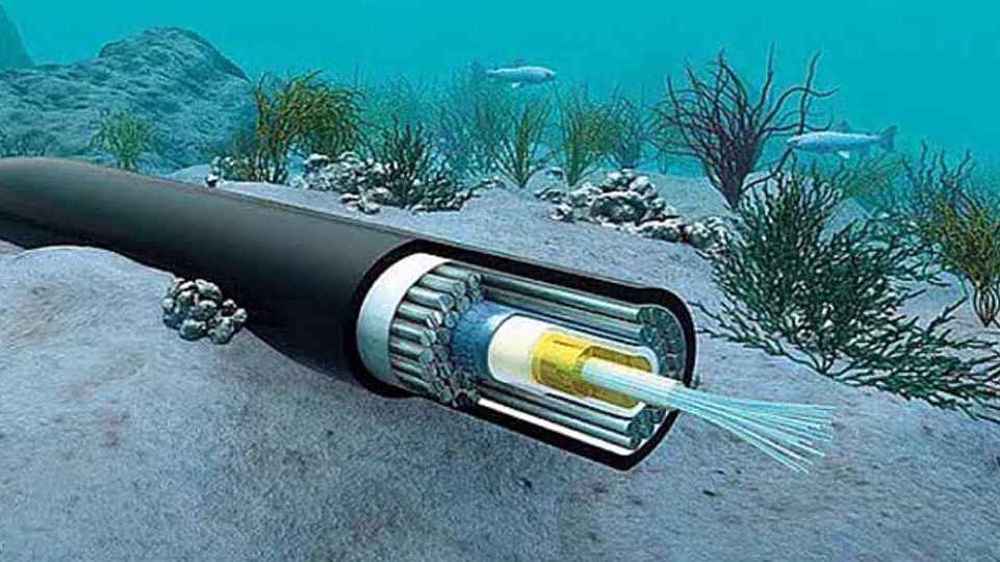
These cables, which include major systems such as FALCON (owned by Tata Communications of India), the Gulf Bridge International (GBI) system, and the TGN-Gulf system, form the backbone of the digital economy, not just for the Persian Gulf region but the entire world.
They carry international internet traffic, cloud data centre synchronization, enterprise virtual private networks, voice-over-IP communications, and – most critically – international banking and financial transactions, including SWIFT messages.
Any disruption to these communication highways, whether from natural disasters, ship anchoring, or military action, could cause irreparable damage to the tune of tens to hundreds of millions of dollars daily.
What makes this issue particularly significant for Iran is the undisputed legal reality that the Strait of Hormuz is not, and has never been, international waters.
The careful repetition of the phrase "international waters" by Western media and think tanks is part of a cognitive and legal battle designed to diminish the legitimate sovereignty of the Islamic Republic of Iran over one of the world's most vital waterways.
Why is the Strait Iranian territory
The legal status of the Strait of Hormuz must be understood through the precise geometry of international maritime law.
According to the 1982 United Nations Convention on the Law of the Sea, each coastal state has the right to determine the width of its territorial sea up to a maximum distance of 12 nautical miles from its baselines.
Iran has never ratified this convention, but it serves as a reference point for international practice. Within these 12 miles, the coastal state exercises absolute sovereignty over the water column, the seabed, the subsoil, and even the airspace above.
This is exactly the same sovereignty it exercises over the territory of its capital city.
The Islamic Republic of Iran has determined the width of its territorial sea in the Persian Gulf and the Sea of Oman to be 12 nautical miles. The Kingdom of Oman has adopted exactly the same procedure.
The Strait of Hormuz, at its narrowest point between Iranian islands and the Omani coast, measures approximately 21 nautical miles in width.
When Iran extends its territorial sea 12 nautical miles southward from its northern coast, and Oman extends its territorial sea 12 nautical miles northward from the Musandam Peninsula, the combined territorial waters of the two countries total 24 nautical miles.
This exceeds the total width of the strait at that point by three nautical miles.
The result is geometrically inevitable: the territorial seas of Iran and Oman collide and overlap in the middle of the Strait of Hormuz.
There is not a single drop of water in the narrowest points of the strait and its main shipping channels that can be legally classified as high seas or even as an exclusive economic zone.
Any vessel, submarine, or cable that passes through this point is legally passing within the sovereign borders of the Islamic Republic of Iran.
To this geometric reality must be added the clarifying force of Article 34 of the Convention on the Law of the Sea.
That article states definitively that the regime of passage through straits used for international navigation does not in any way affect the legal status of the waters forming these straits.
Nor does it affect the exercise of sovereignty and jurisdiction by the bordering states over those waters, their airspace, their bed, and their subsoil.
The international community possesses only the right of passage through these waters under the rules set by Iran. This right of passage is limited to the rapid and continuous movement of ships and aircraft.
It does not extend to the laying of fixed infrastructure such as internet cables or energy pipelines on the seabed.
Sovereignty over the seabed, for laying communication cables, energy pipelines, and conducting research, remains entirely the exclusive preserve of the Islamic Republic of Iran.
✍️ Investigation - Geography, energy, asymmetric power: Strait of Hormuz as Iran's permanent strategic asset
— Press TV 🔻 (@PressTV) April 12, 2026
By Ivan Kesichttps://t.co/cBDPs3weJX
Value of what passes through Iranian waters
The economic significance of the cables transiting the Strait of Hormuz is staggering.
According to data from the TeleGeography database updated to January 2026, the main cable systems crossing the strait form a complex network connecting the Persian Gulf countries to the global network spanning Europe, India, and East Asia.
These systems carry not only public internet traffic but also the most sensitive and valuable data streams in the global economy.
Global content providers known as hyperscalers, companies including Google, Microsoft, Amazon, and Meta, use these fibre-optic cables to connect their local nodes to the core of their global networks.
The traffic these companies carry consists primarily of cloud data centre synchronization, including real-time copies of distributed databases, virtual machine migrations, internal application programming interface traffic, and user-generated content.
In cloud computing architecture, maintaining stability and reliability at the level of 99.999 percent uptime, known as the “five nines” standard, is a mandatory requirement in service level agreements.
Rather than purchasing small amounts of bandwidth, these companies lease long-term dark capacity or purchase irrevocable rights to use submarine cables for periods of 15 to 25 years, keeping network latency in the millisecond range.
Level 1 and Level 2 telecommunications operators, including Etisalat of the UAE, Ooredoo of Qatar and Oman, the Telecommunications Infrastructure Company of Iran, and STC of Saudi Arabia, are responsible for transporting international internet traffic.
This traffic includes Border Gateway Protocol routing information, enterprise virtual private networks, international mobile roaming traffic, and network-based voice packets.
These operators are the gateway to the internet for the countries of the region, receiving terabits per second of capacity from the submarine cables in the Strait of Hormuz and then distributing it to smaller operators and end users.
MarineTraffic data shows that not a single commercial ship has passed through the Strait of Hormuz in the past 24 hours.
— Press TV 🔻 (@PressTV) May 9, 2026
Follow Press TV on Telegram: https://t.co/LWoNSpkc2J pic.twitter.com/mNZwWwLkdK
These cables form the backbone of the digital economy of the Persian Gulf countries, creating a near-total dependence on connectivity to the global network.
Most critically, global financial institutions and content distribution networks, including Akamai, Cloudflare, and the SWIFT financial messaging network, depend on these cables.
Bank settlement messages and high-frequency transactions require dedicated, encrypted, low-latency paths with minimal signal variability.
In global stock market trading, a delay of even one millisecond can result in millions of dollars in losses. Submarine cables are the safest, fastest, and most reliable physical medium for transporting these sensitive intercontinental financial transactions.
According to analytical reports from British think tanks and transaction data from international payment networks, including SWIFT and the Central Interbank Dollar Payments System CHIPS, submarine cables carry more than 10 trillion US dollars in financial transactions every single day.
This colossal figure represents bank settlements, stock market transactions, foreign exchange operations, and all financial activities that form the lifeblood of the global economy.
The United Nations Conference on Trade and Development confirms in its annual Digital Economy Reports that more than 99 percent of all international data traffic is transmitted through this cable network.
At the regional level, the West Asia international broadband market, for which the Strait of Hormuz serves as the main thoroughfare, is worth several billion dollars annually.
This value derives from the bulk sale of capacity by cable owners such as FALCON, GBI, and TGN-Gulf to national telecommunications operators.
The damage caused by a disruption or complete outage at this strategic bottleneck, however, is far larger than the direct revenues of this market.
Modelling based on studies of transatlantic cable outages estimates that a five-day disruption of cables through the Strait of Hormuz could inflict tens to hundreds of millions of dollars in damage daily to the combined economies of the Persian Gulf countries.
Failure of alternatives
In response to Iran’s assertion of its sovereign rights, some Western analysts have suggested that alternative routes or technologies could bypass the Strait of Hormuz.
The technical reality, however, offers no fast and reliable alternative.
Next-generation low Earth orbit (LEO) satellite constellations such as Starlink offer lower latency than fibre-optic cables for very long distances, because lasers in space travel at actual light speed while light in glass fibres travels at roughly two-thirds of that speed.
However, while a single submarine cable can carry terabits of data per second, an entire satellite constellation offers bandwidth measured in gigabits.
Satellites cannot yet handle the massive bandwidth demands of artificial intelligence training, high-definition streaming for millions of users, or cloud backups. They are, in the assessment of industry experts, a boutique solution not scalable to millions of users.
Terrestrial overland corridors represent the most practical alternative, with massive land cables running through Iraq to Turkey or through Syria to the Mediterranean.
Ambitious projects such as Saudi Arabia’s SilkLink and Qatar’s FiG are underway. However, these routes must cross war-torn regions, including Syria and Iraq, where West-backed wars have previously destroyed similar infrastructure and where local militias and unstable governments remain capable of seizure, taxation, or sabotage.
These are not peaceful alternatives; they merely exchange one set of vulnerabilities for another. Free-space optical systems using lasers transmitted through air or vacuum are not a solution for the Strait of Hormuz at all.
Such systems are extremely susceptible to weather interference, including the fog and sandstorms common to the Persian Gulf, and have a limited range of less than 50 kilometres.
The verdict is clear: there exists no single alternative that is simultaneously fast, high-capacity, and secure. The Strait of Hormuz remains an irreplaceable chokepoint for global digital communications.
Repair regime and Iran’s essential role
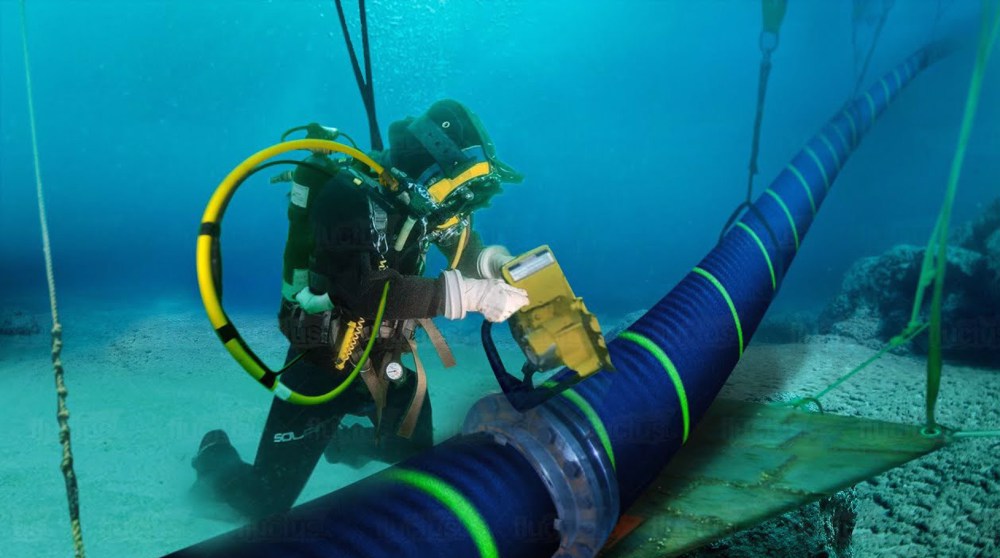
The maintenance and repair of submarine cables in the Strait of Hormuz present another dimension of Iran’s sovereign authority.
According to International Cable Protection Committee technical documents and performance reports, the repair process for a complete cable cut follows a well-established sequence: fault location using optical time-domain reflectometer tools, application for navigation permits under international law, and dispatch of a cable repair ship.
The process of dispatching a ship, retrieving the two ends of the cable from the seabed, performing the reconnection, and returning the cable to the seabed typically requires between 7 and 30 days, depending on weather conditions and the availability of repair vessels.
In the Strait of Hormuz specifically, the exceptionally high volume of maritime traffic requires intensive traffic coordination during cable laying and repair operations.
Under normal conditions with full cooperation from the countries exercising sovereignty over the strait, the repair process would be expected to take up to 45 days.
During the recent joint US-Israeli aggression, however, major cable installation contractors, including Alcatel Submarine Networks, declared force majeure on Persian Gulf operations, halting both new installations and maintenance of existing systems.
Billions of dollars’ worth of cable projects were suspended or abandoned, with some reportedly 90 percent complete before work stopped.
Given that the Strait of Hormuz lies entirely within Iranian territorial waters, the logical conclusion is inescapable: the user companies whose cables transit Iranian sovereign territory must conclude contracts for cable repair and maintenance exclusively with Iranian companies, specifically companies owned more than 50 percent by Iranian entities and operating entirely under the laws of the Islamic Republic of Iran.
This is not a matter of political choice but of legal necessity arising from the undisputed fact that foreign vessels, including cable repair ships, cannot operate in Iranian territorial waters without Iranian permission.
Global recognition of the new reality
The world media has taken notice of Iran’s digital sovereignty initiative. Indian media outlets, including ABP Live and the Economic Times, have warned that a significant portion of India’s internet passes through the Persian Gulf and the Strait of Hormuz, and that any disruption to these routes could disrupt online services, digital banking, and communications, pressuring the digital economy of countries, including India.
Russian media outlet AIA Daily reported that Iran has effectively conveyed the message that it possesses physical access to vital routes of the global internet, emphasizing that at least seven major internet cables pass through the Strait of Hormuz and serve as the backbone of e-commerce, cloud services, and international communications.
Asian media, including Korea’s Asia Business Daily and the English-language Asia Times, have described the Strait of Hormuz as one of the world’s most important internet bottlenecks.
Asia Times wrote that data infrastructure and fibre-optic cables have become part of the deterrence equation in the region, warning that an attack on cables could disrupt the global economy without firing a missile, and that future wars may take place on the seabed and over data cables rather than traditional battlefields.
Western media have also acknowledged the vulnerability. Reuters reported in a piece that Iran’s warning about the vulnerability of undersea cables has raised concerns, emphasizing that several important fibre-optic cables lie in the Strait of Hormuz connecting countries in Asia, the Persian Gulf, and Europe, and that any damage in this area would disrupt cloud services, online communications, and the digital economy.
The Washington Post warned that submarine cables have become one of the most vulnerable parts of the world’s digital economy, with Western governments concerned that undersea cables could be used as a tool of strategic pressure.
The French newspaper Le Monde wrote that the joint US-Israeli aggression against Iran has placed infrastructure, including submarine cables, data centres, and cloud computing networks under the simultaneous pressure of geopolitical and security crises.
Iran's Foreign Ministry spox at presser:
— Press TV 🔻 (@PressTV) May 11, 2026
US must end its one-sided pressure and meet Iran's legitimate demands: ending the war, lifting blockades, halting maritime piracy, freeing frozen assets, and ensuring security in the Strait of Hormuz & security in Lebanon and the region. pic.twitter.com/oOb1bUq2q5
Three practical steps
Based on the legal, technical, and economic factors, the Islamic Republic of Iran can implement three practical steps to generate hundreds of millions of dollars in annual revenue from the Strait of Hormuz internet cables while exercising its full sovereign rights.
First, all companies wishing to use this infrastructure must obtain an initial license from Iranian authorities, and because this license must be renewed annually, these companies must pay all outstanding amounts on a recurring basis.
The fee model can draw from international precedents, including the Egyptian model based on providing exclusive services, the Singaporean model based on policy-making and administrative licensing, the Indonesian bureaucratic model based on permits and corridors, and the Russian model based on strategic control and state participation.
Egypt, for example, earns between 250 million and 400 million US dollars annually from submarine cable infrastructure alone, representing 15 to 20 percent of the Egyptian Telecommunications Company’s total operating revenues.
Second, all cross-border communications and information technology companies operating in the region, including US companies such as Meta, Amazon, and Microsoft that transfer Iranian user data abroad through these cables, must be subject to the laws of the Islamic Republic of Iran and supervised and regulated by the Iranian Ministry of Communications and Information Technology.
With the official activities of these companies and their cooperation with the Iranian side, there would no longer be any need for filtering or blocking of their platforms.
Third, because the Strait of Hormuz is entirely part of Iranian territory, the user companies must conclude contracts for cable repair and maintenance exclusively with an Iranian company, meaning a company owned more than 50 percent by the Iranian side and operating fully under the laws of the Islamic Republic of Iran.
The proceeds from this entire framework will flow to the Ministry of Communications and Information Technology, specifically to the Fibre-Optic Development Fund, and will be used to create and improve the country’s information technology infrastructure.
 This makes it easy to access the Press TV website