End of American exceptionalism: How MAGA foreign policy collided with reality in war on Iran
By: Y.P. Rāzi
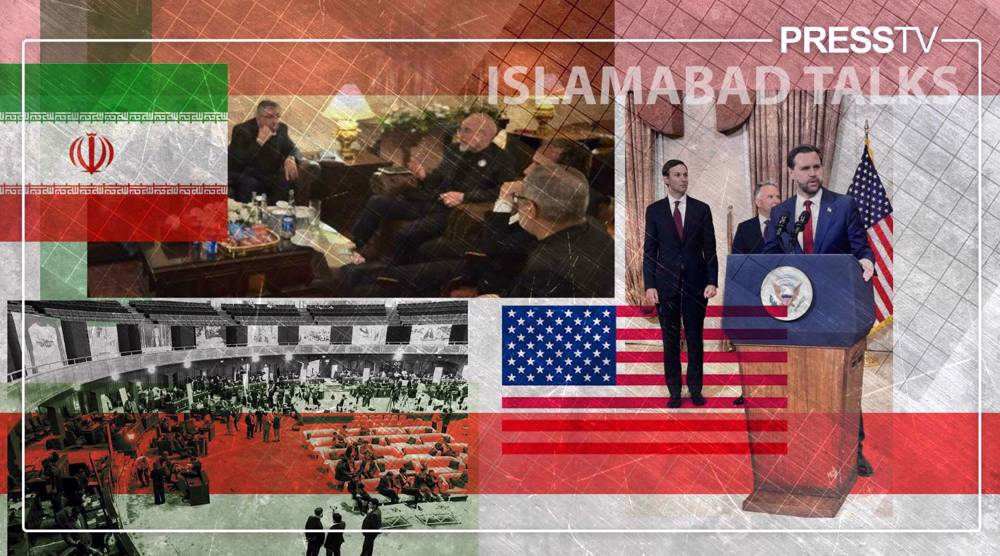
The latest round of US-Iran ceasefire negotiations, which ended in deadlock in Islamabad on April 12, has laid bare a fundamental shift in Washington's approach to international diplomacy.
While global media focused on the collapse of talks, the real story lies in the composition of the American team – and what it reveals about a new, highly unorthodox foreign policy machine.
According to officials familiar with the discussions that transpired in Islamabad, the primary sticking point was a series of "maximalist" American demands.
They said Washington was attempting to secure through negotiation what it failed to achieve through military pressure and economic sanctions, in the 40-day war and before that. But is this a shrewd strategic gambit – or a symptom of profound inexperience?
To answer that, one must examine the three men at the heart of the US foreign policy team.
"48 hours is enough to build a hell, just ask Saddam Hussein's 72 hours"
— Press TV 🔻 (@PressTV) April 5, 2026
Iranian patriots respond to US President Trump's threats.
Follow Press TV on Telegram: https://t.co/LWoNSpkJSh pic.twitter.com/8HaDp7UBoo
The negotiators: Real estate, family ties, and a political conversion
The first is Steve Witkoff, a New York real estate investor and longtime friend of President Donald Trump. Prior to becoming Trump’s West Asia envoy, Witkoff had no diplomatic experience and has reportedly acknowledged that his understanding of politics and conflict is drawn largely from Netflix documentaries.
He has been quoted as saying he sees little difference between negotiating a property sale and mediating a geopolitical crisis. His presence signals Trump’s enduring preference for personal loyalty over institutional expertise.
The second is Jared Kushner, Trump’s Jewish son-in-law. According to regional diplomats who have worked with him, Kushner’s primary allegiance may lie elsewhere, not his own country.
His long-standing personal relationship with Israeli premier Benjamin Netanyahu, who reportedly stayed at the Kushner family home in New Jersey, displacing Kushner to a basement cot, has raised questions about where his priorities lie.
During previous talks in Geneva, even Omani mediators noted that Kushner appeared more focused on securing Israeli interests than American ones. He then passed unverified information to his father-in-law, suggesting that Iran sought not peace but an attack on the US.
The most seasoned – yet still controversial – member of the team is Vice President JD Vance. Once a vocal "Never Trumper" who likened the US president to Hitler and called him "reprehensible," Vance underwent a dramatic political conversion in 2022.
After apologizing to Trump, he embraced the MAGA movement, narrowly defeated his Democratic rival, and later on ascended to the vice presidency. His political résumé includes just two years in the Senate and several earlier failed campaigns.
Prof. Robert Pape argues that Trump faces a critical dilemma: either de-escalate by cutting aid to Israel to save his presidency, or escalate militarily to open the Strait of Hormuz, risking a war of attrition that would politically end his term. pic.twitter.com/nSlFHYkTXy
— Press TV 🔻 (@PressTV) April 4, 2026
A hollowed-out State Department
It would be a mistake to view this team as an ad hoc experiment. Rather, it is the embodiment of the quintessential MAGA foreign policy doctrine.
Trump has long complained about the State Department’s bureaucracy. Since returning to power, he has overseen the dismissal of approximately 3,000 career diplomats and experts, and entire offices have been shuttered in the name of efficiency.
The result, according to current and former American officials, is an apparatus severely lacking in regional expertise. Many of the officials who spent decades studying West Asia, Russia, or China are now seeking employment elsewhere.
The ‘exceptionalism’ illusion
This institutional hollowing-out helps explain what many allies privately call Trump’s reckless decision-making. According to aides, the president has little patience for lengthy briefings or detailed reports. He often makes foreign policy decisions after a few sentences from his son-in-law, Witkoff, Rubio, or some very close entrepreneurs-turned-aides.
Part of this stems from a deep-seated American exceptionalism – a belief that the United States, protected by two oceans and blessed by geography, can shape the world at will.
Trump is the perfect embodiment of this redundant mindset. It is the same mindset that led to the assassination of the Leader of the Islamic Revolution without a clear endgame.
For decades, American popular culture, from superhero comics to blockbuster films, has reinforced the idea that if America fails to get its way, it must be due to internal incompetence, not external resistance. The collapse of the Soviet Union only deepened this illusion, convincing a generation that American power was insurmountable.
US President Donald Trump says he likes to hang around with losers because it makes him feel better!
— Press TV 🔻 (@PressTV) March 29, 2026
Follow https://t.co/B3zXG73Jym pic.twitter.com/UKXoXh2Xpw
The Iraq and Afghanistan hangover
The wars in Iraq and Afghanistan should have served as a corrective. Those imposed wars yielded flag-draped coffins, rising rates of PTSD among veterans, and trillions of dollars in costs.
Yet the MAGA voter has drawn a different lesson. They still support the use of force, but believe it must be swift, brutal, and decisive. They attribute failure not to the enemy’s resilience, but to the weakness of political and military leaders.
Trump is the avatar of that belief. He promised to fire the "incompetent people" and replace them with loyalists who would get results. His supporters chose him precisely because he offered a fantasy of clean, quick victories.
Iran’s long game
That fantasy, however, is colliding with a different reality in West Asia. Iranian strategists have spent decades studying the United States. They understand that Trump needs a visible, fast victory to satisfy his base – and they are systematically denying him one.
While the MAGA base dreams of an easy opening of the Strait of Hormuz, Tehran is playing a long game of patience and attrition. The goal is to make Washington feel some of the economic pain that decades of US sanctions have inflicted on Iran.
For nearly fifty years, Iranians have referred to the United States in official slogans as "global arrogance" – a term that captures not just power, but a refusal to accept limits. Today, that description seems increasingly apt for the Trump administration’s foreign policy.
The uncomfortable truth is that the United States is struggling to adapt to a world where it no longer dominates, where its long-running hegemony has been shattered.
In the end, the image that emerged from the Islamabad talks is not of a superpower imposing its will, but of a political class that has confused diplomacy with a real estate deal.
Y.P. Rāzi is a Tehran-based senior journalist and political commentator.
(The views expressed in this article do not necessarily reflect those of Press TV.)
Iran retains initiative in Strait of Hormuz despite US claims: Armed Forces
New images reveal severe destruction at US base in Kuwait after Iranian strikes
‘Live with it’: Era of US F-35s being ‘hunted down’ has begun, Qalibaf says



VIDEO | Police clash with far-right protesters in The Hague
How Iran turned US military and economic aggression into strategic leverage to dictate terms
‘No restraint’ against any aggression: Iran's top military command warns US, its regional allies
Poll: Over half of US Jews say Netanyahu fueling American anti-Semitism
Trump and Netanyahu will face same fate as Saddam Hussein: Top Iranian cmdr.
VIDEO | Protesters flood Buenos Aires in rally against Milei's economic policies
Iran claim basketball bronze at 2026 Asian Games, win delegation’s first medal
Yemen warns Saudi escalation will draw stronger response


 PressTV NEWSLETTER
now
PressTV NEWSLETTER
now
 This makes it easy to access the Press TV website
