From Carter to Trump: Iran's frozen assets top $100bn in 47-year US economic war

By Ivan Kesic
From Jimmy Carter's freeze of Iranian assets following the 1979 Islamic Revolution to similar acts of successive US presidents, including the current occupant of the White House, hundreds of billions of dollars of Iranian assets have remained frozen.
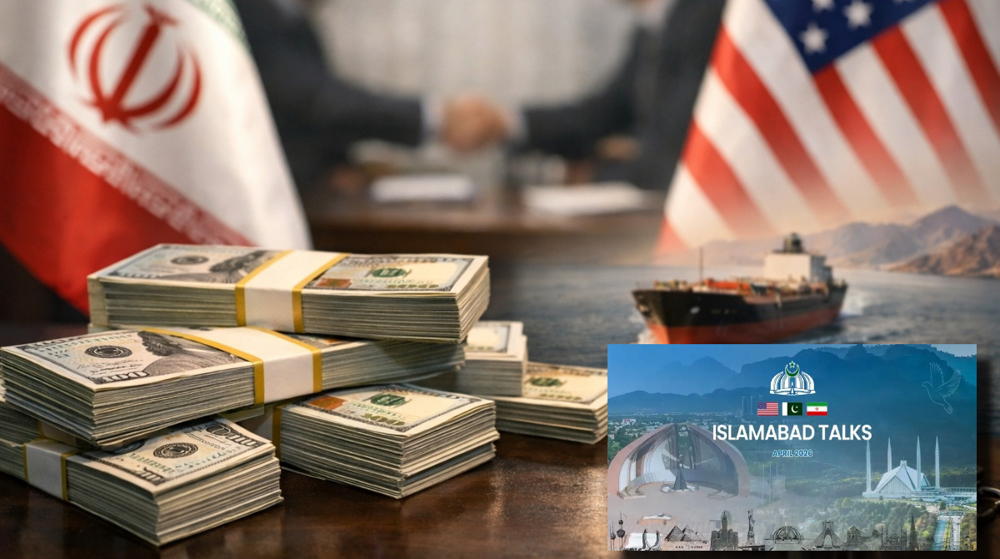
Days after a ceasefire halted the joint US-Israeli aggression on Iran that began on February 28, the question of Iran's frozen assets emerged as the central test of American sincerity at the negotiating table.
After 21 hours of marathon talks in Islamabad, however, the United States failed that test.
For 47 years, the United States has held billions of dollars of legitimate Iranian wealth: oil revenues, central bank reserves, and commercial assets, seized through illegitimate executive orders and maintained through political pressure.
What Washington never anticipated was that this financial siege would forge a nation of such economic ingenuity that it would eventually turn the tables completely.
US agrees to release Iran's frozen assets as precondition ahead of Islamabad talks: Reporthttps://t.co/GMoewljqRu
— Press TV 🔻 (@PressTV) April 11, 2026
1979 freeze and the birth of economic war
The first major freeze of Iranian assets came on November 14, 1979, when President Jimmy Carter signed Executive Order 12170, blocking approximately $8 billion in Iranian government assets held in American banks.
The order targeted not only Iranian state accounts but also the assets of the Central Bank of Iran and any Iranian entity doing business with American institutions.
Major American and international banks — Citibank, Chase Manhattan, Bank of America, HSBC, Standard Chartered, BNP Paribas, Deutsche Bank, Commerzbank, Credit Suisse, and Barclays — severed their Iranian relationships.
The freeze extended beyond banking to major industrial and energy corporations: Shell, Total, ENI, Siemens, General Electric, and Boeing. They walked away from Iranian contracts, leaving projects unfinished and Iranian investments stranded.
These assets were partially released under the 1981 Algiers Accords, but it was only partial, and came with conditions. Iran received approximately $3.6 billion, far less than the original $8 billion. The remainder was held back to settle claims against Iran filed by American corporations and citizens. The Algiers Accords also established the Iran-United States Claims Tribunal at The Hague, a body that continues to adjudicate disputes to this day.
For Iran, the settlement was a bitter pill: legitimate national wealth, reduced through legal maneuvering and political pressure. The Islamic Republic resolved never to be placed in such a position again.
Carter's legacy in Iran is one of hostility and miscalculation – from his infamous Christmas Eve speech calling the deposed dictator's regime "an island of stability," to his authorization of the failed Operation Eagle Claw, to his incitement of Iraq to invade Iran in 1980.
✍️ Viewpoint - Jimmy Carter and his tainted legacy of hostility toward Islamic Republic of Iran
— Press TV 🔻 (@PressTV) January 1, 2025
By Ivan Kesichttps://t.co/56twYCPPeo pic.twitter.com/WVqTFK87dq
Expanding web of frozen wealth
Over the decades that followed, the scale of frozen Iranian assets grew exponentially. By some estimates, between $100 billion and $120 billion of Iranian wealth is now locked away globally.
Countries such as South Korea, Iraq, China, and Japan have held significant portions of these funds — often accumulated through legitimate oil trade but rendered inaccessible by US secondary sanctions.
One of the most well-known cases involves the proceeds from gas condensate sales to South Korea. Approximately $7 billion of Iran's foreign exchange earnings remained frozen in South Korean banks.
Tens of billions more in Iranian oil revenues are held in accounts linked to China. Some reports estimate these funds at between $22 billion and $30 billion.
There are no official statistics on the total sum. Earlier estimates suggested Iran had foreign reserves well over $100 billion abroad, though media reports have placed the figure between $40 billion and $50 billion.
The frozen assets include funds held in Japan, Qatar, Luxembourg, Canada, Oman, and the United Arab Emirates.
In 2023, the United States issued a sanctions waiver allowing Iraq to pay over $2.7 billion of the $11 billion it owed Tehran for electricity and natural gas imports. But the money had to be transferred to Omani banks — and could only be used for humanitarian purchases such as food and medicine, all under US supervision.
A historic $530 million debt that the United Kingdom paid Iran in 2022 — after forty years — was also blocked in Oman. The payment was for 1,750 Chieftain tanks and other vehicles purchased before the Islamic Revolution, almost none of which were ever delivered.
Meanwhile, $1.7 billion of Iranian assets held by Deutsche Börse's Clearstream unit in Luxembourg have faced US lawsuits seeking their seizure.
In addition to IRGC, the US has sanctioned hundreds of Iranian entities, therefore reviving JCPOA is useless without removing all of them from the US sanctions list, says Mostafa Khoshcheshm. pic.twitter.com/pNOSkqFLW4
— Press TV 🔻 (@PressTV) June 29, 2022
JCPOA era: A brief window of relief
The Joint Comprehensive Plan of Action, also known as Iran nuclear deal, which was signed in July 2015, offered the first real prospect of sanctions relief since 1979.
At that time, different figures were put forward about the volume of Iran’s assets abroad.
Then-US President Barack Obama put the approximate figure of $100 billion for Iran’s frozen assets in an interview, a figure he later reduced to around $50 billion to $60 billion.
Nader Habibi, a professor of economics, estimated in 2015 that Iran’s total frozen assets since the 1979 revolution were more than $100 billion.
Vali Asif, then-Central Bank of Iran Governor, said in August 2015 that Iran’s frozen assets were around $29 billion, of which $23 billion belonged to central banks in countries such as Japan, South Korea, and the United Arab Emirates, and around $6 billion came from oil sales in India.
The asset release under the JCPOA was substantial but incomplete. Iran regained access to approximately $50 billion to $60 billion in frozen assets held in escrow accounts, but the relief was temporary.
The United States, under President Donald Trump, unilaterally withdrew from the JCPOA in May 2018 and reimposed all sweeping nuclear-related sanctions, including the freezing of assets that had been released just three years earlier.
Iran’s diplomatic efforts to regain access to these funds were repeatedly thwarted by hostile US policies, leaving a bitter legacy of unmet financial claims.
#Iran has issued 1,000 licenses for #crypto #mining: Reporthttps://t.co/mftZGJps3c
— Press TV 🔻 (@PressTV) January 28, 2020
Maximum pressure campaign and Iran’s cryptocurrency pivot
The Trump administration’s “maximum pressure” campaign, launched in 2018, was designed to reduce Iranian oil exports to zero and cut off all Iranian access to international finance.
The campaign included the re-freezing of assets that had been released under the JCPOA, the designation of the Central Bank of Iran as a “terrorist entity,” and the extension of sanctions to cover any entity—including Chinese, Russian, and European companies—doing business with Iran.
South Korean banks, which had been holding approximately $6 billion to $7 billion in Iranian oil proceeds, were forced to freeze those accounts indefinitely. Japanese, Indian, and European banks followed suit.
By 2020, the total value of Iranian assets frozen abroad had climbed back to an estimated $30 billion to $50 billion.
Iran’s response to maximum pressure was its most innovative yet. The Islamic Republic became one of the world’s earliest and most determined adopters of cryptocurrency as a sanctions-evasion tool.
The Central Bank of Iran authorized the use of cryptocurrencies for import payments and began mining Bitcoin and other digital currencies on an industrial scale.
The cheap electricity generated by Iran’s abundant natural gas—much of which was previously flared as waste—was redirected to power massive crypto mining farms.
The strategy had multiple benefits: cryptocurrency mining allowed Iran to monetize otherwise wasted energy resources, Bitcoin and other digital currencies could be transferred across borders without passing through the traditional banking system, making them immune to SWIFT bans and asset freezes, and crypto payments could be made in complete anonymity, allowing Iranian buyers and sellers to transact without US oversight.
By 2022, Iran was mining an estimated 4.5 percent of all Bitcoin worldwide, generating hundreds of millions of dollars in annual revenue.
‘Null and void’: West-engineered ‘snapback’ sanctions against Iran legally toothless https://t.co/RRoKXQ9ucf
— Press TV 🔻 (@PressTV) September 30, 2025
$6 billion question: Qatar, prisoner swaps, and re-freezing
In September 2023, a prisoner swap between the United States and Iran brought the frozen assets issue back into the international spotlight.
Under the agreement mediated by Qatar, the US permitted the transfer of approximately $6 billion in frozen Iranian oil revenues from South Korean banks to restricted accounts in Doha.
The funds, which had been accumulated from Iranian oil sales to South Korea before the 2018 re-imposition of sanctions, were placed in Qatari banks with a strict condition: they could only be used for humanitarian purchases—food, medicine, medical equipment, and agricultural goods—and each transaction required approval from the US Treasury to ensure no funds were diverted.
When the Qatari Emir called on Ayatollah Seyyed Ali Khamenei in Tehran, the Leader of the Islamic Revolution asked the Persian Gulf kingdom to release the $6 billion in Iranian oil revenues held in Doha, despite US pressure not to do so.
However, following the Israeli aggression against Iran in October 2024, the United States instructed Qatar to block Iran’s access to the funds, and the $6 billion remained inaccessible.
The latest twist in this ongoing saga underscores the volatility of the situation, with Iran’s financial resources subject to the whims of shifting diplomatic and geopolitical priorities.
Responding to new EU sanctions, Iran's Foreign Ministry spokesperson condemned the move as irrational and unlawful, arguing that by punishing Iran for its legitimate self-defense against US-Israeli aggression, the EU is actively complicit in arming genocidal aggressors. pic.twitter.com/wHwXdnLMUP
— Press TV 🔻 (@PressTV) March 11, 2026
2026 aggression, ceasefire, and the Islamabad negotiations
The joint US-Israeli aggression that began on February 28 transformed the frozen assets issue from a financial technicality into a central condition for peace.
As Iranian forces demonstrated their ability to effectively shut down the Strait of Hormuz, cutting off approximately 20 percent of global oil shipments, the strategic calculus shifted dramatically.
On April 11, reports emerged that the United States had agreed to release Iranian frozen assets in Qatar and other foreign banks as a precondition ahead of the Islamabad talks.
A senior Iranian source stated that the unfreezing of assets was “directly linked to ensuring safe passage through the Strait of Hormuz,” which is expected to be a key issue in the negotiations.
Based on the statement by Iran’s Supreme National Security Council, the United States had been forced to accept the ten-point plan of the Islamic Republic of Iran, in which America was principally committed to non-aggression, the continuation of Iran’s control over the Strait of Hormuz, acceptance of enrichment, the lifting of all primary and secondary sanctions, the termination of all UN Security Council and IAEA Board of Governors resolutions, compensation for Iran’s damages, the withdrawal of US combat forces from the region, and the cessation of war on all fronts.
Earlier, Iran’s Parliament Speaker Mohammad Baqer Qalibaf and the lead negotiator said two of the actions agreed upon by the parties had to be realized for talks to materialzie.
✍️ Analysis - Frozen assets: Iran’s non-negotiable condition for talks with US in Islamabadhttps://t.co/V2nEO92YN2
— Press TV 🔻 (@PressTV) April 11, 2026
Iran’s red lines: No negotiations without asset release
For Iran, the release of its frozen funds is not just a matter of financial restitution; it symbolizes a longstanding grievance that stretches back decades.
Iranian officials emphasized two major red lines in their negotiations with the United States: first, a comprehensive ceasefire in Lebanon and an end to Israeli attacks, and second, the full unfreezing of Iranian assets abroad.
With neither of these conditions met, the talks in Islamabad failed to make headway. The American side also made maximalist demands far removed from reality.
The accumulated distrust from the past, especially before the Islamic Revolution, has posed significant challenges for both sides.
Recently, Iranian Foreign Minister Abbas Araghchi emphasized in an interview that gaining Iran’s trust is not an easy task, as Iranian funds have been frozen in various countries for years due to actions by the United States.
While Iran has upheld its commitments, the United States has failed to fulfill its obligations, and it must take concrete steps to build trust. The release of Iran’s blocked funds is a non-negotiable condition for any talks to produce a desirable breakthrough.
The most significant development in the April 2026 negotiations is the explicit linkage between frozen assets and the Strait of Hormuz.
According to Iranian officials, the unfreezing of assets is directly tied to ensuring safe passage through the strait—a waterway that Iran has now demonstrated it can effectively shut down.
This linkage represents a fundamental shift in the balance of power.
The United States, which for decades insisted that frozen assets would only be released as part of a comprehensive nuclear agreement, is now negotiating their release as a separate, war-termination measure directly tied to Iranian military leverage.
Iran's Speaker of Parliament Mohammad Bagher Ghalibaf says Iran will only take part in the Islamabad peace talks once a ceasefire is in place in Lebanon and Iran's assets are unblocked, which are two of the measures that had been mutually agreed upon. pic.twitter.com/wFx87khEHf
— Press TV 🔻 (@PressTV) April 10, 2026
Total value: Estimating Iran’s frozen wealth
Quantifying the total value of Iranian assets frozen abroad remains challenging, as the figures are constantly changing and are often obscured by political considerations.
However, a reasonable estimate can be constructed from available data. The 1979 freeze involved approximately $8 billion to $11 billion, depending on the source.
Subsequent freezes, including those imposed during the 2000s nuclear crisis, the 2012 SWIFT ban, and the 2018 maximum pressure campaign, have accumulated.
The $6 billion held in Qatar is just one component. Additional funds are frozen in South Korea, Japan, India, China, and various European countries.
The largest category is the oil revenue that Iran has earned but has been unable to repatriate.
During periods of maximum sanctions, Iranian oil continues to be sold—primarily to China—but the proceeds are often held in escrow accounts in third countries, as international banks refuse to process direct transfers to Iran.
Last December, a former housing minister stated that China was holding $21 billion of Iranian oil money in an escrow account and had proposed to activate it as a credit facility for development projects in the Islamic Republic.
Adding central bank reserves, commercial assets, and real estate holdings brings the total estimated value of frozen Iranian assets to between $80 billion and $120 billion.
This represents years of national labor, natural resource extraction, and economic activity—all denied to the Iranian people through extra-legal executive actions by hostile foreign powers.
Behind Iran’s record wheat harvest amid drought, sanctions and war

US sanctions will not halt Iran’s aviation industry: Civil aviation chief
Iran inaugurates major desalination plants, says US threats won’t halt development



Iran will be ‘far more advanced technologically’ in any new war: Acting defense minister
Israeli strike kills two in Gaza as hospitals face energy shortages
Iran calls on UN to protect Lebanese civilians as Israel’s attacks continue
Yemeni military advance along Red Sea alters balance of power amid Saudi siege, aggression: Analyst
VIDEO | Iran can smash US naval blockade
VIDEO | Sana’a secures Bab el-Mandeb, safeguarding global maritime trade
Stories Beyond Numbers: A pregnant woman killed alongside 8 family members in US-Israeli strike
VIDEO | Untold story of July 31: Hours after US strikes, Iran locked onto F-35 and destroyed MQ-9 Reaper



 PressTV NEWSLETTER
now
PressTV NEWSLETTER
now
 This makes it easy to access the Press TV website
