35 days on, US war goals unmet as Iranian retaliation imposes heavy military, economic costs
By Press TV Website Staff
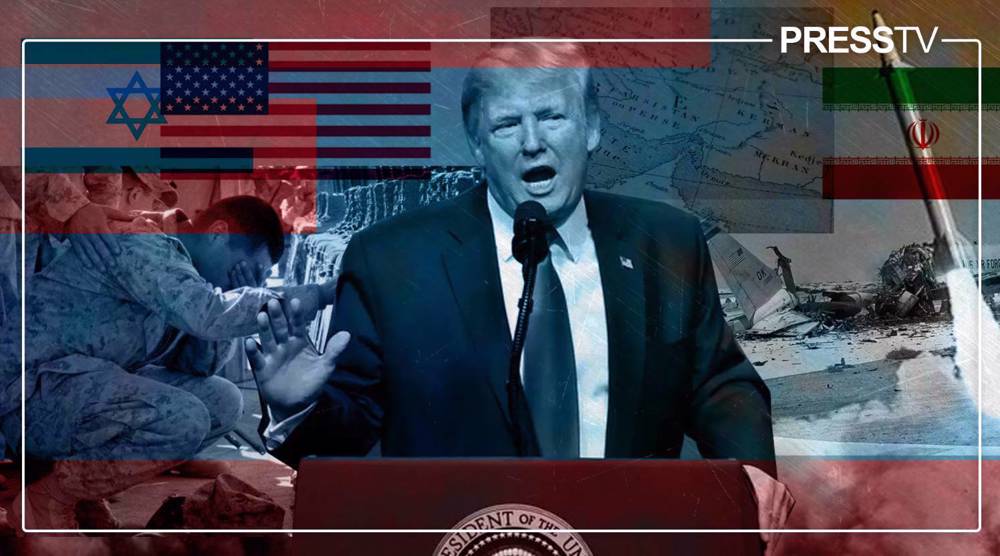
After 35 days of the war imposed on the Islamic Republic of Iran, as US President Donald Trump searches for an off-ramp, the writing is on the wall: the aggressor failed to achieve any of its war objectives, despite deploying an overwhelming force.
The war of aggression, launched amid indirect nuclear talks between Tehran and Washington under Omani mediation on February 28, was initially aimed at “regime change” in Iran. The first wave specifically targeted the Leader of the Islamic Revolution, Ayatollah Seyyed Ali Khamenei, and some top-ranking military commanders.
Unlike the 12-day war in June last year – which also came in the middle of nuclear diplomacy – when all overt and covert attempts to assassinate the Leader failed, this time “regime change” proponents in Washington and Tel Aviv presumed the foundations of the Islamic Republic had been shaken, and its collapse was imminent.
Immediately after launching the so-called ‘Operation Epic Fury,’ Trump expressed hope that the Iranian people would overthrow their government once the US-Israeli strikes ended.
“When we are finished, take over your government. It will be yours to take,” he said, addressing Iranians, while not ruling out American boots on the ground.
According to one observer who spoke to Press TV, the plan was to reenact the Venezuela scenario in Iran, albeit with far greater military force than was deployed in Caracas.
Last week, after nearly all US military bases and assets in the region were decimated in Iranian retaliatory strikes, Trump claimed that the “regime change” had already occurred in Iran, referring to the election of Ayatollah Seyyed Mojtaba Khamenei as the new Leader.
Many social media users mocked the claim, saying the US-Israeli war machine failed to even change the revolutionary slogans, let alone bring about the “regime change.”
In his first message to the Iranian nation on March 13, Ayatollah Mojtaba Khamenei vowed revenge for Iranian martyrs, reaffirmed Iran’s commitment to resisting aggressors, and highlighted the strategic importance of maintaining leverage over the Strait of Hormuz.
Observers note that the election of Ayatollah Mojtaba Khamenei and his public statements underscore the fact that the Islamic Republic is built on enduring institutional structures rooted in the country’s constitution, not dependent on individuals, and that its strategic doctrine remains intact amid wartime pressures.
“Regimes fall, democratic republics with functional governments don’t,” one social media user wrote, referring to the robust Iranian democracy, which has been on full display in the past month with millions on the streets, rejecting Trump’s “help.”
The issue of Iran’s nuclear program has also dominated the war discourse.
Before the war, Trump repeatedly framed Iran’s nuclear program as a central threat and threatened military action to dismantle Iranian nuclear infrastructure – over eight months after he had claimed the program was “obliterated.”
✍️ Viewpoint- Trump’s military gamble against Iran backfires spectacularly with no exit strategy
— Press TV 🔻 (@PressTV) March 15, 2026
By Abbas Ali Abedihttps://t.co/06y6NVI1pC
In his State of the Union address on February 24, the US president – rebuffing his own intelligence agency – accused Iran of restarting its nuclear program and claimed it was pursuing capabilities capable of threatening Europe and even the United States.
However, more than a month on, like the “regime change” project, Trump’s threat to dismantle Iran’s nuclear program has also proven hollow, primarily because, as Iranian officials have repeatedly asserted, the indigenous nuclear program – peaceful in nature – cannot be obliterated by bombing a few facilities in violation of international law.
After these first two objectives failed, Trump turned his attention to the Strait of Hormuz, which the Iranian Navy has effectively closed to American and allied vessels following the unprovoked war, which has so far claimed nearly 2,000 lives.
Trump issued repeated warnings that continued closure or disruption of shipping through the strategic waterway, which carries around 20% of the world's crude oil supply, would trigger severe retaliation, including strikes on Iranian power plants.
Deadlines initially set at 48 hours were later extended to five days and then ten, even as the Iranian armed forces dismissed the threats and warned of severe countermeasures.
In a desperate move, Trump urged European partners to dispatch naval forces to the Strait to escort tankers and ensure freedom of navigation. None responded, fueling his frustration.
More recently, after all options had been exhausted, the US president signaled that securing and reopening the Strait is no longer a key American war objective, reportedly suggesting that military operations against Iran could end even if the Strait remains closed, and that other countries might need to assume responsibility for protecting shipping lanes.
The shifting objectives in the US military campaign against the Islamic Republic – from day one to day 33 – highlight the lack of strategy, a point underscored by even American politicians and pundits who have condemned the war as unprovoked and unnecessary.
At the time of writing, the Strait of Hormuz remains effectively closed to US and allied tankers, with many other vessels avoiding the strategic chokepoint due to heightened tensions. Many vessels – with Iranian permission – have passed through it.
Brigadier General Ali Fadavi, an adviser to the commander-in-chief of the Islamic Revolution Guards Corps (IRGC), said on Tuesday that the US has failed to achieve its stated objectives in the war against Iran, warning that violations of international law are deepening global crises, particularly in the strategically vital Strait of Hormuz.
“Due to the follies of the ‘Great Satan,’ people around the world have been deprived,” he said, adding that the Strait of Hormuz plays a fundamental role in the global economy.
Feature- US war on Iran burns past $1bn in early days, with total projected to exceed $95bnhttps://t.co/uD07nFJs87
— Press TV 🔻 (@PressTV) March 5, 2026
Iranian retaliation and US military losses
Apart from failing to achieve any of its key war objectives, the United States has suffered staggering military and economic losses in Iran’s retaliatory strikes as part of Operation True Promise 4, launched immediately after the February 28 aggression.
In the first week alone, US media reported that the war cost American taxpayers over $1 billion. Deployment of carriers, warplanes, and troops accounted for $630 million, while the loss of F-15E fighter jets in Kuwait added nearly $300 million.
Budget analysts warned that if the war continued for a few months, total direct military expenses could reach $95 billion, with broader economic damage far higher.
While media estimates cited $1 billion per day for US attacks, with one putting the first xsi days at $11 billion, Brazilian military analyst Patricia Marins said the true cost is far higher.
She projected that US expenditures could reach a colossal $360 billion within two months if the war continues, a sum that she warned “would test the patience of any treasury, let alone American taxpayers already feeling the pinch of soaring oil prices.”
“I believe this will be Israel's cost, but the American cost so far is triple that due to three factors: the number of interceptors expended, the quantity of missiles and guided bombs used, and the cost of damages to bases and radars,” she told the Press TV website.
Combined, she noted, the cost for the American side is expected to be “no less than $6-8 billion daily during these two weeks of war.”
According to Marins, the three primary goals of the war –regime change, limiting Iran’s missile capabilities, and dismantling its nuclear program – have all failed.
One month later, the war has become a costly quagmire for the Trump administration, widely seen as a trap orchestrated by Israeli prime minister Benjamin Netanyahu.
US military bases across the region have been leveled in nearly 90 waves of Iranian missile and drone strikes over the past 33 days, rendering them uninhabitable.
The New York Times reported earlier this week that at least 13 US military bases have been destroyed across the Persian Gulf, forcing American troops to abandon fortified installations for hotels and office spaces. The IRGC has also targeted hotels and other locations where US occupation forces have been hiding, with the true casualty toll still unknown.
✍️ Feature - $700M AWACS bites the dust: Iranian strike ends US air dominance over Persian Gulf
— Press TV 🔻 (@PressTV) March 30, 2026
By Yousef Ramazani https://t.co/hwPz7yMu6U
The Fifth Fleet in Bahrain has been the worst hit. Iranian strikes repeatedly targeted its headquarters in the Bandar Mina region, demonstrating that Iran not only can reach this strategic base but has also pioneered a new model of asymmetric warfare, according to experts.
Damaged infrastructure includes two AN/GSC-52B satellite communication terminals, the backbone of the Fifth Fleet’s C4ISR network, providing secure, real-time communication with aircraft carriers, MQ-4C Triton drones, P-8A Poseidon patrol aircraft, and CENTCOM command centers. Satellite images also show extensive damage to ammunition depots, service facilities, command buildings, and advanced communications infrastructure, with fires spreading across the base.
On the evening of March 27, the IRGC Aerospace Force executed one of the most devastating strikes against American air power in decades at Prince Sultan Air Base in Saudi Arabia. Using a coordinated assault of ballistic missiles and drones, the operation pierced the base’s multi-layered defenses, destroying a $700 million E-3 Sentry AWACS, a critical asset for airborne command, control, and surveillance.
Two EC-130H Compass Call electronic warfare planes were heavily damaged, while multiple KC-135 Stratotanker refueling aircraft were crippled, sharply diminishing the operational capabilities of US forces in the region.
The E-3 Sentry is not merely another military aircraft. Derived from the Boeing 707 commercial airframe and first introduced in the late 1970s, it functions as a flying radar station capable of tracking hundreds of aerial targets simultaneously while directing fighter operations over vast distances, military experts say.
Two weeks earlier, over just three days, Iran and the Axis of Resistance destroyed six KC-135 Stratotankers and damaged a seventh, exposing a fatal vulnerability at the heart of US-Israeli aggression against Iran.
On March 12, the Islamic Resistance in Iraq, coordinated with Iranian forces, launched a precision missile strike that downed a KC-135 over western Iraq, killing all six American crew members. Two days later, Iranian ballistic missiles struck Prince Sultan Air Base in Saudi Arabia, destroying five more Stratotankers in a single salvo.
✍ Feature - Silence of the stealth: How Iran shattered the 'invincibility' of US fighter jet F-35
— Press TV 🔻 (@PressTV) March 21, 2026
By Yousef Ramazani https://t.co/TVRx3GDXip
The KC-135, a 1950s-era Boeing 367-80 adaptation, is essentially a flying fuel tank – but in the 21st-century Persian Gulf, it has become America’s most vital air-power asset.
On March 19, Iran achieved what no country had before: a successful engagement against the US Air Force’s crown jewel, the F-35 Lightning II stealth fighter, using the Majid infrared-guided system in central Iran. For nearly two decades, the F-35 program represented the zenith of American military hegemony, a multi-trillion-dollar, fifth-generation platform designed to penetrate the world’s most sophisticated air defenses with impunity.
Other jets in the F-family have also been engaged and struck over the past month, including several F-15s, F-16s, and F-18s, intercepted by Iran’s advanced integrated air defense systems, which experts note have improved significantly since the 12-day war.
Iranian defenses have also destroyed more than a dozen MQ-9 Reaper drones, valued at roughly $30 million each and forming the backbone of US unmanned surveillance and strike operations. As of Tuesday, the IRGC announced that the total number of drones downed by the Joint Air Defense Headquarters’ integrated network has reached 146.
In the initial days of the war, IRGC strikes severely degraded the US integrated air and missile defense architecture across the region. At least four AN/TPY-2 THAAD radars, a billion-dollar early-warning radar installation in Qatar, multiple supporting sensor nodes, and critical communications infrastructure were destroyed or severely damaged.
Over the past four weeks, American air defenses have been completely wiped out.
In four weeks of war against Iran, according to a report in the Washington Post, the US fired over 850 Tomahawk cruise missiles, far exceeding annual production and raising Pentagon concerns about stockpile strain.
Each missile costs $2–$4 million, with total expenditure reaching up to $3 billion.
Two US aircraft carriers, the USS Gerald R. Ford and the USS Abraham Lincoln, were forced to withdraw from forward positions in the Persian Gulf region following Iranian missile and drone strikes, which inflicted severe damage on them.
Satellite imagery confirms the carriers moved roughly 1,000 kilometers from Iranian shores – the Ford relocating to the Red Sea near Jeddah and the Lincoln to waters off Salalah, Oman.
The IRGC Navy claimed responsibility for striking both vessels, saying the retaliatory attacks inflicted damage and forced their retreat from the Persian Gulf and the Sea of Oman.
✍️ Feature - Blinded giant: How Iran crippled America’s multi-billion dollar THAAD network in days By Ivan Kesic
— Press TV 🔻 (@PressTV) March 7, 2026
By @kesic_ivan https://t.co/7kPk7z0YIq
Iranian retaliation and US economic losses
The economic dimension of the ongoing war is equally critical, exposing Trump’s grave miscalculation and disregard for pre-war warnings from friends and foes alike.
Earlier this week, oil prices closed at their highest level in more than three years as the US-Israeli war of aggression against Iran continued and the Strait of Hormuz remained shut.
The effective shutdown of the strait has disrupted global supply and triggered a sharp surge in oil prices, with Brent crude climbing toward record levels. Analysts warn prices could reach $200 per barrel if the war of aggression persists and the US refuses Iranian demands.
The rise in crude prices has quickly filtered into the US gasoline market. Average prices have climbed above $4 per gallon, while diesel has approached $5–$6 per gallon in many states, levels not seen in years. This surge is fueling growing discontent across the United States.
Beyond crude, the closure of the Strait to US and allied vessels has also disrupted LNG, fertilizer, and other key commodities. Logistics costs and insurance premiums have surged, intensifying inflationary pressures in the US, particularly through higher transportation, food, and industrial costs.
American consumers are increasingly feeling the strain, both at the pump and in their household budgets, as rising energy prices ripple through everyday expenses, according to US media reports.
Democrats in the US, and some Republicans too, have sharply criticized Trump and his administration over the spike in energy prices. Senate Minority Leader Chuck Schumer (D-NY) posted on X a screenshot of a New York Times article, stating that the “White House failed to prepare for rising oil prices from his reckless war.”
The impact has extended well beyond the US. Countries heavily dependent on energy imports through the Strait of Hormuz, particularly in Asia, have been severely affected. In several cases, fuel shortages have disrupted transportation and logistics networks.
Iran had warned that it would close the Strait of Hormuz in response to any act of aggression against the country and the involvement of regional states in the war.
Trump, through his social media platforms, has attempted to project confidence in market performance, despite stocks consistently and alarmingly plummeting over the past five weeks and global oil benchmarks rising by roughly 60 percent.
✍️ Viewpoint - Trump's Iran war lies trigger market swings while media conceals US military failure
— Press TV 🔻 (@PressTV) March 26, 2026
By Shabbir Rizvihttps://t.co/Q7EfwDQ4St
As Shabbir Rizvi wrote in an article for Press TV, the recent crippling of energy exports from the region "has shocked the global market and threatened the petrodollar, as Iran demands that countries wishing to pass through the strategic waterway of the Strait of Hormuz pay in Chinese Yuan, a move towards dedollarization it has been pushing for years."
"The entire strategy of lying serves one clear purpose: market manipulation. It is not an indicator of the failure that is the aggression on Iran; it is not a way to rally voters, but rather, it is a way to ensure capital stays on the side of the military folly of the Trump administration and the Zionist regime," he wrote.
In contrast, according to reports, Iran has doubled its daily oil revenue since late February, turning the ongoing imposed war into a strategic financial advantage.
A recent analysis by The Economist indicates that as the war of aggression entered its fifth week, the geopolitical balance within the energy sector has shifted significantly.
The disruption of the Strait of Hormuz has eroded export revenues for several Persian Gulf monarchies while strengthening Iran’s position as a dominant power in the region.
Data cited by The Economist suggests that Iran is currently exporting between 2.4 million and 2.8 million barrels per day (bpd), including 1.5 million to 1.8 million bpd of crude, with the remainder consisting of condensates.
Meanwhile, in the wake of the ongoing war, Trump’s approval rating has dropped to 36 percent, the lowest since his return to the White House, according to a Reuters/Ipsos poll released on Monday.
Another poll by Fox News placed Trump’s disapproval rating at 59 percent, the highest recorded across both of his terms, amid mounting dissatisfaction over the war against Iran.
The survey, published on Wednesday, found that nearly 60 percent of Americans disapprove of Trump’s performance – the highest level since his initial election in 2016.
A striking 59 percent of respondents said they disapprove of Trump’s performance as president, while 47 percent indicated that they “strongly disapprove.”
This weekend, more than seven million Americans took to the streets across the US in 'No Kings' demonstrations against Trump's disastrous domestic and foreign policies, particularly the unprovoked and illegal war against the Islamic Republic of Iran.
More than 3,200 marches were held across all 50 states, with organizers describing it as the “single largest non-violent day of action” in American history - against Trump.
The report, citing a senior Trump administration official, noted that the White House has grown increasingly concerned about the political fallout from the war, particularly as midterm elections approach.
Hostile media outlets could be military targets, Iran's armed forces warn
Strait of Hormuz won’t reopen unless US accepts Iran’s conditions: IRGC
Iran to expand successful air defense systems, revise tactics: Commander



New Israeli settlement expansion aims to seize more Palestinian land: Hamas
Hostile media outlets could be military targets, Iran's armed forces warn
Strait of Hormuz won’t reopen unless US accepts Iran’s conditions: IRGC
VIDEO | Cuba’s alternatives to fuel shortage
Iran’s nanocoating industry powering high-tech manufacturing, exports and industrial innovation
VIDEO | Why did Damascus agree to talks with Tel Aviv despite escalating attacks?
Iran: Israel’s nuclear arsenal threatens global non-proliferation regime
Energy minister: Iran's power grid can withstand full-scale enemy attack



 PressTV NEWSLETTER
now
PressTV NEWSLETTER
now
 This makes it easy to access the Press TV website
