'Wish we could offer our lives': Kashmir pours its heart in massive donation drive for Iran
By Humaira Ahad
She walked through the narrow lanes with measured steps, one hand clasping the arm of a male relative, the other clutching a small cloth bundle as though it held her very soul.
Above the winding streets of Budgam, a district in central Kashmir, the spring sun had climbed to its zenith, splashing white light against weather-beaten walls and sending shadows crawling through the labyrinthine alleyways.
A few blocks ahead, outside a modest mosque with a faded turquoise door, stood a makeshift wooden stall. Behind it, cardboard boxes lay open, with two words: For Iran.
A middle-aged woman, visually impaired but brimming with confidence, reached the stall. She untied the bundle in her hands. Inside lay a single gold ring. She gently placed it into the box and whisked away with a little prayer.
The men at the stall watched silently. One of them, a young volunteer who moments earlier had been briskly counting notes, stared at the ring. He was speechless.
"It is not charity," he said with surprise. "This is presence, a show of love for Islam, for Iran."
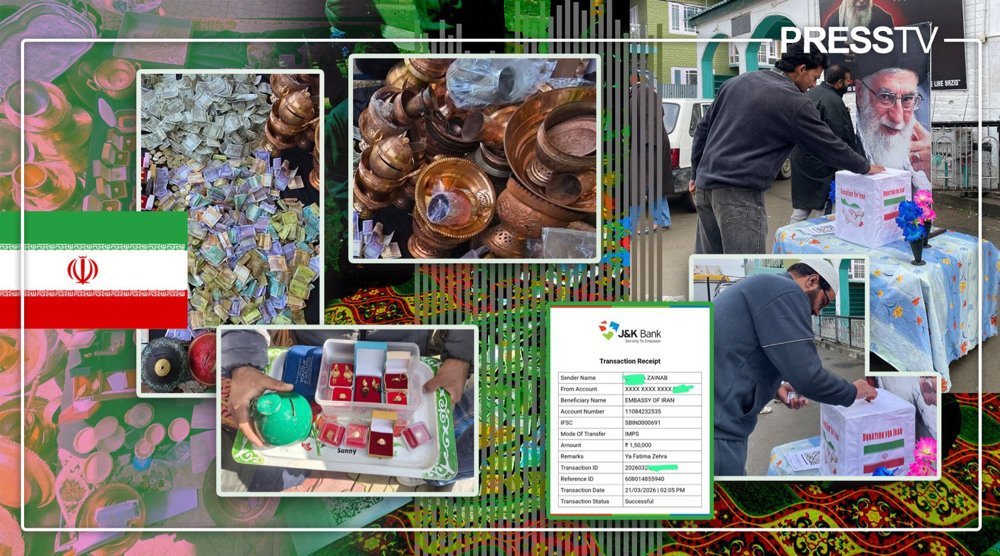
That simple act of charity, repeated in countless neighborhoods across the Himalayan valley of Kashmir over the past several days, has become the defining image of one of the largest and most emotionally intense public donation drives the region has witnessed.
"It is a movement born not of political organization or institutional coordination, but of grief, raw, overwhelming, and deeply personal, following the martyrdom of Imam Sayyed Ali Khamenei (RA) and the imposed war on Iran by the United States and Israel," said Muhammad Arif, a Kashmir-based journalist, in his conversations with the Press TV website.
The donation drive that began as scattered gestures of solidarity quickly transformed into a mass mobilization, cutting across age, gender, and sect.
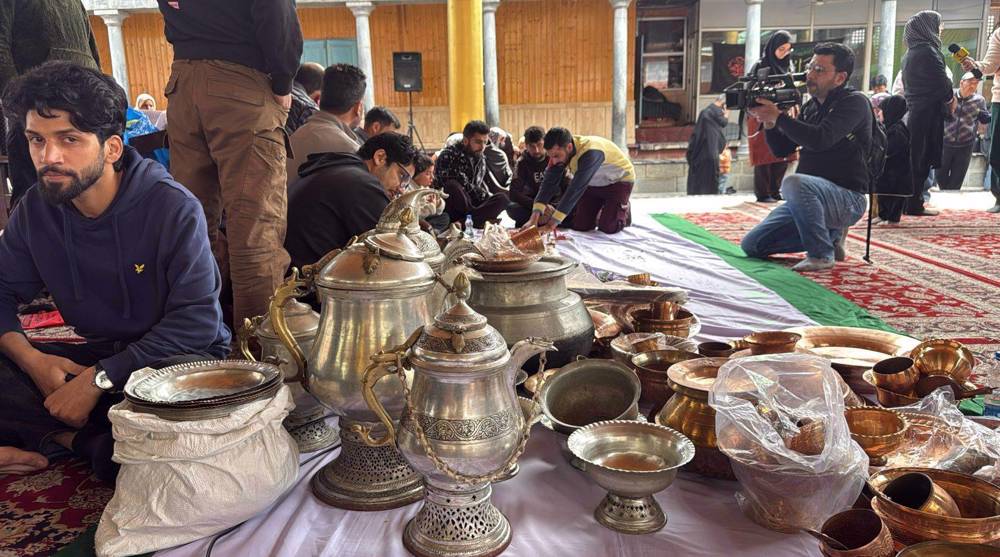
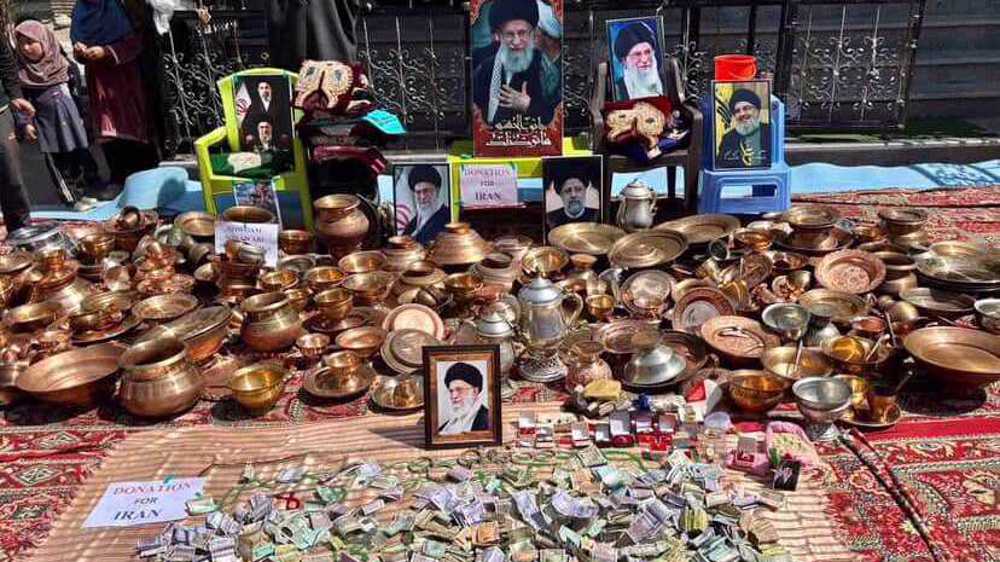
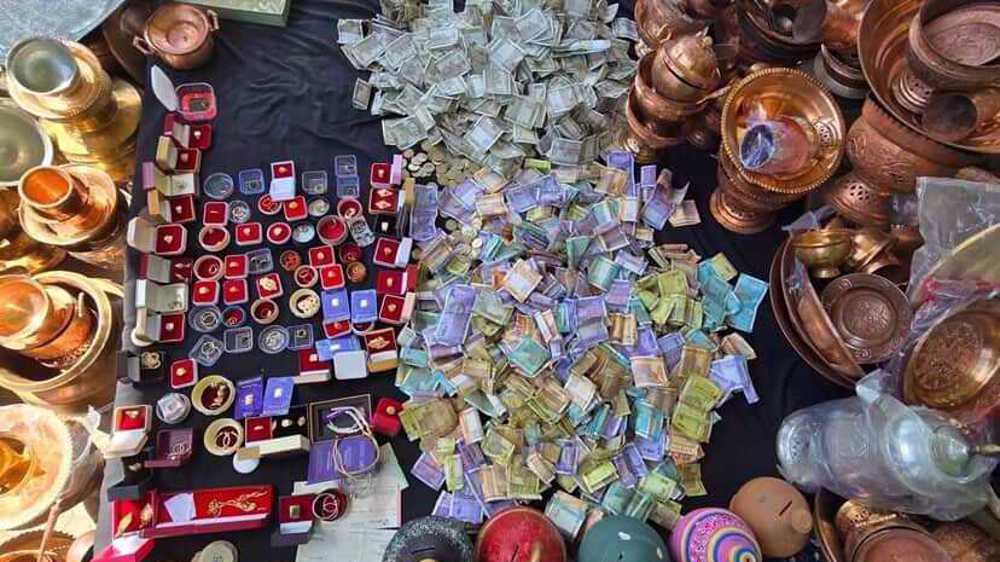
Volunteers at the locality level have coordinated precisely, organizing systematic collections of money, gold, silver, copper utensils, livestock, land deeds, and household items.
"People heard that the Iranian embassy had opened accounts for donations. After a few days, people mobilized at the mohalla (locality) level," Arif added.
Kashmir-based photojournalist Syed Shariyar, who has been documenting the drive throughout the valley, said it has been a deeply emotional experience for him.
"Yesterday was so intense. We saw people crying while sitting on the roadside. Strange… for me, it was deeply emotional," he told the Press TV website.
"Imagine children coming out with their clay banks," he added, with a pause.
‘I am present in today's Karbala’
In Srinagar, the capital of Kashmir, Hurmat Zahra, a young woman in her early 20s, spoke about her motivation to contribute. The gold earrings she wore that day were among her most prized possessions. But she let it go – for the place and the people she holds dear.
"After the assassination of the Leader of the Islamic Revolution, Sayyed Ali Khamenei, I am donating my jewellery for Iran," she told the Press TV website.
"I know Iran may not necessarily need this, but we are doing it for the sake of our martyred Leader, for the sake of Islam. Everyone is contributing in their own humble way."
Her voice was steady, but her composure faltered as she explained why she chose to give her earrings.
"I gave them for the sake of Hazrat Sakina (daughter of Imam Hussain (AS)), whose earrings were snatched in Karbala. I was not present in Karbala in 680 CE, but I am present in this Karbala," she stated, struggling to hold back her tears.
In Shia tradition, the moment when little Sakina’s earrings were forcibly snatched is remembered as one of the most painful episodes of that tragedy.
"That time Imam Hussain (AS) was martyred for Islam, and now Ayatollah Khamenei has also been martyred for Islam," she said in a choked voice. "These little things don’t matter to us; we are ready to sacrifice our lives for Islam."
Her words echoed a sentiment felt throughout the Kashmir valley. Most Kashmiris view the ongoing war of aggression against the Islamic Republic of Iran not as some distant war, but as a continuation of a struggle stretching back to the earliest years of Islam.
"In this struggle against falsehood, we want to be among the participants and not mere spectators," Zahra added.
Tahira Akhtar, a mother of three from Srinagar city, donated the gold chain she had received on her wedding day, which she valued both for its emotional value and as an investment.
"My motivation to donate it is Islam. Iran is standing alone for truth against the superpowers of the world, the Yazids of today’s world," she said, referring to the despotic Omayyad ruler who confronted Imam Hussain (AS) in the desert plains of Karbala.
"This is the least we can do from our side. We can’t be there to fight, so we are showing our solidarity with the Islamic Republic of Iran with these small acts."
When asked if she thought of her children before donating, she replied:
"Yes, I am a mother, and I do think about my children’s future. But when it comes to Islam and the path of Allah, Mohammad (peace be upon him), and the Holy Prophet’s progeny (peace be upon them), I am even ready to sacrifice my own children for the path. Gold is the bare minimum I can do."
She spoke of what moved her most, not the news of war in the abstract, but an image:
"Whatever is happening was a driving force. But what moved and tore me apart, particularly as a mother myself, was when I saw the school bags of those girls of Minab covered in dust and blood. It shattered me," she told the Press TV website.
She was referring to images of schoolchildren martyred at an elementary school in Minab in an American-Israeli aggression, widely circulated on social media. Many pictures showed school bags strewn amid rubble after the devastating bombing that killed over 170.
"And obviously Rehbar’s (Ayatollah Khamenei) martyrdom was a big blow to our hearts," she added. "We are still not able to recover from this harsh truth."
People in Kashmir grieve for the martyrdom of the Leader of the Islamic Revolution.
— Press TV 🔻 (@PressTV) March 1, 2026
Follow: https://t.co/mLGcUTS2ei pic.twitter.com/27lKgoLW7y
‘We wish we could offer our lives’
Across the length and breadth of Kashmir, the martyrdom of Ayatollah Khamenei in a cowardly act of terrorism has acted as a catalyst and a unifying factor for people.
"It is his shahadat (martyrdom) that brought everyone out," Shujaat Hussain, an engineer from Srinagar, told the Press TV website.
"Rich, middle-class, poor, everyone is arriving with something. They all say the same thing: even this is not enough. We wish we could offer our lives for the Leader."
This sentiment that no material offering is sufficient and the true desire is self-sacrifice resonates across communities in the picturesque Himalayan valley.
Zeeshan Jaipuri, a poet from downtown Srinagar, said people in the valley feel helpless for not being able to do anything more than make material contributions.
"People feel guilty about the fact that they are in Kashmir and not in Iran. They say we should have also been able to get martyrdom, but we are helplessly here," he said while speaking to the Press TV website.
Volunteers reported scenes that left even journalists and activists in tears.
"I felt very emotional when I saw the way people were donating money, gold, copper utensils, carpets," Shariyar said. "I have not seen something like this."
He spoke about a Budgam village where residents live below the official poverty line. Despite their circumstances, the collective donations from that single village amounted to 15 lakh Indian rupees (around $20,000) in cash, gold worth 25 lakh rupees (around $32,000), and copper worth 10 lakh rupees (around $20,000).
In another village, a Sunni Muslim farmer with no money donated a goat. An elderly man, unable to walk, made his way to a local Imam Bargah (Hosseiniyah) to give whatever money he had for the people of Iran.
Arif, who witnessed it, said: "An elderly Sunni man from our extended family who cannot even walk properly and was carried by people went to an Imam Bargah to donate whatever money he had."
Arif also recalled an unexpectedly heartwarming moment when a child arrived with a 50-paise coin, long obsolete.
"The people at the donation center, moved by his resolve to donate, auctioned the coin, and it fetched 17,000 Indian rupees to encourage him and respect his love for Islam and Imam," he told the Press TV website.
Even Kashmiri children are offering their piggy banks as gifts to Iran.
— Iran in India (@Iran_in_India) March 22, 2026
God bless you. pic.twitter.com/OfI6w4rNUb
Children with piggy banks
At one stall in Budgam, a six-year-old girl placed her pink piggy bank on the table.
"It is for Iran," she told the volunteers. Her mother stood behind her, wiping tears. "She insisted on giving it away. She said the children there need it more."
The Iranian Embassy in New Delhi highlighted similar stories on social media, noting Kashmiri children were “offering their piggy banks as gifts to Iran. God bless you.”
"I spoke to a few kids. No one actually told them to donate. They just noticed their elders and decided for themselves. It was so moving," said Jaipuri.
"I was thinking about it, about the enthusiasm of these children, the emotions we are witnessing. The answer lies in how families inculcated Aga’s (Ayatollah Khamenei’s) love. I remember when I was a kid, my cousin and I used to say salawat whenever he appeared on television. We had his pictures hung in our house."
He recalled a recent conversation with a cousin, who reminded him of how they would sit endlessly for hours and talk about him.
"Childish, deep conversations, you know. So basically, the culture at home triggered those conversations. I think if I go back to that age, this is how I’ll react, like these children."
He recalled a moment that, for him, seemed to crystallize everything.
"I saw a child with his toy sword. He wanted to kill Trump with it," referencing the US president who, in collaboration with Israel, ordered the unprovoked and unjustified military aggression against Iran in the middle of indirect nuclear talks, assassinating the Leader of the Islamic Revolution, many high-ranking officials and thousands of civilians.
Kashmiri man donated his vehicle, valued at $22,500, to support humanitarian efforts for the resilient people of Iran.
— Press TV 🔻 (@PressTV) March 23, 2026
Follow: https://t.co/mLGcUTS2ei pic.twitter.com/O6mkuNc30B
‘Not a donation, gift for Iran’s stand’
Srinagar-based journalist Sajid Rasool recounted an encounter on his social media page.
"I gave a lift to a woman on her way to donate jewellery," he wrote. "She said it was not a donation but a reward for Iran’s stand for truth and its resistance to US and Israeli hegemony. Her awareness was inspiring. Iran will prevail, InshaAllah."
Irfan Ali, a biotechnologist, said he was "humbled to see the spirit of giving" in his village.
"Since 8 AM, locals have already raised over 75 lakhs for the Iranian cause through crowdfunding and the day is still long. I wouldn’t be surprised if it reaches close to 3 crores. Truly inspiring," he wrote on his social media page.
Entrepreneur Owais Ali Bhat posted: "People are giving gold, cash, transferring into given accounts. Today huge collection from the masjid I went for Eid namaz. Iran has our full support in whatever capacity they want us to contribute."
Donations go beyond cash. A Kashmiri man donated his vehicle worth $22,500. Videos circulating online show people pledging to donate cars and motorbikes to fund the drive.
In one instance, a woman whose husband had already donated to the campaign returned home and gave her personal belongings as well.
"Her husband did donate," a volunteer said. "But she was not satisfied. She wanted to give away her personal belongings as well, so she donated her favorite bangles."
Collections across districts reportedly have exceeded 500 crores Indian rupees (approximately 60 million US dollars), Hussain said, with organizers noting the actual figure is likely much higher due to discreet cash contributions and difficulty in tracking physical assets.
All sectarian curtains have been removed
Observers note that the campaign has transcended sectarian lines, with members of both Shia and Sunni communities contributing side by side for the noble cause.
"I saw a video where a young Sunni bhai (brother) actually donated his bike," Jaipuri said. "Even in my locality, many Sunnis showed up at the donation site."
Arif offered a broader assessment: "Sunnis are contributing as much as Shias are. It is a miracle of the martyrdom of Imam Khamenei. All the sectarian curtains have been removed. People can see the difference between truth and falsehood."
As per eye witness accounts, Sunnis across the valley donated gold, copperware, motorcycles, and cash alongside Shia neighbors. For many, this unity was among the most profound outcomes.
"I have always thought of Kashmiri as an identity," Jaipuri reflected. "I finally resolved that they are people of love, and can go to any extent when in love."
Historical bond and revolutionary spirit
Agha Syed Mohammad Hadi, a well-known religious scholar and president of the Anjuman-e-Sharie Shiayan, one of Kashmir’s oldest socio-religious organizations, said the scale of this moment cannot be explained by a single factor.
What is unfolding, he noted, is the convergence of history, faith, and a long memory of shared struggle between the Islamic Republic of Iran and Kashmir.
He described Kashmir’s relationship with Iran as one rooted in religion, culture, and civilizational exchange, a bond visible in everything from theology and scholarship to art, literature, and the rhythms of public life.
The revolutionary interpretation of Islam that shaped modern Iran, he stressed, has long resonated with Kashmiri society, which carries its own deep-seated tradition of resistance and moral defiance.
"Kashmir, having endured pain for many years, can naturally feel the pain of the Iranian nation. This sense of shared suffering has now turned into a sense of responsibility. The people of Kashmir feel that the time has come to repay, even in part, the efforts Iranians have made, whether as missionaries, artists, or cultural figures in shaping Kashmiri identity," he told the Press TV website.
"Driven by this sense of responsibility, they have seized the moment and now wish to give whatever they have in return."
He framed these donations as a way for ordinary people in faraway Kashmir to assert where they stand in the moral geography of the moment, on “the right side of history,” in a world where silence itself can feel like complicity.
Imam Hussain’s (AS) legacy
The teachings of Imam Hussain — sacrifice, justice, and the refusal to bow before oppression — have always run deep in Kashmiri culture. They are carried through sermons, poetry, mourning, and intergenerational memory.
Observers note that for many, the current wave of giving is simply in line with the values moving from remembrance into action. Agha Hadi described this shift as a kind of moral calculus shaped by the profound and everlasting lessons of Ashura.
“If people cannot offer their lives for the truth, he said, then they believe they must offer their wealth, and so they do. Yet even with this outpouring,” he noted, “Kashmiris still see themselves as indebted to the Hussaini tradition, not fulfilling it.”
On the ground, the echoes of Karbala appear in striking scenes — a young girl nudging her piggy bank across a table, an old woman walking with difficulty to place her gold earrings among the donations.
“These collective gestures signal that Kashmiris do not view themselves as observers of a distant war, but as direct participants in a long historical arc, one that links their own struggles with the sacrifices of Karbala and now, in their eyes, with the defense of Iran,” said Imran Bhat, a volunteer at one of the donation centers in uptown Srinagar.
Mobility-impaired Kashmiri girl donates her gold earrings in support of Iran and the resistance.
— Press TV 🔻 (@PressTV) March 23, 2026
Follow: https://t.co/mLGcUTS2ei pic.twitter.com/1htcbPE4bI
It is a moral compass, not charity
For many Kashmiris, the wave of donations that has swept the valley following the Israeli-American war against Iran is not viewed as charity. It is a moral and political statement.
The unjust and illegal war on Iran is understood as part of a much older struggle for justice, autonomy, and human dignity
Hussain said the ongoing war is being interpreted as a moment of global weight, a point where ordinary people feel their small sacrifices carry a larger meaning.
He described it as a way for Kashmiris to place themselves “inside a shared human fight for dignity,” rather than standing on the sidelines.
“People feel that their support itself becomes a kind of presence in this imposed war,” he said. “And every time the enemy, what many have started calling the ‘Epstein-coalition’, suffers a setback, there’s a real sense of relief. Everyone is waiting, wishing for it to fall apart.”
The term “Epstein-coalition” has taken root in local conversations, used to describe a circle of global elites widely believed to shape US and Israeli policy. The reference comes from Jeffrey Epstein, the disgraced financier and sex trafficker whose links to Trump resurfaced through thousands of emails released by the US Justice Department.
Observers also believe that this movement cannot be brushed off as charity or pious performance. For those taking part, it is an act of moral positioning, a way of standing on the right side of history, and of turning cultural, religious, and ethical commitments into action.
Meanwhile, a video circulating widely captured this sentiment in raw form, a mobility-impaired Kashmiri girl crawling on the ground to hand over her gold earrings.
The clip spread rapidly, joined by dozens of other posts showing children, elderly women, and entire families offering whatever they could — pocket money, life savings, heirloom jewellery — to support Iran in a moment they believe carries global significance.
Discover Iran: Tabriz’s ‘Mausoleum of Poets,’ where centuries of Persian literary history live on
Discover Iran: Tabriz’s Blue Mosque, where glorious history meets timeless Iranian architecture
200 nights, one resilient nation: Iranian people’s epic in defense of homeland and Revolution



Iran FM: Our first task in New York is to defend the just cause of Iranian people
US lawmaker admits American people footing bill for Trump’s failed aggression against Iran
VIDEO | Trump's America is dying for Israel
US visa ban on Iranian president’s media team is bid to hide the truth: FM spokesman
VIDEO | Iran fully prepared to respond to new aggression
US aggression, economic warfare amount to crimes against humanity: Iran's UN envoy
Protests erupt in US as ICE agent shoots Venezuelan driver
US pressure fuels cooperation among Muslim states: Pezeshkian



 PressTV NEWSLETTER
now
PressTV NEWSLETTER
now
 This makes it easy to access the Press TV website
