‘Cinema Verité’ festival and a new geography of global resistance documentary
By Sheida Eslami
At a time when global media continue to reproduce a politicized image of Iran, Cinema Verité in Tehran stands as a clear and cultural response to such portrayals – a platform to see Iran not through news headlines, but through the eyes of Iranians themselves.
Now in its nineteenth edition, the international documentary festival is no longer merely an artistic event. It has become a media phenomenon that demonstrates how Iran has entered a dialogue of truth with the Global South through the language of visuals.
Being organized under the direction of Mohammad Hamidi-Moghaddam from December 10 to 16, 2025, this year’s edition seeks to re-examine the relationship between reality, memory, and legitimacy in the era of “global de-imaging.”
The prestigious festival is organized by the Documentary, Experimental and Animation Film Center (DEFC), an institution that has in recent decades transformed documentary filmmaking from an “artistic marginality” into one of the pillars of collective self-awareness and visual resistance among Iranians.
National structure at the intersection of memory and simultaneity
Cinema Verité has now become a showcase of honors for Iranian filmmakers - an opportunity few other documentary festivals can offer.
The success of Iranian documentarians at Cinema Verité is neither accidental nor sudden. It is cumulative and steadily deepening.
In the nineteenth edition, competition among Iranian documentarians unfolds with 23 films in the National Feature Documentary Competition, 25 films in the National Short Documentary Competition, 20 films in the National Mid-Length Documentary Competition, 24 films in the Martyr Avini Award section, and 18 films in the Student Documentary section.
The competitive “Iran” section, newly added in the nineteenth edition, is for the first time dedicated to screening documentaries that adopt a humanistic, national, and realistic approach to the experience of the Zionist regime’s attack against Iran in June and its social, psychological, and cultural consequences.
With three selected works, this section focuses on popular narratives, civil resistance, social solidarity, and everyday life amid crisis. These films, through honesty and creativity and far from clichés, depict a shared experience of steadfastness.
The various dimensions of resistance, alongside attention to the essence of life and Iran’s ancient history as an integrated land that has never surrendered to foreign culture, temperament, or conduct, are regarded as the key strengths of these works.
Accordingly, “Integrated Iran,” “Ancient Civilization,” and the “Twelve-Day War” are three axes that reflect three aspects of Iran’s cultural policy: on the one hand, an emphasis on unity and a singular national identity under the Iranian flag, along with historical reconstruction and civilizational memory that function as symbolic capital in the official artistic discourse; and on the other hand, a desire to document contemporary events such as the twelve-day war – granting Iranian documentarians a space to act as narrative witnesses and to address the most sensitive and significant period of open confrontation between Iran and its external enemies since the eight-year imposed war in the 1980s.
While Iranian documentarians in previous years were concerned mainly with expressing reality within a native aesthetic framework, this year the emphasis is on articulating reality in confrontation with the logic of global media.
For this reason, the festival’s “Iran” section has become a testing ground for new documentary languages in Iran – from personal and psychological narratives to quasi-experimental and semiotic works addressing national memory in the field of defense and resilience.
Presence on the international stage through diversity and cross-connections
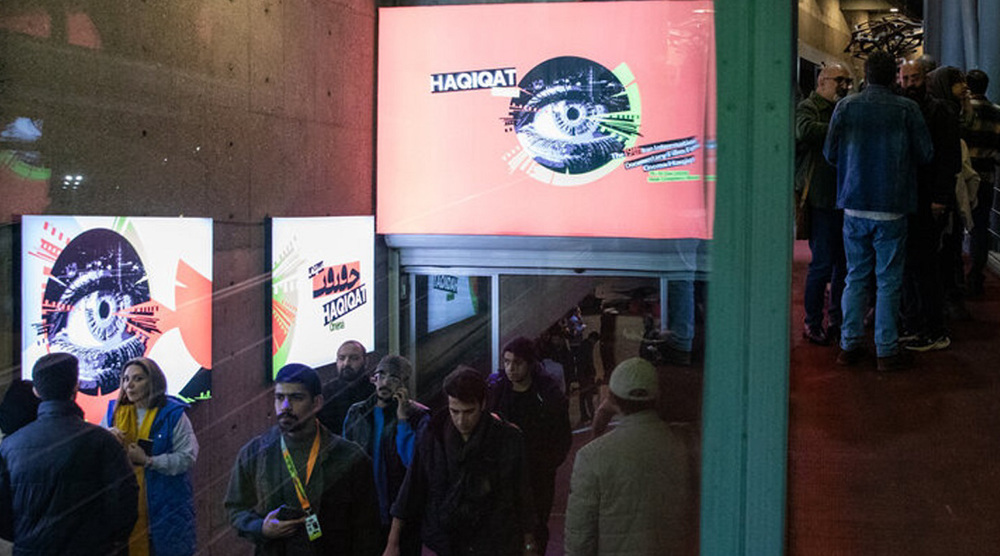
In the international competition section, the presence of 59 films from 43 countries across several subsections forms the focal point of the global South-to-South discourse.
The titles and geographies are vast: from Indonesia, Namibia, Austria, Mexico, and Tunisia to Denmark, Poland, Kazakhstan, and Chile. While this diversity may appear scattered on the surface, it carries a distinct thematic concentration.
If one reads the selected works as a “mental map,” the conclusion is clear: from identity questions to the climate crisis and late capitalism, from refugees and forced displacement to small-scale yet deeply meaningful narratives embedded in daily life and compelling experiences, from life during war and post-war realities to the challenges faced by contemporary humans on the margins of global power – all converge side by side.
This composition implicitly conveys a political message: Tehran in 2025 stands as one of the nodal points of documentary dialogue among Asia, Africa, Latin America, and Europe, not as a passive periphery, but as a host and coordinator of this dialogue.
In fact, rather than serving as a stage for Iran’s presence in the world, the Cinema Verité festival has become a platform where the world recognizes Iran as the host of a truth-producing dialogue.
This shift carries a soft yet effective political implication: Tehran has become a hub for the convergence of documentary experiences from forgotten regions – from war to migration, from climate to historical memory.
Gaza section and strengthening global resistance cinema
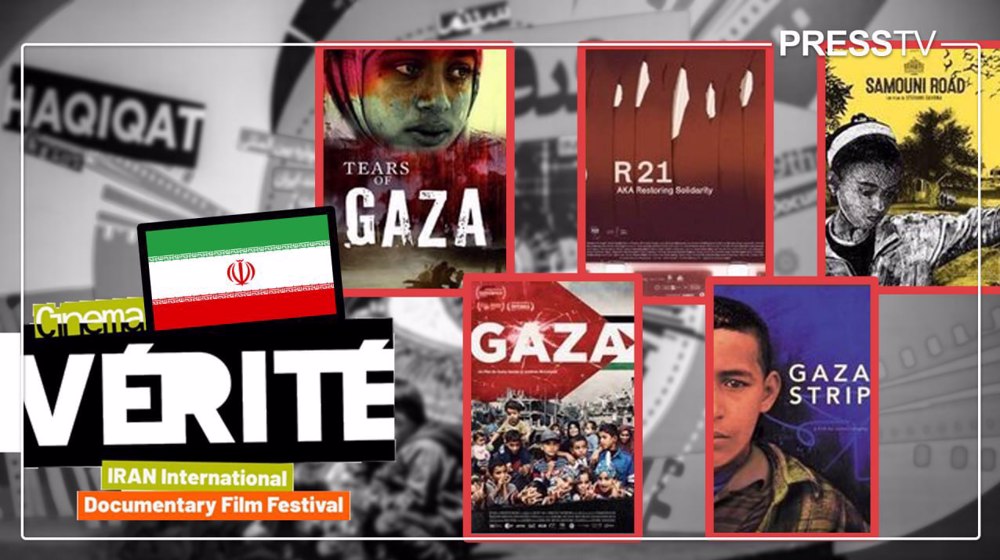
The special Gaza section (within the international segment), featuring 10 foreign documentaries, alongside the special “Iran” section, represents the most prominent manifestation of attention to an emerging conceptual cinema in global discourse: resistance.
Setting aside any technical or aesthetic shortcomings of these works, the very presence of this section constitutes a cultural statement – an emphasis on resistance documentary cinema whose semantic center begins in West Asia and North Africa and extends to Latin America and Southern Europe.
Films such as Gaza: A Stolen Childhood (Palestine/Qatar), Notes on an Exile (Brazil/Palestine), and Free Words: A Poet from Gaza (Egypt/Turkey), among others, operate through a distinct language. In these works, lived experience functions as a living archive, and each frame goes beyond representing reality to make an epistemological claim about the act of seeing itself.
From this perspective, the inclusion of these works in an Iranian festival goes beyond mere support for the people of Gaza. It represents a form of epistemic synergy among the Global Souths – something rarely witnessed in the global media space and now manifested in international attention to a blood-soaked strip of land in Palestine following the October 7 Operation Al-Aqsa Flood.

Contributing to the production and management of documentary knowledge
The international credibility of Cinema Verité in its nineteenth edition has been strengthened by a ten-part program of specialized workshops and masterclasses, from “Strategy in Recreating Truth” with Serbian documentarian Goran Radovanović to “Hybrid Narratives Between Documentary and Fiction” taught by Nishtha Jain (India), as well as “Breaking Free from Brand Noise: Conscious Camera Choice” with Morteza Janbakhsh and “Underwater Photography and Cinematography” with Ramin Ardastani.
Such a program demonstrates that the festival does not view itself merely as a venue for film screenings, but also as a laboratory for advancing the language and techniques of documentary filmmaking – from engaging with artificial intelligence to serious entry into virtual reality and intermedia experiences.
This year’s specialized workshops, spanning artificial intelligence, virtual reality, historical montage, and more, show that Cinema Verité is no longer just a film exhibitor. It is shaping national documentary knowledge by drawing on global experiences.
This orientation can be seen as an extension of an approach that prioritizes building intellectual and technological infrastructure for the art of resistance and identity.
As some critics suggest, the inclusion of such topics (such as AI and hybrid documentary) reflects an effort to reclaim a domain traditionally dominated by the West, a space where truth is reduced to an algorithmic product, while the Iranian festival seeks to return it to a human ground.
It can be said that Cinema Verité has rightly earned the title “the paradise of documentarians.” The hosting of this significant event affirms the successful transition of Iran’s cultural values from political language to the ritual language of images.
It demonstrates that Cinema Verité is not only a festival for viewing truth, but also a body of Iran’s narrative diplomacy – a model in which documentary becomes a medium for dialogue, crisis analysis, identity recovery, and preservation, rooted in a long history of struggle, justice-seeking, and the re-reading of collective memory.
If, in the early decades of the Islamic Revolution, Iran’s national cinema was tasked with “representation,” today’s documentary cinema is engaged in “re-narration” – telling truth from below, from the citizen’s perspective, from the angle of the body and lived experience.
For this reason, at the end of 2025, Cinema Verité is not merely an artistic festival, but a laboratory for reconstructing the relationship between the world and the Iranian image – a place where, instead of reconstructing Iran’s face, the very concept of truth is reconstructed.
Cinema Verité represents an approach in which documentary filmmaking is not merely an artistic genre, but a strategic tool for presenting Iran to the world and for understanding the world through the lens of truth and resistance, particularly as it highlights Iran’s perspective on the Gaza war.
A section that, by focusing on genocide, siege, resistance, and the power of word and image, demonstrates that the official policy of erasing and denying images is doomed to failure; because somewhere, in the dark halls of Mellat Cineplex, other images are screened – images that challenge dominant narratives and place truth-centeredness and the pursuit of justice, rather than politicization, at the center of the frame.
Sheida Islami is a Tehran-based writer, media advisor and cultural critic.
Arbaeen 2026 becomes statement of unity and resilience amid US-Israeli war on Iran, resistance axis
First black stork spotted in Western Iran’s Zaribar Wetland, marking an environmental milestone
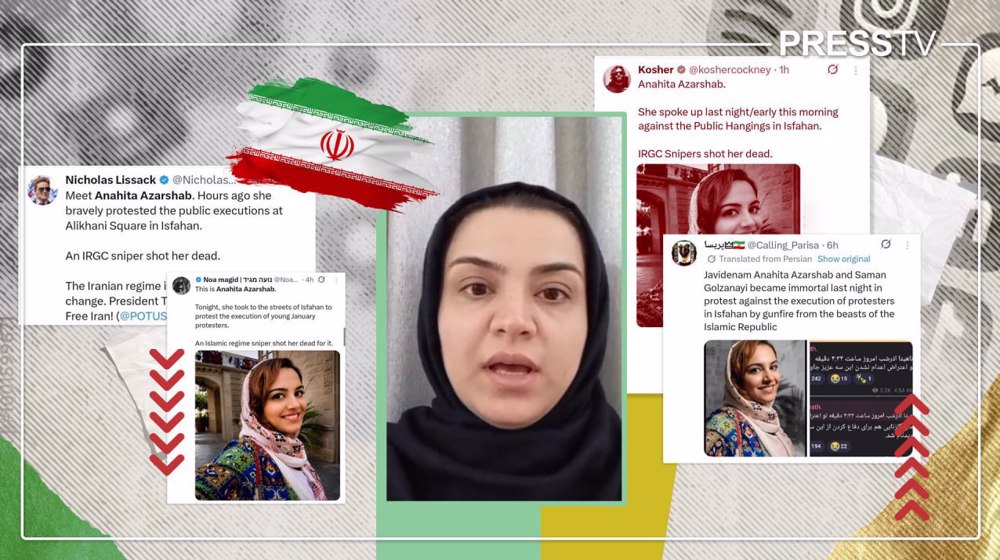
Old playbook, new 'victim': Iranian woman declared ‘killed’ appears alive, foiling unrest plot



US finds a new way to ‘undercount’ casualties from Iranian retaliation: Report
VIDEO | Gaza buries 112 Palestinians killed by Israel, bodies recovered after nearly three years
VIDEO | Gaza hospitals struggle to treat burn victims amid Israeli attacks, aid restrictions
VIDEO | 'The US cannot teach us about sovereignty': Palestinian political analyst
US-led ‘Board of Peace’ violates terms for Israeli withdrawal from Gaza
Iran-Oman bilateral talks on Strait of Hormuz progressing positively, FM spokesman says
Indian ship hit and sunk after attack off Yemen in Red Sea: Reports
Spain returns 70,000 migrants to Morocco as EU backs Madrid’s response to Ceuta crisis


 PressTV NEWSLETTER
now
PressTV NEWSLETTER
now
 This makes it easy to access the Press TV website
