Why Lebanon doesn’t trust Israeli-American intentions — and why it shouldn’t

By Hussein Mousavi
As Lebanon’s government, led by Prime Minister Nawaf Salam, inches closer to implementing its multi-phase plan to disarm Hezbollah, one question continues to divide the country:
What if Hezbollah lays down its arms… and the Israeli regime still doesn’t change its behavior?
The plan - drafted under the supervision of the Lebanese Armed Forces (LAF) and backed by the US, France, and several Arab states, including Saudi Arabia, Qatar, and the UAE - seeks to reassert the state’s monopoly on the use of force.
On paper, it sounds like a long-delayed step toward full “sovereignty.” That’s how the Lebanese premier and his allies - both inside and outside the country – try to present the issue.
Yet for many ordinary Lebanese, the proposal feels less like progress and more like exposure. And so, it raises a deeper fear.
Disarming the Hezbollah resistance movement, they fear, could strip Lebanon of its last line of deterrence, without changing anything about Israeli long-standing hostility.
Syrian precedent: Disarmament without security
Elsewhere in the region, Syria’s experience stands as a grim reminder. Even after the Jolani regime made public gestures toward normalization with the Israeli regime, the airstrikes on Syrian territory have never stopped. They continued unabated.
These attacks - justified by Israel as “preemptive” measures against so-called Iranian entrenchment (despite any evidence suggesting the same) have convinced many in Lebanon that military restraint does not necessarily guarantee security.
To many Lebanese, that says it all: even a weakened and cooperative neighbor hasn’t been spared unprovoked Israeli assault.
So, for the majority of Lebanese, the question resonates: If a disarmed, diplomatically compliant Syria was still bombed, why would a disarmed Lebanon be treated any differently?
That logic has sunk deep… even among communities once skeptical of the resistance. This isn’t about ideology anymore. It’s about survival, sovereignty and dignity.
People genuinely fear that weakness, not resistance, invites aggression.
“Every piece of land in Lebanon is called Lebanon”
— Press TV 🔻 (@PressTV) October 31, 2025
Hezbollah Secretary General Sheikh Naeem Qassem affirms that Lebanon’s unity, sovereignty, and dignity rest on collective sacrifice and resistance against occupation.
Follow Press TV on Telegram: https://t.co/LWoNSpkJSh pic.twitter.com/m6R9JTyq9b
Social undercurrents: A shift in perception
Hezbollah’s argument for keeping its weapons has always been rooted in resistance to Israeli military occupation and the defense of Lebanese sovereignty and territorial integrity.
For years, that claim was losing traction—chipped away by the US, Israeli regime (Hasbara), and Persian Gulf-funded campaigns that painted the resistance movement as a destabilizing force.
But the chaos next door changed the mood.
The violence in Syria, especially the relentless massacres committed by Al-Qaeda-linked groups in Suweida, jolted many Lebanese back to a hard truth: in a region defined by uncertainty and terrorism, some form of deterrence is still necessary.
Even among Christians and Druze, there’s a quiet shift. What was once a divisive argument is slowly becoming a reluctant consensus:
“Lebanon without a deterrent is Lebanon exposed. And now, no one in Beirut really believes the skies will stay quiet after disarmament. Not anymore.”
Washington’s back-out: The missing guarantees
Lebanese skepticism was further reinforced by Washington itself. If anyone still hoped for international reassurance, Washington’s recent message was clear.
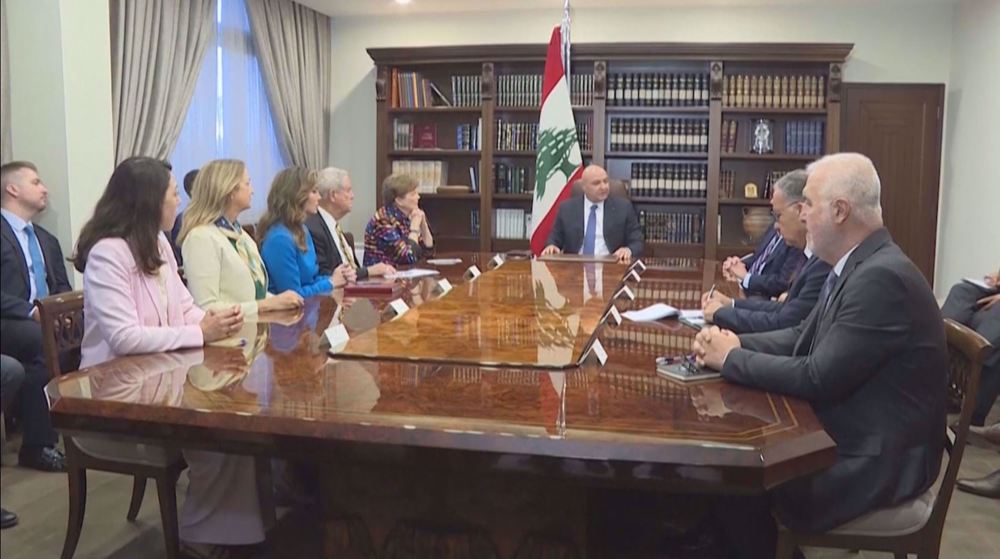
During his visit to Beirut, US envoy Tom Barrack openly admitted that Washington could not provide any binding guarantees that the Israeli occupation forces would refrain from future military action, even if Hezbollah were to be fully disarmed.
It was a rare moment of honesty, and a devastating one. For many Lebanese, it confirmed what Hezbollah has been saying for years: Without credible security guarantees, disarmament amounts to a strategic suicide.
Barrack’s inflammatory statement spread quickly across social media platforms and prime-time talk shows. It fueled the perception that Western powers are happy to demand disarmament but will not lift a finger to protect Lebanon afterward.
So, for now, Hezbollah’s deterrent remains the only shield people trust in a region where promises evaporate, and treaties rarely hold.
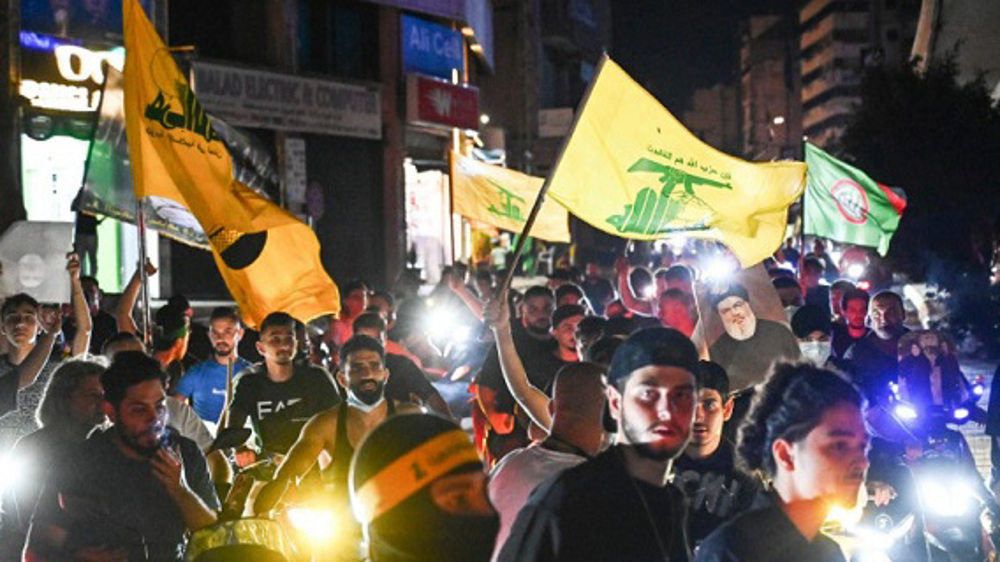
Pro-Resistance demonstrators set tires on fire at the Saint Michael's Church intersection in Beirut in protest to the Lebanese government's decision to disarm Hezbollah.
— PressTV Extra (@PresstvExtra) August 7, 2025
Follow Press TV on Telegram: https://t.co/h0eMpigtxM pic.twitter.com/ILHqtcXYNJ
A state caught between principle and survival
That leaves the Lebanese government trapped in a painful paradox and facing an impossible balance.
Internationally, disarmament is pitched as a prerequisite for reconstruction after the 2024 Israeli aggression. Domestically, it looks more like a setup, an attempt to squeeze out concessions that Washington and Tel Aviv couldn’t win through war.
PM Salam insists the Lebanese Army can fill the security gap once Hezbollah disarms. But everyone knows the LAF is overstretched, underfunded, and struggling to retain personnel amid an economic meltdown.
Even LAF Commander “Rodolph Haykal” has quietly admitted the limits.
And with UNIFIL’s mandate due to expire in 2026, the southern buffer zone that once helped keep the peace is fading fast.
Given these realities, Hezbollah’s arsenal (long portrayed by Israeli, American, and certain Arab media as “the problem”) is tied to something deeper: the complete absence of trust in Israel’s intentions, and the lack of any reliable security guarantees from its allies.
Trust, deterrence, and the price of “peace”
Trust can’t be declared in a press release. It’s earned through behavior, consistency, and respect. For Lebanon, disarmament cannot be separated from reciprocity.
Unless the Israeli regime demonstrates, through verifiable actions, that it will respect Lebanese sovereignty - and unless those commitments are backed by enforceable international guarantees - any talk of disarmament will remain politically impossible and socially toxic.
✍🏻 Viewpoint - Hezbollah’s legendary ‘Uli al-Baas’ battle and rebirth of the Lebanese resistance
— Press TV 🔻 (@PressTV) October 28, 2025
By Ali Hammoudhttps://t.co/bWVT74hDvq
A peace built on parity
Lebanon’s real dilemma isn’t whether disarmament is good in theory. It’s whether peace can exist without parity, and whether Western powers are willing to enforce that parity with real guarantees, not vague assurances.
Until that happens, every call for disarmament will collide with the realities of regional mistrust... and also with the same hard truth:
You can’t convince its citizens to give up their shield when the sky above them still burns.
And that’s why, for many in Lebanon today, neither the government nor the resistance has any reason to trust the Israeli regime.
Hussein Mousavi is a Lebanese journalist and commentator
New resolution and UNSC referral show IAEA continues to be weaponized by US, Europe against Iran

The farce of ‘war on terror’: How US military-industrial complex bred terrorism after 9/11 attacks

How US imperialism dehumanizes the 'other' to justify ghastly war crimes and escape accountability



US tested Lockheed cluster missiles on Iranian civilians, Baghaei says
Iran, Oman jointly postpone Persian Gulf foreign ministers’ meeting
VIDEO | Gaza’s women: The sole providers of families shattered by war
VIDEO | News Review: Trump’s comments on Irish unification spark backlash among his British allies
VIDEO | Press TV's news headlines
Yemen reports 58 Saudi attacks in one day, vows decisive response
VIDEO | US failed economic policy on Iran
Swedes head to polls to vote in general elections


 PressTV NEWSLETTER
now
PressTV NEWSLETTER
now
 This makes it easy to access the Press TV website
