Dancing to Zionist tune: Australia's diplomatic fallout with Iran on bogus anti-Semitic claims
By Mohammad Homaeefar
For many in the West, it may appear entirely natural that Australia decided to sever diplomatic relations with Iran after blaming Tehran for two anti-Semitic attacks.
For long, Iran has been demonized by the Western mainstream media as the world’s number one "Jew-hater."
However, such allegations crumble under simple fact-checking. Iran is home to more than 100 synagogues, including many in Tehran, and has made every effort to protect its minority Jewish community.
It hosts the largest Jewish population in West Asia outside the Zionist entity, and the Jewish community is one of Iran’s officially recognized religious minorities with a designated seat in parliament.
For decades, Iran has been portrayed to ordinary Westerners as a nation bent on destroying the “Jewish state” and killing all Jews in the process.
These baseless allegations, fueled by toxic Iranophobia in the West, have been consistently rejected by Iranian officials. Yet Western media either ignore or deliberately distort Iran’s official stance, shaping the narrative in a way that it becomes almost impossible not to view Iran as the problem.
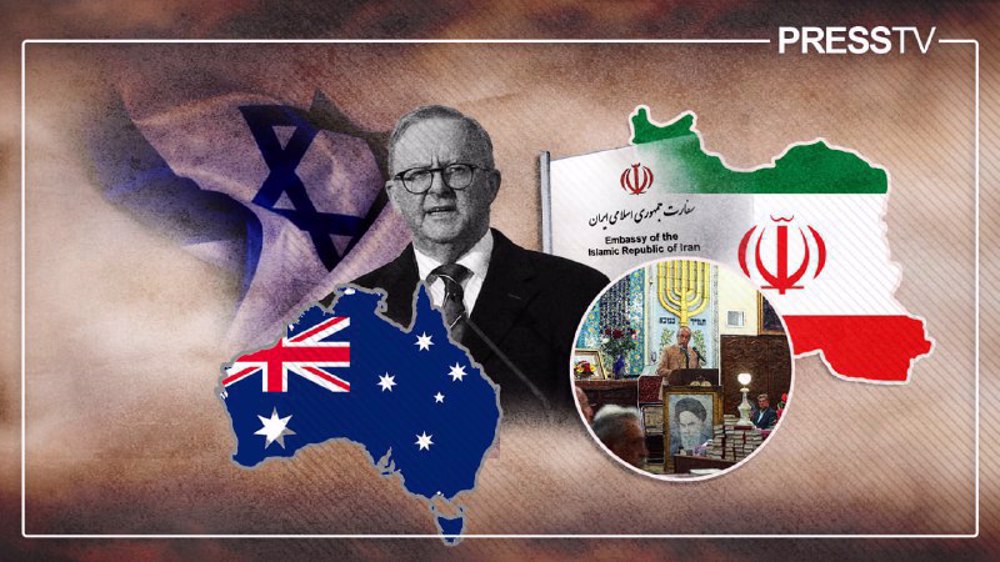
The latest example of this smear campaign came this week when Australia severed diplomatic ties with Iran after accusing the Islamic Republic of carrying out two anti-Semitic arson attacks in Sydney and Melbourne.
Australian authorities gave Iran’s ambassador seven days to leave the country, in first such diplomatic fallout since World War II.
Prime Minister Anthony Albanese claimed in a statement that the Australian Security Intelligence Organization had gathered “credible” intelligence linking Iran to the attacks.
"Iran vows reciprocal response to Canberra"
— Press TV 🔻 (@PressTV) August 27, 2025
Iran says Australia’s decision to expel the Iranian ambassador is in line with Israel’s policy to divert global attention from the genocide in the occupied Palestine.
Follow https://t.co/B3zXG73Jym pic.twitter.com/ds2cThxHRN
“These were extraordinary and dangerous acts of aggression orchestrated by a foreign nation on Australian soil,” he said. “They were attempts to undermine social cohesion and sow discord in our community.”
Albanese, however, stopped short of presenting any evidence to support the accusations. He insisted that his country’s security agency believed Iran was likely behind more such planned attacks.
As expected, Israel welcomed the decision, with its embassy in Australia claiming that the Islamic Republic “is not only a threat to Jews or Israel, it endangers the entire free world, including Australia.”
Israeli cabinet spokesman David Mencer told reporters, “For the Australian government to take those threats seriously is a positive outcome.”
‘Anti-Semitism a Western phenomenon’
Iran, in response, vowed to take appropriate reciprocal action against the move, which it said was motivated by internal affairs, reiterating that acts of religious discrimination have no place in the nation’s culture, history, or faith.
Foreign Ministry spokesman Esmaeil Baghaei dismissed the existence of any anti-Semitic inclinations across Iran’s time-honored cultural, historical, and religious background, saying, “This phenomenon is [rather] a Western and European one.”
“If you look at history, persecution of Jews because of their religion is a matter rooted in Europe; and it is they who must be held accountable for their historical past, which has continued to this day.”
The ministry also released a statement, highlighting the fact that anti-Semitism is primarily a Western-European phenomenon that has been manifested in various forms at different times, which “suggests that the recent misuse of this concept is aimed at suppressing protests against the Israeli occupation, apartheid, and genocide against the Palestinians.”
Foreign Minister Abbas Araghchi also condemned Australia’s decision, describing it as an act of appeasement toward the Israeli regime.
Araghchi rejected Canberra’s allegation, citing Iran’s longstanding protection of its Jewish community.
‘Anti-Semitism just a ploy’: Iran vows to retaliate after Australia expels ambassadorhttps://t.co/HOXPG0dx1a
— Press TV 🔻 (@PressTV) August 26, 2025
“Iran is home to the world’s oldest Jewish communities, including dozens of synagogues. Accusing Iran of attacking such sites in Australia while we do our utmost to protect them in our own country makes zero sense,” he noted.
“Iran is paying the price for the Australian people’s support for Palestine,” the top diplomat said, pointing to rising pro-Palestine protests across Australia amid the ongoing Israeli genocidal war on Gaza.
Earlier this month, tens of thousands of pro-Palestinian protesters marched across the Sydney Harbour Bridge, demanding an end to Israel’s brutal war on Gaza. Hundreds of thousands of Australians also attended more than 40 pro-Palestinian rallies across Australia on Sunday, demanding that their government sanction Israel.
Pressured by the public protests, Australia’s government has announced that it would join France and some other countries in officially recognizing the Palestinian state at the UN General Assembly in September.
The move angered Israeli Prime Minister Benjamin Netanyahu, who accused Albanese of “abandoning Australia’s Jews” and called him a “weak politician.”
Araghchi said he was “not in the habit of joining causes" with wanted war criminals, but added that Netanyahu is right about one thing: "Australia’s PM is indeed a ‘weak politician’.”
Issuing a warning to Australia, he added, “Canberra should know better than to attempt to appease a regime led by War Criminals. Doing so will only embolden Netanyahu and his ilk.”
Others on X also slammed Australia’s decision. Foreign policy analyst Reza Nasri pointed out that “Iran is home to about 100 to 110 synagogues, including 31 in Tehran alone.”
He argued that Israel and “its yes-men in the West, including in Australia, are just trying to frame the Iran-Israel conflict as a religious war between Iran and the Jewish people.”
Iran is home to about 100 to 110 synagogues, including 31 in Tehran alone. Israel and its yes-men in the West, including in Australia, are just trying to frame the Iran-Israel conflict as a religious war between Iran and the Jewish people. This is what these allegations are all… https://t.co/oL4ty9zaVw
— Reza Nasri (@RezaNasri1) August 26, 2025
Tim Anderson, Director of the Centre for Counter Hegemonic Studies, wrote that just the decision came after Israeli spy agency Mossad fooled the Australian prime minister that Iran was behind a string of “anti-Semitic” attacks in Australian cities.
“The packaged story comes from Australian spy agency ASIO, which receives most of its intel on [West Asia] from US and Israeli sources, and in particular from the CIA and Mossad,” he said.
Just days after a diplomatic row over Australia’s symbolic recognition of Palestine, Mossad, the spy branch of the genocidal Israeli regime, has fooled the Albanese government into claiming that Iran was behind a string of “antisemitic” attacks in Australian cities. The packaged… pic.twitter.com/9ljZ3eTYUq
— tim anderson (@timand2037) August 26, 2025
Reacting to Albanese’s statement, journalist Caitlin Johnstone said sarcastically that it was “nice of Iran to stage ‘anti-Semitic attacks’ in Australia which solely advance the interests of Israel and benefit Iran in no way whatsoever.”
“Very kind of Iran to help Israel like that,” she wrote in a post on X. “Quick question: what foreign intelligence agencies assisted ASIO in this assessment?”
Sure was nice of Iran to stage "antisemitic attacks" in Australia which solely advance the interests of Israel and benefit Iran in no way whatsoever. Very kind of Iran to help Israel like that.
— Caitlin Johnstone (@caitoz) August 26, 2025
Quick question: what foreign intelligence agencies assisted ASIO in this assessment? https://t.co/Otgc1TfCDH
Well-known modus operandi
This is not the first time that Iran has been, without a shred of evidence, accused of anti-Semitic conspiracies, but part of a decades-long US-Israeli practice that has already been seen in various countries around the world.
During the early 1990s, the Israeli regime shifted its focus to countering Iran, leveraging influential lobbying groups like the American Israel Public Affairs Committee (AIPAC) to push for stronger US sanctions.
Martin Indyk, who led the AIPAC-affiliated Washington Institute for Near East Policy (WINEP), played a key role in this effort. After rapidly rising to a prominent position in the Bill Clinton administration, he promoted his "dual containment" strategy in 1993.
This policy centered on imposing sanctions by accusing Iran of sponsoring terrorism, obstructing West Asia peace, and pursuing weapons of mass destruction.
These claims became the lasting justification for US sanctions, and during this period, pro-Israeli lobbying groups effectively became the primary architects of America’s Iran policy.
A year after defining this policy, a suspicious attack was carried out on the Argentine Jewish Mutual Association (AMIA) community center in Buenos Aires, the perpetrators of which were never precisely identified.
The US and the Israeli regime made great efforts to blame Iran and Hezbollah for the attack, even though there was no evidence, and the attack became a symbol of alleged "Iranian-sponsored terrorism" in popular Zionist discourse.
Thanks to lobbying by the George Bush administration and Israeli spy agencies, Interpol placed five Iranian officials on a red list, which later served as the basis for an Iranophobic propaganda campaign.
The alleged evidence of Iranian involvement was the testimony of three exiled Iranians who were found in 2007 to be members of the Mujahedin Khalq Organization (MKO), a terrorist cult whose main goal is the overthrow of the Iranian political system.
Australian senator smeared by anti-Iran groups for saying Iranian women 'have a voice'https://t.co/V1ZLsMfu7V pic.twitter.com/6rXPFnWZzf
— Press TV 🔻 (@PressTV) February 25, 2025
Tehran not only denied any involvement in the attack, but in 2013 signed a memorandum of understanding with Buenos Aires, allowing top Iranian officials to testify in Argentine courts and be questioned by their inspectors.
Alberto Nisman, the Argentine-Jewish prosecutor who formally indicted Hezbollah and Iran in 2006 under external pressure, opposed the memorandum and continued with unsubstantiated accusations.
In 2014, then-Argentine President Cristina Fernández de Kirchner gave a speech to the UN General Assembly in which she said that investigations conducted by the Argentine side showed that Iran had not participated in the bombing.
She added pointedly that the earlier Argentine accusations were "the result of intense political pressure imposed by the United States and Israel," and that the memorandum had brought the country under attack from Zionist lobbyists, including in the US Congress.
Her speech was censored and ignored by the Western mass media, and after the elections were won by parties and politicians close to the US, the memorandum was discarded and the dissemination of baseless accusations continued on the international stage.
After months of interviewing officials at the US Embassy in Buenos Aires, the FBI team lead, and Argentina’s most knowledgeable independent investigator, investigative journalist Gareth Porter found no credible evidence linking Iran to the bombing.
According to Porter, the investigation appears to have been driven from the start by US hostility toward Iran rather than a genuine pursuit of the truth.
The same modus operandi from Argentina, with accusations against Iran, lack of evidence, involvement of MKO members as false witnesses, American and Israeli lobbying, and a media propaganda campaign, was applied in subsequent years in several other countries, including Azerbaijan, Belgium, Bulgaria, Canada, Cyprus, France, Germany, India, Thailand, Turkey, the UK, and the US.
More recently, an Australia Muslim senator came under blistering attack from the influential Zionist lobby and MKO rabble rousers in Australia for taking part in a program related to Iranian women and for speaking to Press TV after the event.
She was forced to tender an apology later, tamely succumbing to the pressure.
Threat, ultimatum, retreat: Why Trump’s bellicose rhetoric against Iran always ends in backtracking
Iranian precision drones cripple US Patriot shield in Erbil, forcing a hasty American pullout
Eagle’s final flight: How Martyr Kazemi and other Su-24 pilots struck at the heart of US air power



Iran captures 21 mercenaries linked to Israeli regime in Kerman Province
Post-war reconstruction drives Iran's petrochemical expansion
Preliminary review of Iran's UNESCO nomination for Historic Port of Siraf successfully completed
Iran to launch most advanced National Primate Laboratory this year
Lebanon’s direct talks with Israel will bring successive concessions: Hezbollah MP
VIDEO | Press TV's news headlines
Italian teachers scrutinized for speaking out on Gaza
Israeli forces attack Press TV reporter covering Qalandiya raid in occupied West Bank


 PressTV NEWSLETTER
now
PressTV NEWSLETTER
now
 This makes it easy to access the Press TV website
