Seven years after reinstating Iran sanctions, US still clings to failed 'max pressure' policy
By Mohammad Homaeefar
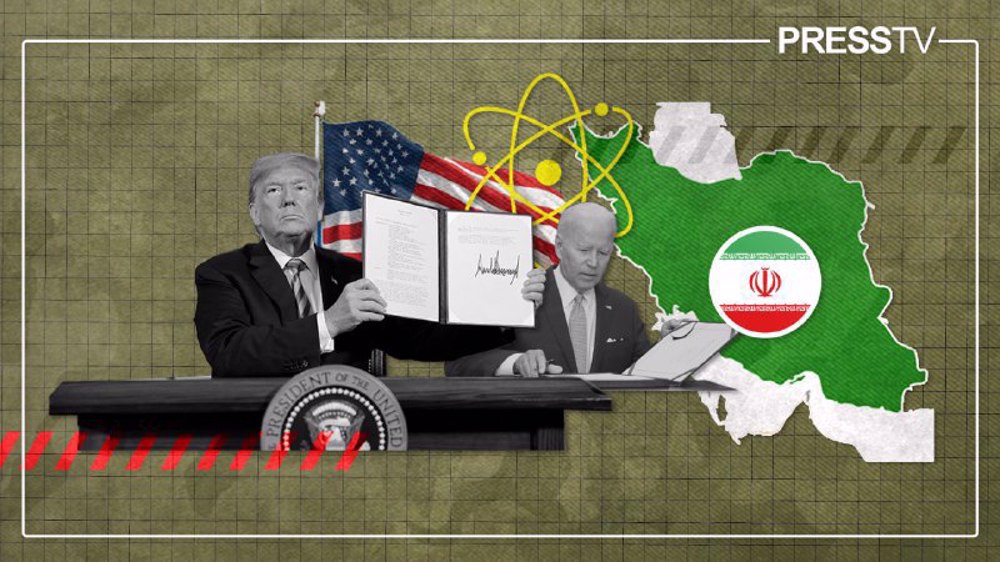
Since unilaterally withdrawing from the nuclear agreement in May 2018, successive administrations in Washington have heavily relied on draconian sanctions as the centerpiece of America's "maximum pressure" policy toward Iran, despite Tehran’s full compliance with the multilateral deal.
On May 8, 2018, US President Donald Trump withdrew the US from the nuclear deal, officially called the Joint Comprehensive Plan of Action (JCPOA), and embarked on a confrontational policy against Iran.
Under the JCPOA, which was reached in July 2015 and came into force in January 2016, Iran had accepted, in good faith, certain limitations on its nuclear program in exchange for a degree of sanctions relief.
Upon taking office, Trump infamously called the nuclear agreement reached by his predecessor “the worst deal in history” and promised to strike a “better deal” that would also address other issues such as Iran's ballistic missile program and regional activities, issues seen in Iran as redlines.
In unilaterally and illegally pulling out of the deal, the US president initiated what he called a “maximum pressure” campaign aimed at compelling Iran to renegotiate a new deal.
All the other parties to the deal – Russia, China, Britain, France, and Germany – expressed regret over the US decision and pledged to uphold the agreement.
On August 6, 2018, the Trump administration issued Executive Order 13846 to reinstate the sanctions lifted as part of the JCPOA. The sanctions took effect the following day.
The US Treasury Department also added 700 entities, including individuals, banks, vessels, aircraft and Iran’s energy sector to its list of “maximum pressure” sanctions.
British journalist @richimedhurst says that both Trump and Netanyahu took risks when the former ripped apart the JCPOA and the latter attacked Iran, and both ultimately failed.
— Press TV 🔻 (@PressTV) June 24, 2025
Follow: https://t.co/mLGcUTS2ei pic.twitter.com/GlU72Tn4hd
Then-US Secretary of State Mike Pompeo openly threatened to starve the Iranian population through sanctions, declaring infamously that Tehran must listen to Washington if “they want their people to eat.”
Washington also warned that any country doing business with Iran would not be able to do business with the United States.
As a result of the unilateral American sanctions, France’s Total pulled out of the Iranian South Pars gas field, leaving China’s CNPC to take up their 50 percent share in the natural gas field, of which it already had 30 percent.
The CNPC held this 80 percent share until October 2019, when it withdrew its investment share once again owing to the pressure of sanctions from the US.
Unlawful nature of US sanctions
Between 2015 and 2018, when the JCPOA was in full force, fifteen reports from the International Atomic Energy Agency (IAEA) confirmed Iran’s full compliance with the accord, showing that the country met and often exceeded its nuclear obligations.
The IAEA confirmed that Iran’s enriched uranium stockpile and heavy water reserves remained within the specified limits, noting that Iran had not exceeded the agreed-upon limits on key nuclear activities and had provided inspectors access to all necessary sites.
The unlawful US withdrawal and re-imposition of sanctions came in the wake of those reports, prompting Iran to enrich uranium to 4.5 percent, then 20 percent, and eventually 60 percent purity, as part of its “remedial” measures aimed at bringing the US back to the deal.
Still, the US continued its incendiary politics and piled up illegal sanctions, while pledging to drive Iran’s oil exports to zero.
Iran, meanwhile, decided to bring its case against the US to the International Court of Justice (ICJ) based on the 1955 Treaty of Amity.
✍️ Feature - JCPOA is dead: Ten years on, how US and its European allies killed the Iran nuclear deal https://t.co/yvirzlCNIM
— Press TV 🔻 (@PressTV) July 14, 2025
Consequently, on October 3, 2018, the ICJ ordered the US to lift sanctions imposed on humanitarian goods to Iran. It unanimously ruled that Washington “shall remove by means of its choosing any impediments arising from the measures announced on May 8 to the free exportation to Iran of medicines and medical devices, food and agricultural commodities.”
It also ordered US sanctions on spare parts for aircraft to be lifted due to their “potential to endanger civil aviation safety in Iran and the lives of its users.”
“Another failure for sanctions-addicted USG and victory for rule of law. Imperative for int’l community to collectively counter malign US unilateralism,” then-Iranian Foreign Minister Mohammad Javad Zarif tweeted after the ruling.
While Iran hailed the court decision as a victory that proved once again the illegality and cruelty of US sanctions, Pompeo unsurprisingly rejected the ruling, claiming the court had no jurisdiction whatsoever.
Maximum pressure revived
Iran remained steadfast throughout the years despite the countless problems it faced because of these sanctions, which were not eased during Joe Biden’s presidency between 2021 and 2025.
The year 2025 saw Trump returning to the White House, after which he immediately reloaded his “maximum pressure” campaign against Iran in a different form and shape.
On February 4, he signed a National Security Presidential Memorandum directing the Treasury and State Departments to intensify sanctions, aiming yet again to drive Iran’s oil exports to zero and dismantle its missile capabilities and regional influence.
In a move that underscored the contradictions of Washington’s approach, Trump sent a letter to Leader of the Islamic Revolution Ayatollah Seyyed Ali Khamenei, expressing willingness to reach a deal, while threatening Iran with military action if no agreement was reached.
In a February 7 speech, Ayatollah Khamenei pointed out that the JCPOA, which was the result of two years of intense negotiations, was torn up under Trump’s first term, asserting that negotiating with such an administration is “not wise, smart and honorable.”
. @RealScottRitter says the underlying fact in Iran’s nuclear deal is that the US withdrew from the JCPOA, and the EU failed to live up to its obligations under the deal. pic.twitter.com/MSDVZMCdvz
— Press TV 🔻 (@PressTV) June 25, 2024
The Islamic Republic, however, decided to give diplomacy another chance, and entered into indirect negotiations with the US, mediated by Oman.
However, in yet another betrayal of diplomacy, the US greenlighted the Israeli regime's unprovoked and unjustified military aggression against Iran on June 13, and after Israel was cornered and humiliated due to the strong Iranian retaliation, Washington came to its aid and carried out airstrikes of its own against Iranian nuclear sites.
Seeing diplomacy as cover for the military offensive, which came two days ahead of the sixth round of indirect talks in Muscat, Tehran suspended the talks indefinitely and halted its cooperation with the IAEA for colluding with Tel Aviv.
The unprovoked Israeli-American war of aggression showed that despite cosmetic diplomatic signals, Washington’s approach toward Iran remains unchanged.
More recently, in July 2025, the US imposed its largest sanctions package since 2018, targeting over 50 individuals, entities, and vessels linked to a vast shipping network that supports Tehran’s oil exports.
According to observers, these developments make it clear that US policy continues to prioritize punitive measures over diplomacy by restricting Iran's access to global markets, financial systems, and oil revenue streams.
Threat, ultimatum, retreat: Why Trump’s bellicose rhetoric against Iran always ends in backtracking
Iranian precision drones cripple US Patriot shield in Erbil, forcing a hasty American pullout
Eagle’s final flight: How Martyr Kazemi and other Su-24 pilots struck at the heart of US air power



‘Time to rely only on ourselves, embrace true brotherhood’: Iran tells regional Muslim nations
US on the verge of 'significant strategic defeat' against Iran: Ex-US negotiator
VIDEO | Tunisia’s medicine price hikes fuel social concerns over healthcare access
AIPAC eyes another push against El-Sayed after $32 million defeat in Michigan primary
Any country joining Saudi aggression is aggressor, Yemen warns after joint ‘defense' deal
VIDEO | Press TV's news headlines
Persian Gulf security must come from within the region, not outside: Iran deputy FM
Iraqi Resistance 'delays' planned retaliatory strike on US-Saudi interests


 PressTV NEWSLETTER
now
PressTV NEWSLETTER
now
 This makes it easy to access the Press TV website
