Oldest ever modern finger bone hints earlier decent from trees

Scientists say an almost two-million-year-old finger bone, unearthed in East Africa, suggests modern humans evolved earlier than previously thought.
The 1.85-million-year-old little finger bone, dubbed OH 86, was found at the Olduvai Gorge paleontological site in northern Tanzania and is believed by scientists to belong to an unidentified ancient hominin species.
The discovery, published in a study in the journal Nature Communications on Tuesday, pushes back the origin of the modern-human-like hand -- ideal for grasping tools but inadequate for climbing trees -- by around 400,000 years.
“This bone belongs to somebody who’s not spending any time in the trees at all,” says the study’s lead author Manuel Dominguez-Rodrigo.
The pinky provides further information about the descent of pre-human hominins from the trees to the ground, and belongs to a transitionary species between Homo sapiens and smaller species like Homo habilis and Paranthropus boisei.
Based on the bone, researchers presume that species was likely around 180 centimeters tall whereas Homo habilis was only about 90 centimeters tall.
"This provides good evidence supporting the hypothesis that, by about 2 million years ago, our early ancestors lost the anatomy linked to our tree-climbing past," Brian Richmond, an anthropologist with the American Museum of Natural History in New York, told UPI.
"Our hand evolved to allow us a variety of grips and enough gripping power to allow us the widest range of manipulation observed in any primate," Dominguez-Rodrigo said. "It is this manipulation capability that interacted with our brains to develop our intelligence, mainly through the invention and use of tools.”
The team is currently digging for more bones, particularly from the new species, to strengthen their theories.
"For human evolution, the new discovery shows the oldest hominin adapted to terrestrial [life] completely," he added.

Iranian students win gold, silver medals at American Mathematics Olympiad
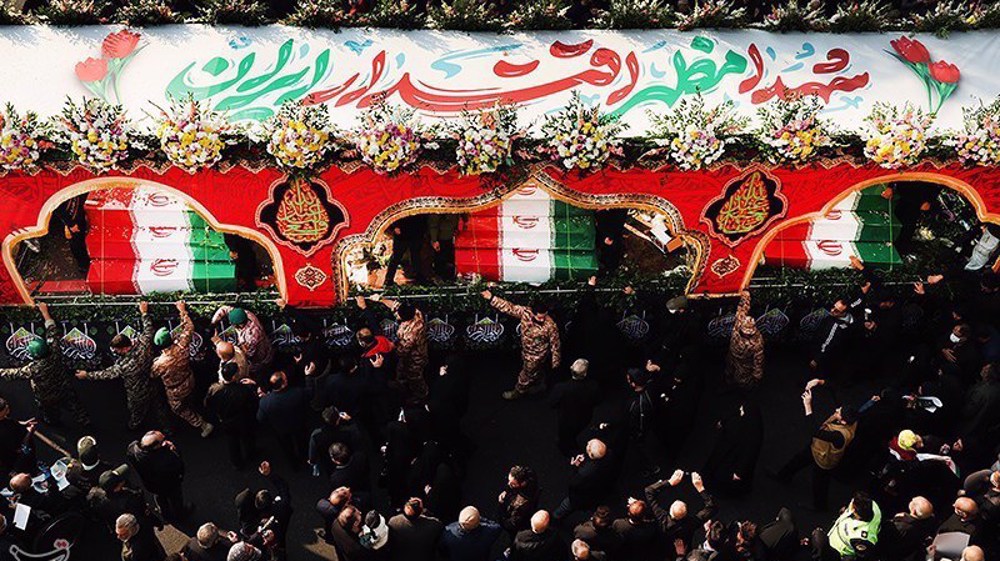
Iran holds mass funeral procession for 300 unidentified martyrs

Israel kills two Palestinian children in Gaza every day despite ceasefire: UNICEF



China expands use of Iranian rail corridor for cargo transit
Ukraine’s Zelensky says open to dropping NATO bid for security guarantees
Israel kills 3 in south Lebanon as it threatens ‘wide-scale’ attack
VIDEO | Iran’s mega solar plant to power 2.5 million homes
Hamas warns against Israel's plans to 're-engineer' Gaza
VIDEO | South Koreans join migrants in Seoul to protest on Migrant Workers' Day
VIDEO | Press TV's news headlines
VIDEO | Iraq, UN officially mark end of UNAMI mission in country


 PressTV NEWSLETTER
now
PressTV NEWSLETTER
now

 This makes it easy to access the Press TV website
