
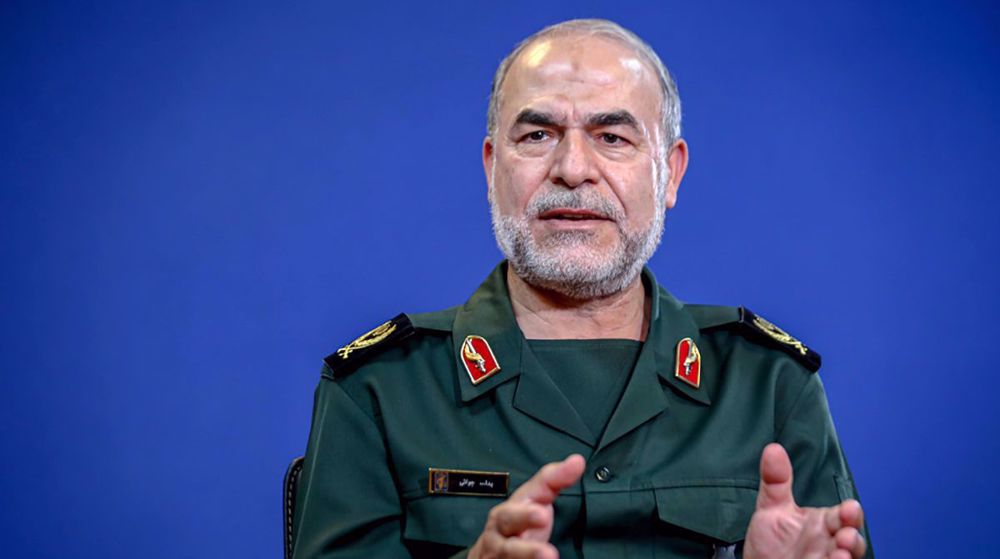
A senior Islamic Revolution Guards Corps (IRGC) commander says the United States made a strategic miscalculation in its war on Iran by assuming that the assassination of the late Leader of the Islamic Revolution, Ayatollah Seyyed Ali Khamenei, attacks on political and security structures, and attempts to create chaos would bring down the establishment.
Brigadier General Yadollah Javani, IRGC deputy commander for political affairs, said the enemy’s calculations failed because they did not take into account the resilience of the Iranian nation.
“The enemy imagined that with the martyrdom of the Leader of the Revolution, striking political and security structures, and creating chaos in the streets, it could tear the system apart, but this calculation did not match the reality of the Iranian society,” General Javani said.
General Javani also addressed the Israeli regime’s wrong calculations, saying that Prime Minister Benjamin Netanyahu imagined Iran was in a weak position and that strikes on political and security structures could pave the way for the system’s collapse.
He noted that since before Donald Trump’s presidency until now, Washington has sought to place Iran under maximum pressure, but these efforts have failed in the face of the nation’s steadfastness and the system’s decisive response.
General Javani stressed that Iranian identity is rooted in the culture of martyrdom.
“The Iranian nation was formed on the teachings of martyrdom, and for this reason, threats and pressure from the enemy cannot easily shake its will,” he said.
226 nights of rallies
General Javani pointed to the continued nightly presence of Iranians in the streets, describing 226 consecutive nights of public presence as “a phenomenon rarely seen in human history.”
He said this reflected the same qualities that Imam Khomeini, the founder of the Islamic Republic, had attributed to the Iranian nation.
He noted that people remained in the streets under various weather conditions and even under bombardment, a fact he said should draw the attention of strategists and thinkers.
The US-Israeli war of aggression against Iran began on February 28, 2026, with a wave of joint strikes.
On the first day, the attacks martyred Ayatollah Seyyed Ali Khamenei along with several senior military commanders and civilians. The attacks also targeted nuclear facilities, schools, and hospitals.
Iran’s armed forces responded with Operation True Promise 4, launching waves of missile and drone strikes against US and Israeli targets across the region.
A Pakistan-brokered ceasefire took effect in April, and a 14-point memorandum of understanding was signed in June.
However, Washington repeatedly violated the agreement, including by attempting to force the transit of vessels through the Strait of Hormuz without coordination with Iranian authorities and in direct violation of the MoU's stipulated timelines and conditions.
The move has been widely seen as a deliberate provocation aimed at testing Iran's resolve and unilaterally redefining the terms of the ceasefire.
The Islamic Republic's armed forces have responded swiftly and decisively, intercepting and punishing the violating vessels in accordance with the defensive arrangements established during the war.
 This makes it easy to access the Press TV website