Iran: Regional foreign ministers' meeting in Oman called off at Saudi Arabia's request
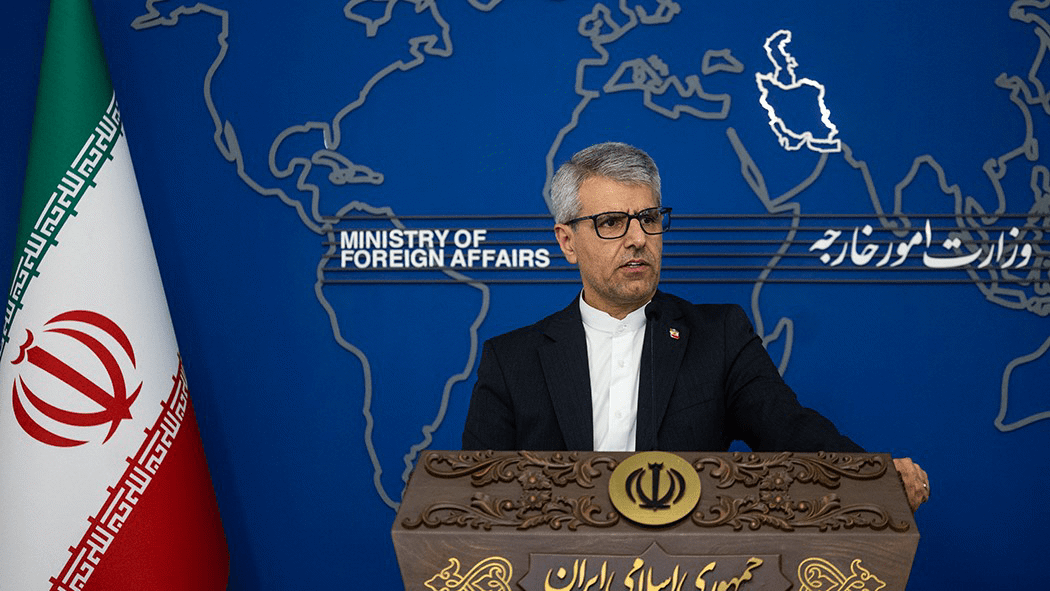
Iranian Foreign Ministry spokesman Esmaeil Baghaei says a meeting of foreign ministers of regional states scheduled in Oman to discuss arrangements for safe commercial navigation through the Strait of Hormuz was canceled at Saudi Arabia’s request.
Addressing reporters at a weekly press conference on Monday, Baghaei said Iran and Oman have finalized an agreement concerning maritime routes.
“The understanding between Iran and Oman, as two littoral states, has been finalized. In consultation with Oman, we will decide on the next step, including how to announce or register the understanding,” he said.
He noted that the Iran-Oman understanding regarding the security of maritime routes was the result of weeks of negotiations between the two countries.
Iran does not make decisions on “highly sensitive and complicated” security-related issues based on a single factor, Baghaei added, stressing that Tehran should not call its own rational and forward-looking actions into question because of the ill-advised actions or broken commitments of others.
Baghaei said the planned meeting in Oman was an “opportunity” created by Tehran and Muscat, saying regional countries were expected to recognize and make use of it.
He reiterated that Iran has consistently made efforts to help resolve regional issues and has demonstrated that commitment in practice.
“We well know that the continuation of war in the region among Muslim countries has only one winner, and that winner is no one other than the Zionist regime (Israel), which seeks to prolong tensions and insecurity among Muslim countries in our region,” the Iranian spokesperson pointed out.
The Strait of Hormuz is a major global energy chokepoint, with roughly one-fifth of global oil demand passing through the waterway. Iran has maintained heightened restrictions on navigation since the start of the US-Israeli military aggression against the country on Feb. 28, citing security concerns and the need to safeguard its sovereignty.
Iran and Oman have been engaged in negotiations for nearly three months over arrangements for safe navigation through the strategic waterway. On August 25, the two countries announced discussions on a phased framework that would initially establish a temporary joint maritime corridor, alongside a joint mine-clearance project.
The framework is aimed at restoring safe navigation while preserving the sovereignty and sovereign rights of coastal states. Technical talks are expected to continue toward a permanent navigation corridor and an agreement on the future administration of the waterway.
Mohammad Alibek, Director General of the Persian Gulf Department at Iran’s Foreign Ministry, said on Sunday that the meeting of foreign ministers from Persian Gulf littoral states, originally scheduled for Monday in Oman’s Salalah, has been postponed to a later date following a joint decision by Iran and Oman, at the request of certain regional countries, stressing that Tehran remains fully committed to the process of constructive regional dialogue.
Claims about Iran’s involvement in attack on Saudi oil pipeline ‘completely false’
Baghaei categorically rejected US claims that Iran was involved in an attack on a Saudi oil pipeline from Iraqi territory, describing the allegation as sheer lies.
“Americans are constantly fabricating news and making false claims without paying any cost. There is no doubt about that,” he said.
He added that US’ repeated lies amid the current circumstances were aimed at deepening divisions among regional countries, and urged the countries of the region to solve issues by themselves.
“Otherwise, those who do not seek the good and interests of our region will continue to resort to such lies to further complicate the situation,” the spokesman warned.
Iran does not interfere in Yemeni decisions
Baghaei also rejected claims about Iranian involvement in Yemeni affairs, saying Iran, as a country that cares about regional stability, is aware that some parties are exploiting the situation to escalate divisions and discord among Muslim countries.
“It is quite clear that the Yemenis make their own decisions. [The Yemeni resistance movement] Ansarullah is an independent Yemeni party that takes decisions based on what it considers to be its own interests and priorities,” he reiterated.
Yemenis have shown that they are free people and that issues concerning the Muslim world and humanity are important to them.
The Iranian spokesman stressed the importance of guaranteeing shipping security and freedom of maritime trade for all.
“You cannot attack a country or countries, impose a naval blockade on them, and then unilaterally expect them to act as the guardians of maritime shipping,” he said.
He recommended that all the countries in the region recognize the realities on the ground and refrain from making baseless accusations against others if they genuinely seek to resolve regional problems.
Mount Kolang allegations part of US media, psychological warfare
In response to a question about the International Atomic Energy Agency (IAEA) claims regarding Iran’s Mount Kolang (Pickaxe) near the Natanz nuclear enrichment facility in central Iran, Baghaei said Iran has provided the agency with all information required under its safeguards obligations, dismissing the allegations as media speculation.
“Remarks about Mount Kolang are part of the United States’ media and psychological warfare,” the spokesman said.
He explained that new allegations are repeatedly raised in an effort to justify false narratives, adding that such claims sometimes mislead observers and public opinion.
The IAEA said on Thursday it has observed construction activity at Iran’s Mount Kolang, with its director general Rafael Grossi claiming that new activity at the complex had been spotted in remote imagery.
“There are some indications that there is activity around this construction site,” Grossi told Bloomberg Television.
“We don’t have any concrete information as to activities that may be taking place there,” he added.

Iran summons Austria’s chargé d’affaires over visa denial for nuclear chief
Baghaei further said Austria’s move to deny a visa to Head of the Atomic Energy Organization of Iran Mohammad Eslami for a trip to Vienna was “completely unjustified,” stressing that the Austrian government should have issued entry visas to the Iranian delegation.
He said Iran’s Foreign Ministry has summoned Austria’s chargé d’affaires to formally convey the Islamic Republic’s strong protest over the decision to the European country.
“They are seeking to prevent Iran’s voice from reaching the world. Austria’s claim that it took this action under US pressure does not absolve the host government of responsibility,” the Iranian spokesperson emphasized.
Eslami was due to attend the annual general conference of the International Atomic Energy Agency (IAEA), the UN’s nuclear agency, in Vienna, which runs through Friday.
Seized US submarine ‘legitimate spoils’
Asked whether the US had held any consultations or negotiations with Iran over the release or return of an advanced US unmanned underwater vehicle seized by Iran, Baghaei said the submarine had not been confiscated but captured as legitimate spoils.
“It was not seized. It was captured as spoils of war, and such spoils are legitimate,” he responded.
Qatar Red Crescent Society pledges cooperation over captive Iranian pilots: Official

Iran's Judiciary seizes assets of 240 individuals over collaboration with hostile regimes
Iran, Oman jointly postpone Persian Gulf foreign ministers’ meeting



VIDEO | Israel concerns about Houthi
Art of killing innocents: How US ‘precision’ missiles turned southern Iran wedding into a massacre
VIDEO | Regional push for Hormuz deal
VIDEO | News Review: Yemen launches large-scale operation against Saudi base
Iran’s strategic location, energy resources position it as a key player in BRICS alliance: Analyst
Yemeni army strikes aircraft hangars, radars, arms depots at Saudi airbase
Meet the 7-year-old Iranian prodigy who won gold at 2026 International Junior Informatics Olympiad
Iranian academic and entrepreneur wins top prize at BRICS women’s startup contest


 PressTV NEWSLETTER
now
PressTV NEWSLETTER
now
 This makes it easy to access the Press TV website
