

Iran has strongly condemned a resolution passed by the International Atomic Energy Agency (IAEA) Board of Governors that refers Tehran to the UN Security Council, warning that the politically driven move undermines global non-proliferation frameworks and ignores the realities of an ongoing war.
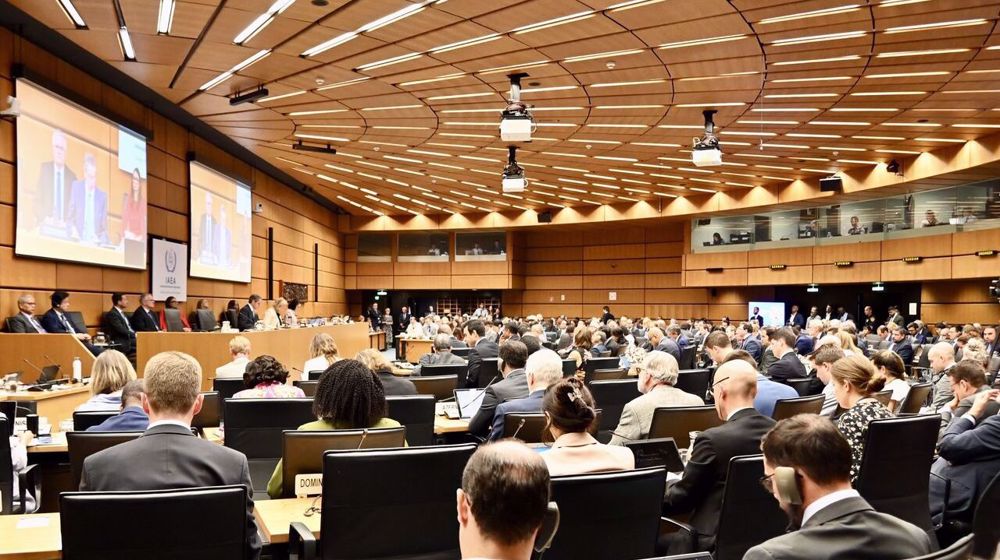
The remarks came on Wednesday after an anti-Iran resolution, drafted by the United States, Britain, France, and Germany, was adopted with 23 votes in favor. Three nations, Russia, China, and Niger, voted against it, while eight abstained.
The text requests IAEA Director General Rafael Grossi to report Iran to the UN Security Council and the General Assembly, marking the first time in 20 years that Tehran has been referred to the council over its nuclear obligations.
In a statement released on X, Iran’s mission to the UN in Vienna slammed the non-consensual adoption of the resolution, arguing that it "facilitates further erosion and ultimate collapse of the proliferation regime as a whole."
Tehran placed the blame for the current nuclear standoff squarely on the United States and Israel, citing their wars of aggression against the country.
"The current situation is created solely because of the criminal acts of aggression by the US and Israeli regime," the statement read.
It dismissed Washington’s efforts to force Iran into "surrender" and seize its oil wealth as a "delusional objective" that has failed despite two years of all-out warfare involving the US, its allies, and regional proxies.
Iran’s mission to the IAEA highlighted the hypocrisy of Western powers that have historically praised "diplomatic solutions" at the IAEA while simultaneously resorting to the unlawful use of force.
Once again, a political resolution on Iran is nonconsensually adopted by the #IAEA BoG. It follows a telling trend and facilitates further erosion and ultimate collapse of the proliferation regime as a whole.
— Iran Mission UN Vienna (@PMIRAN_Vienna) September 9, 2026
The current situation is created solely because of the criminal acts of… pic.twitter.com/MubfUTrzqt
The Iranian mission noted that the US and Israel have bombed "peaceful, safeguarded nuclear sites" and violated basic principles of international law and the UN Charter.
The statement condemned the ongoing military aggression for devastating civilian casualties, specifically referencing war crimes that include the deaths of thousands of civilians, among them "168 children at a primary school and guests at a wedding."
"They will never be able to redeem that defeat by adoption of a biased resolution through the IAEA," the mission added.
Flawed logic
Separately, Iran's Deputy Foreign Minister Kazem Gharibabadi criticized the logic of the IAEA and Western powers, saying that the very lack of access being condemned was manufactured by foreign military strikes.
"They attack Iran's safeguarded nuclear facilities, disrupt the normal verification process, and then use that very disruption as a pretext for issuing a resolution in the Board of Governors," said Gharibabadi.
Gharibabadi dismissed the diplomatic maneuver as a desperate attempt to salvage a failed military and political strategy.
"With this political posturing, you can neither compensate for the failure of your own policies and actions, nor can you achieve anything in the Security Council," he added.
Diplomacy vs. airstrikes
Speaking to reporters following the vote, Iran’s Ambassador to the UN in Vienna, Reza Najafi, dismissed the resolution as a "political tool."
Clarifying Tehran's stance on future inspections amid active military hostilities, Najafi stated that "Iran will cooperate only to the extent that circumstances and safety permit."
The IAEA has not had access to some Iranian nuclear facilities since a US-Israeli military offensive in June 2025, which included direct airstrikes on safeguarded nuclear sites.
Access has remained blocked following a broader war that erupted on February 28, 2026, which has also seen nuclear and civilian infrastructure targeted.
This is while before the June 2025 strikes, the IAEA had access to those nuclear sites.
Diplomatic analysts note that the referral to the UN Security Council is largely symbolic.
While America hopes to layer diplomatic pressure on top of existing economic sanctions and a naval blockade, any attempt to pass punitive measures at the Security Council is expected to be vetoed by Russia and China, both of which oppose the politicization of the nuclear watchdog.
 This makes it easy to access the Press TV website