
Iran’s military made a decade of gains in just 15 months: Qalibaf
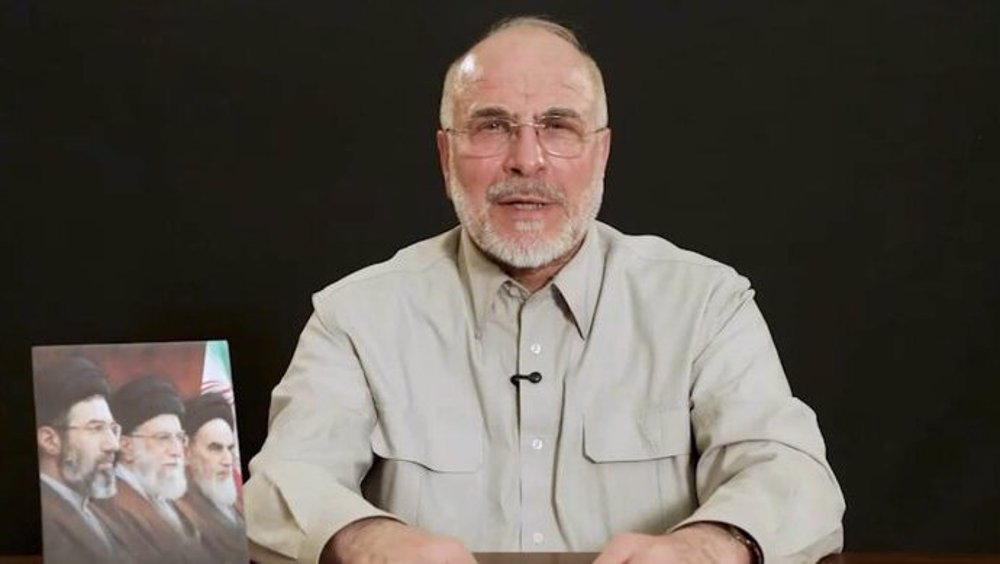
Iranian Parliament Speaker Mohammad Baqer Qalibaf has declared that Iran’s armed forces have not only rebuilt their military capabilities following recent war but have achieved a decade's worth of progress in just 15 months.
In his first direct video address to the Iranian people, Qalibaf assured the nation that the country’s military has emerged stronger and more resilient, driven by indigenous technology and the dedication of its youth.
"In the military arena, contrary to enemy claims, our forces are excellently carrying out the process of rebuilding and strengthening their capabilities," Qalibaf stated. "Whether in rebuilding military equipment or in offensive and defensive arenas, they are advancing in the best possible way. The reason is clear: our technology is indigenous, and the youth of our country are driving the work, without needing to reach out to the enemy."
Asserting that Iran now outpaces its adversaries in reconstruction, Qalibaf warned that any future aggression would be met with overwhelming qualitative and quantitative superiority.
"If I say that in these past 15 months, during which we were almost engaged in two wars, we have made progress and leaps equivalent to a decade, based on the information I have, it is not an exaggeration," he said. "This is the zeal and the blessing of the blood of the martyrs, especially our Martyred Imam."
He pointed to recent engagements, including the 40-day war, as clear evidence of Iran’s evolving air defense and missile capabilities.
"In any future period of war, know that we are more dominant, both in qualitative and quantitative terms, as well as in precision, strikes, and planning."
⚡️ Parliament Speaker Ghalibaf says Iran has made a decade’s worth of MILITARY PROGRESS over the past 15 months.
— Press TV 🔻 (@PressTV) September 1, 2026
Follow https://t.co/boCY50qfi9 pic.twitter.com/o87ic0oSJJ
He also addressed the strategic missile strikes launched against US bases in various countries following the ceasefire and the implementation of the memorandum of understanding (MoU).
"These strikes actually had strategic meanings and led the enemy to the conclusion that they can no longer stop our missiles and our missile firepower."
Absolute control over the Strait of Hormuz
Turning to the Strait of Hormuz, Qalibaf dismissed Western media narratives claiming that the US or its allies control the vital waterway.
He asserted that Iranian forces have complete and definitive control over the strait and will not allow it to be reopened without Iran’s terms.
"We are in a complex, full-scale military war with a powerful enemy," Qalibaf explained. "There have been times when the enemy has had minor successes in passing a few ships, but our military forces are in complete control of the strait and will not allow it to be opened. Whenever they see a move from the enemy, they react with authority and precision."
He mocked the enemy’s attempts to bypass Iranian control, stating, "They are in a defensive position and, despite all their efforts, want to pass a few ships through like thieves and smugglers, which they face our resistance every night."
He also addressed recent clashes in the strait, noting that two Iranian fighters were martyred and several others severely injured. However, he confirmed that Iran delivered a devastating missile response within mere hours.
"The enemy does nothing in its media but lie," Qalibaf said. "If they control the strait, why do they keep repeating every day that the strait is in our hands? If that is the case, why are they worried?"
From 15 demands to a signed MoU
In the diplomatic arena, Qalibaf described the recent memorandum of understanding as a direct translation of Iran’s military and social victories into a political and legal document.
He revealed that the opposing side had initially presented a 15-point draft demanding that Iran abandon its nuclear and missile programs, with no mention of the resistance.
"Today, when you look at these 14 points, you see that they have retreated from all of them," Qalibaf emphasized. "Our resistance and our military arena forced the enemy to retreat, to the point where the President of the United States had to sign this document."
He stressed that just as the signing of the MoU was important, its implementation is equally critical. Acknowledging the historical untrustworthiness of the US, Qalibaf stated that Iran approached the negotiations with pessimism but successfully imposed its rightful demands through the logic of power.
"We will never surrender politically or militarily," he declared.
Furthermore, he highlighted a significant diplomatic achievement with Oman regarding the management of the Strait of Hormuz.
"Based on all international laws and the MoU, the strait must be managed by the coastal countries, which here are Oman and Iran," he said, confirming that the agreement has been reached and will be executed under Iranian management and control, ensuring that third-party countries have no right to interfere.
Warning against hybrid war
Qalibaf warned that having failed in the military and diplomatic arenas, the enemy has now escalated to a hybrid war, heavily utilizing economic pressure, complex psychological operations, and the threat of short, targeted military strikes or assassinations to incite internal unrest.
He dismissed recent threats by the US Treasury Secretary Scott Bessent regarding economic sanctions, comparing the situation to the Persian proverb "a mountain giving birth to a mouse," indicating that the enemy's economic threats amount to much ado about nothing.
However, he issued a stern warning regarding the enemy’s naval blockade. "A naval blockade is certainly considered a military action under international law, and we will certainly respond to it appropriately," Qalibaf said.
"If they want to escalate the blockade, we will no longer wait, and we will certainly take the action that must be taken. We will respond to the naval blockade, which is one of the worst types of military war, militarily."
Concluding his address, Qalibaf called for national unity and vigilance, urging the public and officials not to fall into the enemy’s traps.
"Our people have always been at the forefront and pioneers in all these scenes," he said. "With the planning that has been done and with the cooperation of you, our dear people, we will, God willing, pass through this difficult war as well."
 This makes it easy to access the Press TV website