
By Press TV Website Staff
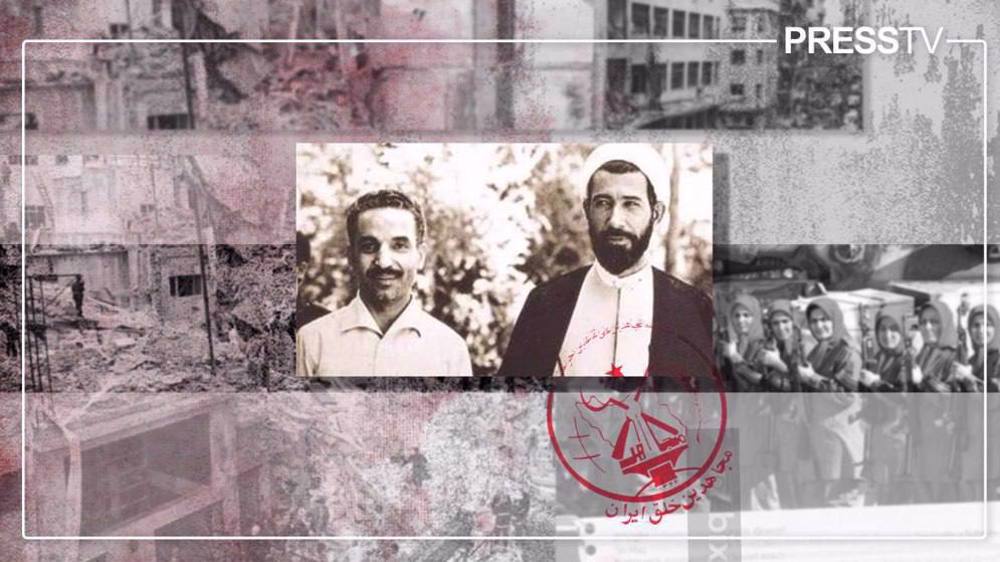
Today, August 30, marks the 45th anniversary of one of the most dastardly and cowardly terrorist attacks in the early years of the Islamic Republic of Iran, when a bombing in Tehran claimed the lives of President Mohammad Ali Rajaei, Prime Minister Mohammad-Javad Bahonar and six other senior government officials.
In Iran, the week preceding the anniversary of their martyrdom is commemorated annually as Government Week, honoring the two great leaders and their service to the country before and after the 1979 Islamic Revolution.
The bombing, which took place on August 30, 1981, was carried out through the infiltration of Masoud Keshmiri, an operative of the Mojahedin-e Khalq (MKO) terrorist group, into Iran’s state apparatus. According to accounts from survivors and witnesses, Keshmiri had concealed an explosive device inside a briefcase and placed it beneath the table during a meeting at the Prime Minister’s office.
How was the bombing carried out?
The attack occurred in the afternoon of August 30, 1981, at the Prime Minister’s office on Pasteur Street in central Tehran.
President Rajaei, Prime Minister Bahonar and a number of senior military and security officials had gathered for an extraordinary meeting when the bomb was detonated.
Keshmiri, who had infiltrated the government while posing as a security official, reportedly served tea to those attending the meeting before placing a briefcase containing the explosive device underneath the meeting table.
Subsequent investigations determined that the briefcase contained a sophisticated bomb loaded with more than one kilogram of TNT. The device bore similarities to the explosive used in the Hafte Tir bombing two months earlier.
Investigators only uncovered the technical characteristics of the explosives used in the two attacks months later. As a result, authorities had not initially possessed sufficient information to identify the methods used or prevent another attack of the same nature.
After planting the bomb, the perpetrator reportedly spoke briefly with Khosrow Tehrani, who headed the intelligence unit at the Prime Minister’s office at the time. He then left the meeting, using an excuse to avoid suspicion.
He made his way toward Pasteur Square, where he reportedly met accomplices who assisted him in reaching a safe location and escaping.
According to testimonies from survivors and eyewitnesses, the massive bomb detonated after one of those present opened the briefcase. The magnitude of the explosion destroyed the first and second floors of the building where the meeting was underway.
Eight people were martyred and 23 others were injured.
The blast left the bodies of Rajaei and Bahonar so severely burned that their identities were subsequently established through dental records, according to reports from that time.
On August 30, 1981, Iran's then-President Rajaei, former PM Bahonar, and six other officials were assassinated by the Mojahedeen-e Khalq (MKO) terrorist group.
— Press TV 🔻 (@PressTV) August 30, 2026
Follow: https://t.co/oa9JV4ikYQ pic.twitter.com/Kjcy81VvfI
Who were Rajaee and Bahonar?
Rajaei and Bahonar were the principal targets of the terrorist bombing. Both had assumed their respective offices only about four weeks before they were assassinated.
Rajaei, a mathematics teacher and graduate of Tarbiat Moallem University, was aged 48 when he was martyred.
Following the victory of the 1979 Islamic Revolution, he became Minister of Education, serving in the position for seven months. He later entered the Islamic Consultative Assembly, representing Tehran, and served as a lawmaker for 15 months.
Rajaei subsequently became prime minister. Following the removal of President Abolhassan Banisadr, he was elected Iran’s second president with a large majority of votes.
A number of major public institutions and infrastructure projects have been named after him, including Teacher Training University in Tehran, a power plant in Qazvin Province, a port in Hormozgan Province and a dam in Mazandaran Province.
Bahonar was an Islamic theologian who studied at the Qom Seminary and later at the University of Tehran, where he earned a doctorate. He was 47 at the time of his martyrdom.
Following the Islamic Revolution, Bahonar served as Minister of Education and was elected to parliament, representing both Kerman and Tehran at different times.
He also became Secretary General of the Islamic Republican Party following the martyrdom of Ayatollah Mohammad Hossein Beheshti.
Bahonar was additionally a member of the Assembly of Experts for the Constitution, the body responsible for drafting Iran’s post-revolutionary constitution.
Rajaei and Bahonar were buried alongside the victims of the Hafte Tir bombing at the Hafte Tir mausoleum in Tehran’s Behesht-e Zahra cemetery.
Six other people were also martyred in the attack. They included Abdol-Hossein Daftarian, the Prime Minister’s chief financial officer, and Vahid Dastjerdi, the head of Iran’s police force.
MKO’s campaign of bombings
While no organization immediately claimed responsibility for the attack on Rajaei and Bahonar, the subsequent investigation identified Keshmiri as an MKO operative who had infiltrated the security apparatus by posing as a security official.
The bombing came just two months after another major MKO terrorist attack in Tehran, targeting a meeting of the Islamic Republican Party (IRP), then Iran’s leading political party.
The June 28, 1981 attack became known as the Hafte Tir bombing, after the date on the Iranian calendar on which it occurred. It was among the deadliest terrorist attacks in the early years of the Islamic Republic and was aimed at destabilizing the newly established system through a campaign of targeted violence.
More than 90 senior officials, including lawmakers and cabinet ministers, were attending the meeting when the bomb exploded. They had gathered to hear a speech by Ayatollah Seyyed Mohammad Beheshti, who was then head of Iran’s judiciary.
The bombing followed another attempted assassination one day earlier.
On June 27, 1981, then-Friday prayer leader Ayatollah Seyyed Ali Khamenei was delivering a speech at Tehran’s Abuzar Mosque when an explosive hidden inside a tape recorder detonated. The attack by MKO operatives severely injured his arm, vocal cords and lungs.
The sophistication of the explosives, the materials employed and the methods used to conceal the devices led Iranian investigators to conclude that foreign intelligence agencies had also played a role in supporting the MKO’s terrorist campaign.
Keshmiri ultimately escaped Iran using a forged passport. Several of his associates were arrested and convicted, while authorities launched extensive security checks among employees of state institutions to identify possible infiltrators.
The precise circumstances of Keshmiri’s subsequent life have never been publicly established. Reports say he escaped to Europe and has continued to live in one of the European countries.
More than four decades later, the August 30 bombing remains one of the deadliest terrorist attacks, while Government Week continues to commemorate Rajaei and Bahonar and their exemplary contribution to the country and an occasion to renew the pledge to continue their unfinished mission.
 This makes it easy to access the Press TV website