Iran will never give up control of Strait of Hormuz at any cost: Expediency Council chief
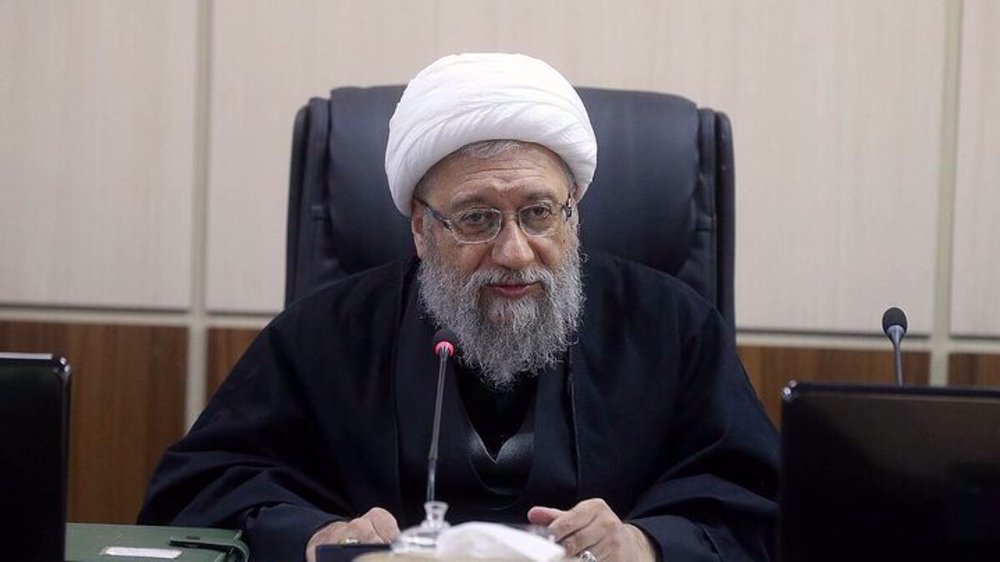
A senior cleric who chairs Iran's Expediency Council has said that the Islamic Republic will not give up its control over the Strait of Hormuz under any circumstances or at any cost.
Ayatollah Sadegh Amoli Larijani, whose body is responsible for settling disputes between Iran's top legislative bodies, said on Sunday that sovereignty over Hormuz belongs to the Islamic Republic.
“We will not retreat at any cost, and the Strait of Hormuz will not return to its previous conditions,” he stated.
Iran began restricting transit through the Strait of Hormuz, a key waterway in the Persian Gulf responsible for a fifth of global oil supply, in early March, days after the United States and the Israeli regime launched a joint war of aggression against the country.
Iran and the US signed a memorandum of understanding (MoU) in June that allowed Iran to manage the strait and gradually return transit to normal levels, in return for the US lifting its sanctions and blockade on the country.
However, Iran reinstated restrictions in Hormuz after the US violated the terms of the MoU by seeking to undermine Iran's management over the strait.

Ayatollah Larijani said the only way for transit in Hormuz to return to normal is for the US and its allies to accept Iran's mandate to control the waterway.
“If they seek free passage, they must comply with the terms of the MoU,” he said.
The senior cleric, who led the Iranian judiciary for 10 years until early 2019, said that the US has been trying to pressure Iran through naval blockades and by restricting its access to international trade.
“The Iranian nation is indomitable, and further oppression will only be to your own detriment,” Amoli Larijani said while addressing the US and its allies.
Iran is engaged in separate negotiations with Oman, a longtime regional mediator with close ties to both Tehran and Washington, to manage Hormuz.
The talks aim to establish a new legal framework and mechanism for shipping through the strait, including the designation of a temporary navigation route that could later form the basis for a permanent arrangement.
However, Iranian officials have stressed that reaching an understanding with Oman does not automatically guarantee the full reopening of the strait.
Iran dismisses new UK sanctions on banks as having no practical effect
IAEA inspectors cannot return to Iran amid US threats: Russia
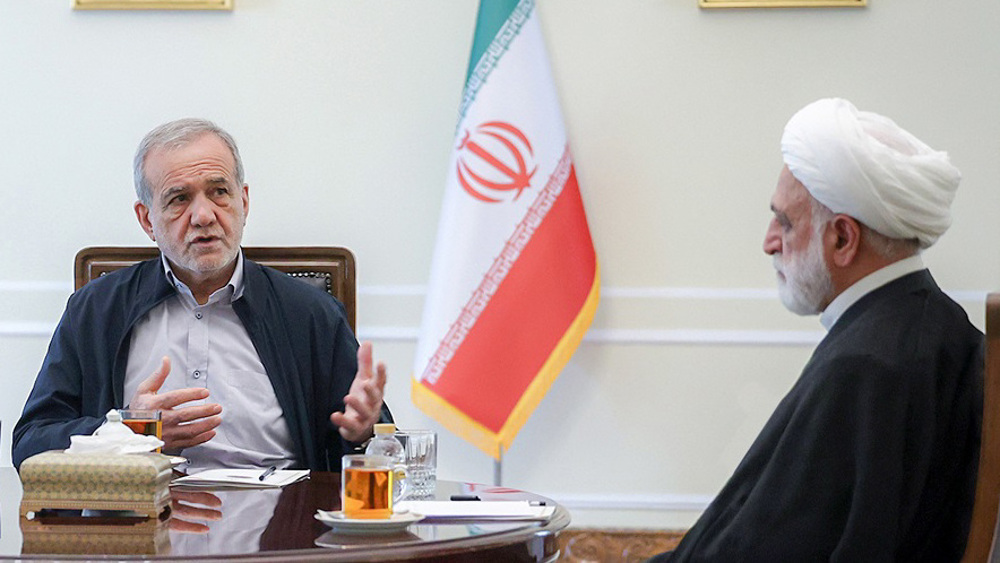
Pezeshkian’s strong UN speech exposed US-Israeli crimes: Judiciary chief



Netanyahu flies over France, Italy, Greece, Canada despite ICC arrest warrant
VIDEO | News Review: Iran’s president at UNGA says Islamic Republic is victim of US, Israeli terrorism
VIDEO | Press TV's news headlines
VIDEO | Between diplomacy and obstruction: Battle over Gaza's reconstruction plan
VIDEO | Afghanistan-Pakistan tensions escalate as Islamabad launches fresh airstrikes on border areas
'Dirty weapon’: Kata’ib Hezbollah urges Iraqis to break US siege on Iran
Qalibaf takes swipe at US economy as Treasury yields hit 10-year highs
Araghchi, Ukrainian counterpart discuss dialogue amid bilateral tensions


 PressTV NEWSLETTER
now
PressTV NEWSLETTER
now
 This makes it easy to access the Press TV website
