Filling the giants’ shoes in Iran’s auto industry
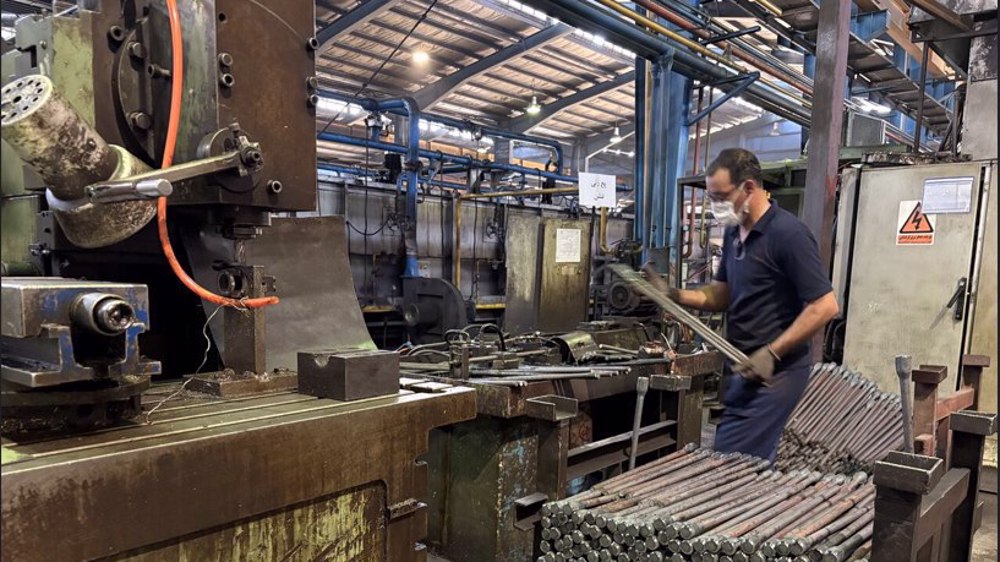
The first thing that catches the eye inside the production hall of Zar Spring Manufacturing in Golpayegan is the orderly rows of dark, heavy alloy-steel bars waiting to be cut.
Within hours, these pieces of steel will pass through cutting, forming, machining, heat treatment and precision inspection before emerging as springs and other components used in vehicle suspension systems.
Hidden beneath the body of a car, a spring is easy for an ordinary driver to overlook. For the automotive industry, however, its production is part of a supply chain that must operate with precision and continuity.
Springs absorb shocks from uneven roads, help maintain a vehicle’s balance and contribute to stable handling.
A weakened or broken spring can compromise a vehicle’s stability and control, particularly on bends and uneven surfaces, turning a seemingly minor component failure into a serious accident and, in the worst cases, loss of life.
The quality of the alloy steel, the accuracy of forming and machining, heat treatment, testing and protective coating all affect the final product. A disruption at any stage can raise costs, delay deliveries or interfere with vehicle production.
That is why the ability of an Iranian factory to carry out the full production of such a vital component using domestic capabilities is an important economic development.
The issue carries particular weight in Iran, whose automotive industry has spent decades developing domestic production while dealing with foreign restrictions, exchange-rate pressures and disruptions in access to overseas technology and components.
These pressures have encouraged the expansion of domestic parts manufacturing and gradually shifted a significant part of the automotive supply network toward Iranian suppliers.
Data from the International Organization of Motor Vehicle Manufacturers show that Iran has ranked among major vehicle-producing countries, with more than 1.5 million vehicles produced in 2017.
The importance of the sector therefore extends well beyond vehicle assembly, encompassing steelmakers, parts manufacturers, machinery producers, engineering companies and distribution networks.
In such a structure, the depth of the domestic supply chain becomes an important factor in industrial resilience.
The greater the share of materials, components and production processes supplied domestically, the less exposed manufacturers are to disruptions in foreign trade provided domestic suppliers can maintain the required quality, price and delivery capacity.
Iran has experienced the consequences of supply-chain vulnerability directly. The World Bank reported that after sanctions intensified, Iranian vehicle production fell from around 1.6 million units before the sanctions to roughly 700,000, with import restrictions, currency depreciation and difficulties obtaining foreign parts and equipment among the main causes.
For automakers, therefore, the availability of components is not simply a procurement issue. A critical imported component can turn exchange-rate fluctuations, payment restrictions or transportation disruptions into production problems.
Zar Spring Manufacturing illustrates how domestic production can provide an alternative.
According to CEO Alireza Pouyan, the company has developed production capabilities for various springs and components used in vehicle suspension and power-transmission systems.
Its alloy-steel raw material is supplied by Iran Alloy Steel in Yazd. The connection between Yazd and Golpayegan demonstrates the broader economics of localization.
Specialized alloy steel is produced at a domestic facility, transported to a parts manufacturer, transformed into a higher-value component and then delivered to an automaker or the aftermarket.
At each stage, employment, investment and technical expertise remain within the country.
Dependence on imported raw materials or finished components exposes producers to exchange-rate movements, payment restrictions and interruptions in international trade.
Iran’s automotive industry experienced this vulnerability directly after foreign companies withdrew from the country.
Peugeot and other French manufacturers left Iran after the reimposition of US sanctions in 2018, disrupting established production and supply arrangements.
Peugeot had previously been producing hundreds of thousands of vehicles in Iran through cooperation with Iran Khodro and Saipa.
The withdrawal was accompanied by difficulties in obtaining components and completing international payments. The same problem affected other manufacturers.
Deliveries of parts for Volvo and Scania trucks, for example, were disrupted in 2018 because suppliers faced difficulties receiving payments from Iranian customers. The result was pressure on the domestic industry to find alternatives.
Iranian manufacturers increasingly turned toward domestic suppliers, while parts producers expanded their capabilities and began taking on components that had previously depended on foreign sources.
The growth of domestic sourcing has continued. Purchases from Iranian parts manufacturers by major automakers have increased, with domestic procurement by Saipa and Bahman Group recording significant growth.
The increase has been driven in part by the shrinking availability of foreign alternatives and the sharp rise in the cost of imported goods.
For manufacturers such as Zar, completing more stages of production inside the country therefore becomes both an industrial and economic strategy.
For an automaker, however, a component must meet required standards, be produced in sufficient volume and deliver consistent performance. Otherwise, savings from reduced imports can be offset by rejected parts, repairs or quality problems.
Quality control is therefore an integral part of the production process at Zar. All products undergo non-destructive magnetic particle inspection, or MPI, to detect surface cracks.
The plant also operates two heat-treatment lines serving the aftermarket, helping ensure that locally produced components can be manufactured consistently and in large volumes.
Iran's automotive industry has consequently moved beyond the simple question of whether a component can be produced domestically. The next challenges are improving quality, reducing costs, developing technology and expanding into new markets.
Domestic parts manufacturers have completed the localization of components for the P90 project, which aims to revive the former L90 platform, and the project has entered the production stage.
They are also working on complex components for Iran's Shahin passenger car, forming processes for the G68 vehicle project, and the mass production of tension bars for the Quick and Saina passenger car families.
At Zar Spring Manufacturing, alloy steel comes from Yazd, technology has drawn on foreign industrial experience, production and quality control take place in Golpayegan, and the finished component moves to automakers or the aftermarket.
The chain offers a practical picture of industrial self-reliance, based on developing sufficient domestic capacity to keep critical production operating when external links are disrupted.
The power of education in Iran’s 85% domestic stationery industry
ECO can play greater role in regional peace, economic integration: Araghchi
Iran says international flights continue despite US sanctions pressure



‘Not just a catch, an intelligence prize’: IRGC spokesman hails seizure of second US underwater dron
Arab League slams dangerous Israeli escalation at al-Aqsa Mosque and across West Bank
VIDEO | Martyr Nasrallah made people believe in possibility of victory, liberation: Political activist
VIDEO | Nasrallah's leadership was based on resistance, liberation, national unity: Analyst
UK police evacuate homes near airbase used by US over bomb threat
US just 'gaslighting' over Hormuz: Iran's Parliament speaker
VIDEO | Press TV's news headlines
Reyhaneh Karimi makes history with Iran’s first women’s weightlifting medal at Asian Games


 PressTV NEWSLETTER
now
PressTV NEWSLETTER
now
 This makes it easy to access the Press TV website
