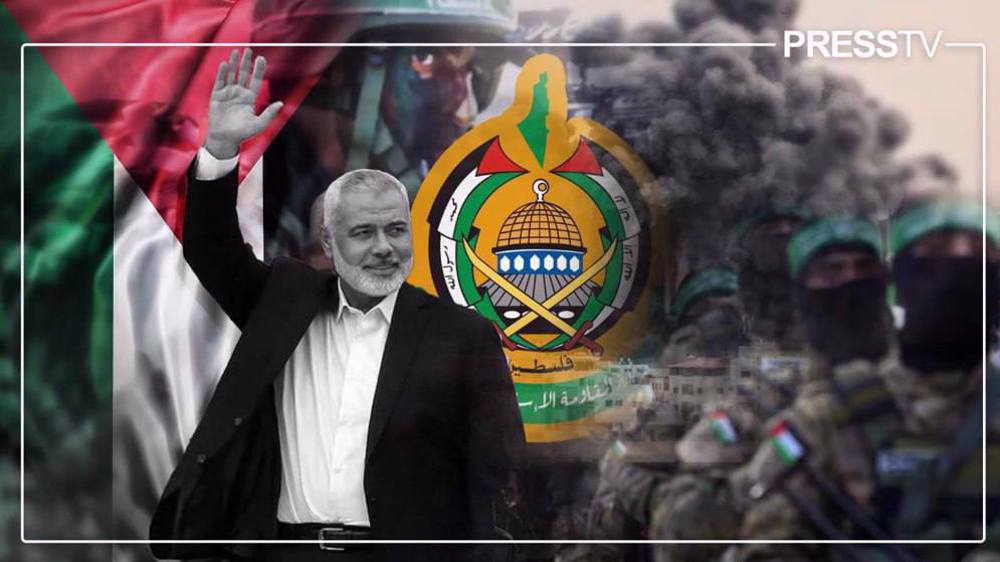
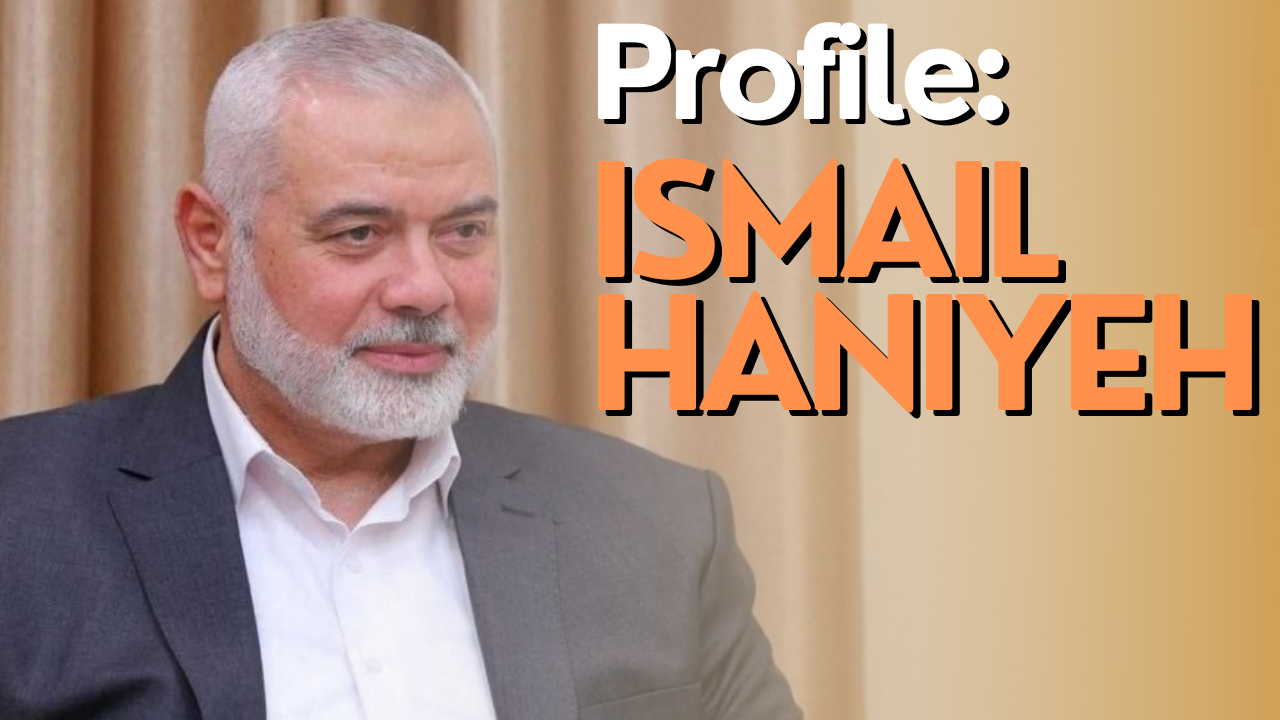
Ismail Haniyeh's enduring vision of resistance and road to liberation, two years after his martyrdom
By Burhan Abidi
On October 7, 2023, the world witnessed a seismic shift in the Palestinian struggle for the liberation of occupied territories from decades of illegal Israeli occupation and apartheid.
Operation Al-Aqsa Flood was not an ordinary military operation. It was, in the words of Ismail Haniyeh, "the beginning of the disappearance of the occupation of our (Palestinian) land."
Haniyeh, the former leader of the Palestinian resistance movement's political office, who played a key role in the October 7 operation, was assassinated in Tehran on July 31, 2024.
In the ten months that followed the Operation Al-Aqsa Flood, before his assassination, Haniyeh articulated a vision of resistance, sacrifice, and ultimate victory that transcended his own life. His words, spoken through resistance and defiance, offer a window into the just Palestinian cause.
When the resistance fighters of Hamas broke through the walls of Gaza's open-air prison on October 7, Haniyeh understood immediately that history had turned a corner.
"We are on the verge of a great victory and a clear conquest on the Gaza front," he said on that first day. "The battle has now moved into the heart of the Zionist entity."
It marked the momentary but significant end of decades of occupation, siege, and humiliation of Palestinians. "Enough is enough," Haniyeh declared at the time. "The cycle of intifadas and revolutions in the battle to liberate our land and our prisoners languishing in occupation prisons must be completed."
For Haniyeh, the operation was fundamentally about the freedom and dignity of Palestinians. The resistance had warned repeatedly that it would not remain silent in the face of provocations at al-Quds and the al-Aqsa Mosque.
When the world kept silent, including the Arab countries, the resistance spoke through decisive action on the ground. From the earliest days of the historic and unprecedented operation, Haniyeh was clear in identifying the regimes arrayed against Palestine
"What Israel is doing is with the support of the US and Western countries based on the issue of double standards and lies," he declared on October 14. "The US administration is giving everything it can to Israel."
As the US-backed Israeli genocidal war against Gaza unfolded, Haniyeh pointed to the evidence mounting before the world's eyes.
"The United States is the main axis of the Israeli war on Gaza," Haniyeh stated on November 24. The world watched as American weapons rained down on Gaza's neighborhoods, hospitals, and schools. "All the civilians killed in Gaza—thousands, tens of thousands of martyrs—were killed with US weapons, with US rockets, under US political protection."
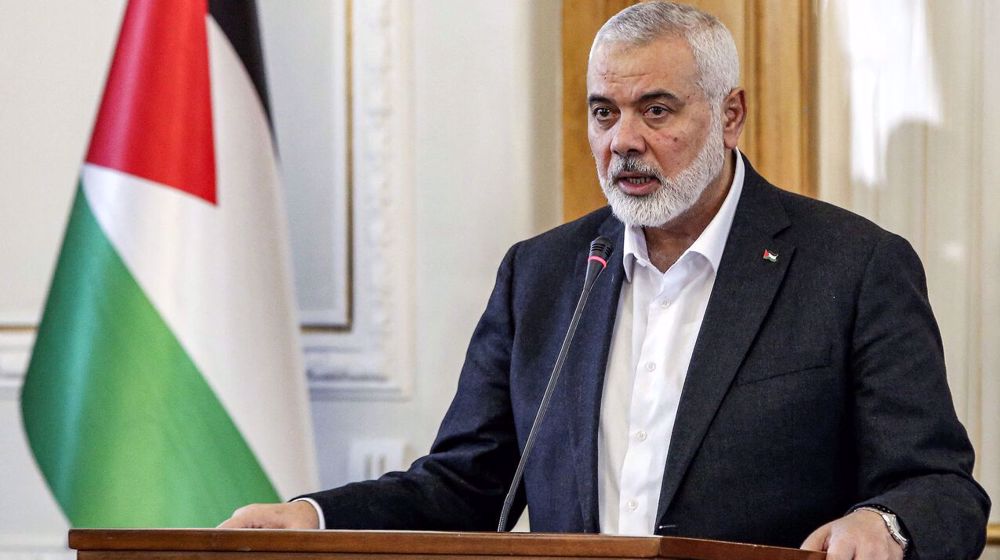
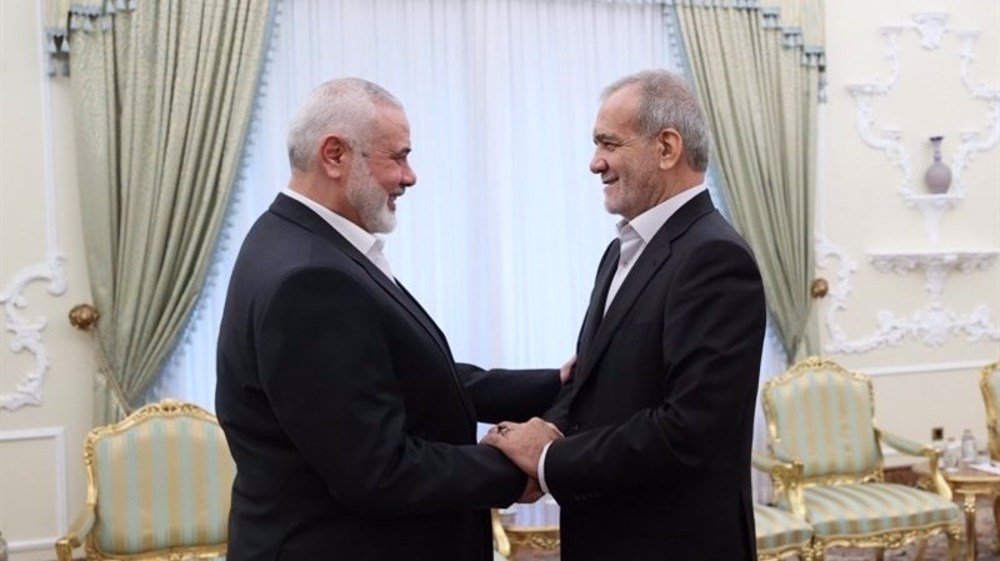
On July 31, 2024, Ismail Haniyeh, head of the political bureau of the Palestinian resistance movement Hamas, was assassinated in Tehran by an Israeli attack, just hours after attending the inauguration of Iranian President Masoud Pezeshkian.
— Press TV 🔻 (@PressTV) July 31, 2026
Follow: https://t.co/mLGcUTS2ei pic.twitter.com/xeGAVoSA9c
The multiple American vetoes of ceasefire resolutions at the UN Security Council revealed the truth behind Washington's unflinching and unapologetic support for the genocidal war.
"What does the US veto of the ceasefire resolution at the UNSC mean?" Haniyeh remarked at the time. "It means that the US is giving full protection and umbrella to the continuation of massacres and murders in Gaza."
The UN General Assembly vote where 120 countries called for a ceasefire represented, in his view, a "political victory" achieved through resistance on the battlefield and showed the US dominance over the international order had irreversibly diminished.
On October 31, weeks after Operation Al-Aqsa Flood, which was followed by an all-out genocidal assault, he noted that "the amount of explosives used against the residents and residential areas of Gaza exceeds the volume of the atomic bomb dropped by the United States on Hiroshima."
The Israeli regime, he asserted, was committing "barbaric massacres against unarmed civilians." This villainy, he warned, would not save them from defeat. "The massacres being committed by the Zionist regime are a clear manifestation of the quagmire that the occupying regime and its ground forces are bogged down in."
He catalogued the crimes, including hospitals bombed, schools and universities destroyed, bakeries and pharmacies targeted. "For over five months, nothing entered Gaza," he stated in April 2024. "Hunger was used as a weapon to break the people's will and to pressure them to migrate from north to south."
He spoke of mass graves discovered daily across Gaza, of children dying from starvation, of a people subjected to ethnic cleansing. Yet through all of this, Haniyeh maintained that Israel was failing and the resistance was winning.
"The declared goals of the war on Gaza are to eliminate the Hamas movement, have their captives back and carry out the displacement plan," he said on January 9, 2024. "I tell you that the enemy, despite the destruction and massacres, has failed to achieve any of the goals of the war."
Israel, he maintained at the time, had not eliminated Hamas. It had also failed to retrieve its captives through force. It had failed to force Palestinians to leave Gaza. What it had done was expose its bloodthirsty nature to the entire world.
Perhaps the central theme of Haniyeh's statements before and after Operation Al-Aqsa Flood was the unwavering resilience of the resistance in the face of genocide and the brutal campaign of extermination.
"The resistance front is fighting an honorable battle in defense of Palestinians and their sanctities," he declared on November 17, 2023. "These resistance fighters will eventually emerge triumphant in the Gaza war."
He was clear about the nature of the war and decades of occupation and apartheid. "If the Zionist enemy desires a long battle, our capacity is much higher than its, and our resistance fighters will act decisively in this regard."
The resistance, he insisted, was engaged in a strategic war and would be "the sole party emerging victorious."
The history of Palestinian resistance, for Haniyeh, demonstrated an unbreakable spirit. Following the assassination of many senior leaders of the movement, it did not break but only became stronger and more determined.
"A movement that offers its leaders and founders as martyrs for the dignity of our people and nation will never be defeated," he declared after the assassination of Saleh al-Arouri. "These attacks only strengthen the resolve, resilience, and unwavering determination of the resistance."
He categorically rejected any suggestion that Hamas could be eliminated by the US-Israeli war machine. "The resistance movement cannot be eliminated because it exists across the homeland and abroad as well as in the conscience of the Muslim Ummah and the world's free people."
As he asserted, Hamas is a mass movement rooted in the lived reality of occupation in Palestine and the universal desire for freedom.
For Haniyeh, the resistance was also morally superior to its enemy. "The resistance fighters, unlike the enemy, do not target civilians, children, or elderly people." This distinction, he believed, was fundamental to understanding the war.
Haniyeh's words carried particular weight because of the personal price he paid. He was on the frontline, and so was his family. He lost nearly 60 members of his family to Israeli airstrikes since October 7, 2023. Three of his sons and three grandchildren were killed in a single attack in April 2024. His response was remarkable in its defiance and patience.
"I thank Allah for this honor that He bestowed upon us through the martyrdom of my three sons and grandchildren," he said. "With this pain and blood, we create hope, a future, and freedom for our people, our cause, and our nation."
"We say to the occupation that this blood will only make us more steadfast in our principles and adherence to our land."
He stated that the Israeli regime was delusional to think it will make the Palestinians change their position by killing their children and family members. "Killing their sons would only make Hamas fighters more steadfast in their principles. My children stayed with our people in the Gaza Strip and did not leave the besieged territory."
While Haniyeh was open to negotiations, he was uncompromising about the fundamental demands of the Palestinian people and their dignity.
"The resistance will not be satisfied with anything less than a complete cessation of aggression, the withdrawal of the occupying army from Gaza, and the lifting of the oppressive siege," he asserted.
He articulated the clear conditions, which included a permanent ceasefire, complete Israeli withdrawal, return of displaced people to their homes, reconstruction of Gaza, lifting of the siege, and a serious prisoner exchange.
"There will be no agreement with the Israeli regime before the full cessation of its aggression against the Gaza Strip and the withdrawal of its forces from the territory."
Haniyeh rejected any arrangement for Gaza that excluded Hamas and other resistance groups, and said any arrangement for Gaza after the war ends that does not include Hamas as well as other Palestinian factions was an illusion.
The resistance, he insisted, would remain "faithful to the Palestinian people and their legitimate aspirations and will continue to guard Gaza."
He also warned against false compromises. "The enemy will not succeed in its goals and the castles will not fall," he said. "What the enemy failed to attain through killing, destruction, and genocide, cannot be achieved in the course of negotiations."
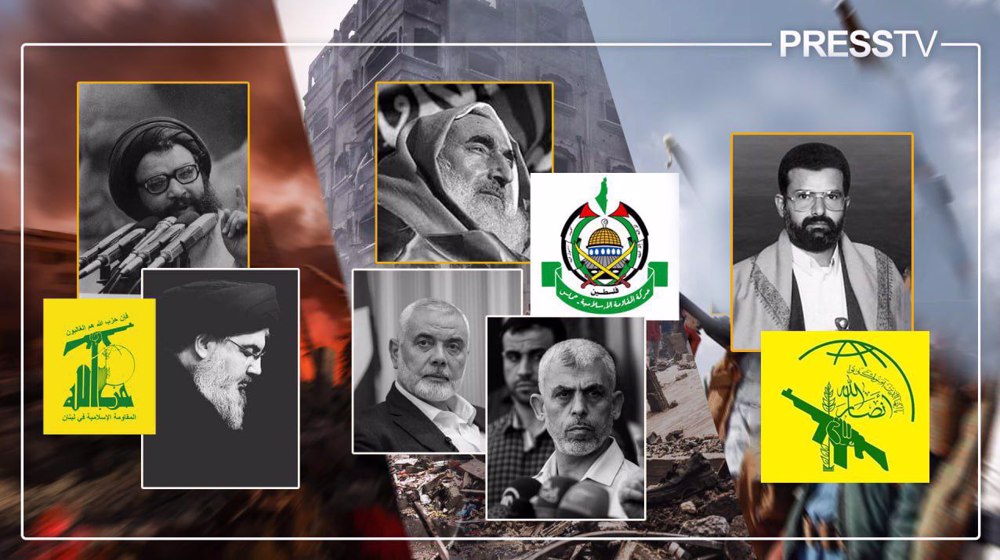
Haniyeh never failed to acknowledge the role of Iran and members of the resistance axis in supporting the Palestinian struggle.
For example, on November 24, 2023, he expressed "gratitude for the firm support of the Leader of the Islamic Revolution, the president, the government and the people of Iran, as well as the active diplomatic support of the Iranian FM for the Palestinian issue and its people."
He also extended this gratitude to Lebanon's Hezbollah, Yemen's Ansarullah, and resistance groups in Iraq and Syria. Their support, he said, "bears a clear message to the Zionist regime and the US" that the resistance was part of a regional front confronting Western hegemony.
✍️Viewpoint: Ismail Haniyeh's illustrious legacy, which Israel didn't kill, will inspire freedom-seekers
— Press TV 🔻 (@PressTV) August 1, 2024
By Wesam Bahranihttps://t.co/CMv9L4I3Dc
On March 26, 2024, he stated that "the support Iran has provided to the Palestinian cause and the people in Gaza during the ongoing war is praiseworthy." Iran's support, he believed, "raises the morale of the Palestinian resistance fighters."
Haniyeh understood the broader strategic importance of this alliance. "Palestinian resistance today stands on the front line against Western hegemony," he declared on July 30, 2024, a day before his assassination. "The enemy seeks to dismantle this front line to impose its policies and dominate the region, aiming to bring the resistance to its knees."
He identified Iran's role as critical in this confrontation: "This underscores the critical strategy of the Islamic Republic of Iran in supporting resistance and countering the influence of regional representations of arrogance, notably the Zionist regime."
In his final statements, Haniyeh projected unwavering confidence in the ultimate outcome. "Palestinian people and resistance fighters must establish their heroism and victory against Israel," he said on July 30, 2024. "The regime's genocidal war on Gaza has reached a critical and historical stage after 300 days."
He saw Israel's aggression as the death throes of a dying settler-colonial project. "Israel's image has been shattered and it has become unprecedentedly isolated," he declared. "Israel poses a danger to the entire Arab and Muslim region."
The regime, he asserted, was a "spoiled child of the West," and its moral bankruptcy was now visible to all. The path forward, for Haniyeh, was clear: "The resistance is the sole solution for the Palestinians to get rid of the Israeli regime's vicious acts."
Haniyeh was assassinated on July 31, 2024. In his final month, he spoke with the clarity of a leader who knew the stakes were high. He had lost family, endured occupation, and witnessed unimaginable suffering, but he never wavered.
The Hamas leader left a legacy not merely of political leadership, but of steadfastness in the face of overwhelming odds. He articulated a vision of Palestine free from occupation, a people united in resistance, and a future built on the sacrifices of the martyrs.
"With this pain and blood, we create hope, a future, and freedom for our people, our cause, and our nation," he declared after the killing of his three sons, demonstrating he valued the Palestinian cause above personal losses.
The resistance, he insisted, would continue. The movement that offers its leaders as martyrs cannot be defeated. And the cause – the liberation of Palestine – would ultimately prevail. That was his conviction, and he died believing it.
Burhan Abidi is a Karachi-based writer and political analyst with focus on Palestine and resistance movements.
(The views expressed in this article are author’s own and do not necessarily reflect those of Press TV)
Yemen's control of Bab al-Mandab 'deepens crisis' in Israel
US senator slams ‘bogus’ spy claims, demands immediate release of Press TV journalist
Israeli occupation court extends detention of Press TV journalist Naqaa Hamed



CPJ slams Israel’s abduction of Press TV journalist, demands her immediate release
‘Stop your crocodile tears’: Araghchi hits back at French FM over human rights allegations
Trump bars CNN, MS NOW and Politico from White House as they question his pro-war policies
Discover Iran: Tabriz, where Iran’s Silk Road legacy meets industry, trade and a new economic future
Sirens blare in Riyadh, across Saudi Arabia amid amid Yemeni retaliatory strikes
New images reveal severe destruction at US base in Kuwait after Iranian strikes
Israeli strike on motorcycle kills Palestinian in Gaza City, injures child
VIDEO | Russians head to polls as 3-day parliamentary elections kick off


 PressTV NEWSLETTER
now
PressTV NEWSLETTER
now
 This makes it easy to access the Press TV website
