
By Wang Hao
I never imagined that my bond with Iran would deepen in such a solemn way.
At the invitation of the Islamic Culture and Relations Organization of Iran, I traveled to Tehran earlier this month to attend the state funeral of the martyred Leader of the Islamic Revolution, Ayatollah Seyyed Ali Khamenei.
As a Chinese historian, poet, and artist, I came with a long-standing admiration for this ancient land, and I departed after more than ten days filled with indelible sights, sounds, and reflections. Now, as I take up my pen, many moments remain vividly alive.
The farewell at Mosalla: A nation's heart laid bare
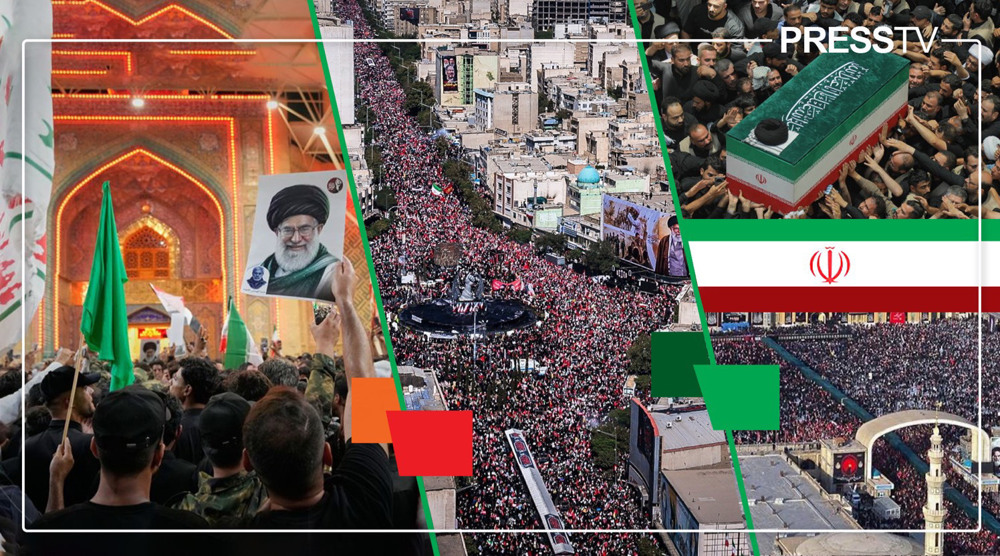
The most sacred moment of my journey took place on July 3rd, when I joined religious leaders and dignitaries from around the world at Tehran's Imam Khomeini Mosalla. There, we gathered to pay our final respects to Ayatollah Khamenei and his family members.
The hall was enveloped in a profound and solemn stillness. Solemn music filled the vast space — not the music of performance, but the music of collective grief, of a nation bidding farewell to its father.
As I stood among the sea of mourners, watching the endless stream of Iranians — young and old, men and women, rich and poor — approach the coffins with tears streaming down their faces, I understood something essential: Ayatollah Seyyed Ali Khamenei was not merely a political leader to these people. He was a spiritual father, a guide, a poet whose words had shaped their innermost thoughts, a scholar whose teachings had illuminated their path.
In that hallowed space, I reflected deeply on the nature of his leadership and legacy. Ayatollah Khamenei was, by all accounts I had gathered, a man of rare and remarkable gifts — a statesman of profound strategic vision, a religious scholar of exacting rigor, and a poet whose verses spoke directly to the Persian soul.
The grief I witnessed was not manufactured; it was as real and as deep as the ancient roots of this land. It was the grief of a people who had lost not just a leader, but the living embodiment of their dignity and their defiance in the face of decades of pressure and isolation.
As a Chinese, I could not help but think of our own tradition of reverence for great figures who have guided the nation through darkness.
The emotion in that mosque was a testament to something that transcends politics — a bond between a leader and his people forged in shared struggle and shared faith. I left the Mosalla that day with a far deeper understanding of what Ayatollah Khamenei meant to Iran, and what Iran means to itself.
A Historic First: 43 million gathered for the funeral of martyred Leader Ayatollah Khamenei, marking the largest mass mourning in recorded history.
— Press TV 🔻 (@PressTV) July 10, 2026
Follow Press TV on Telegram: https://t.co/LWoNSpkJSh pic.twitter.com/Q2SPnAE2mV
First impressions of Tehran: The deep affection and dignity of a nation
During those first days in Tehran, the entire city was shrouded in solemnity. Black flags hung low along the streets, and enormous portraits gazed upon the crowds who came to bid farewell. Standing among them, I watched Iranians of all ages and appearances — Seyyeds in black turbans, modestly dressed bazaar merchants, young mothers holding their children's hands — converge from every direction to say goodbye to their spiritual leader.
In that moment, I felt profoundly that this was not an orchestrated ceremony, but an emotion growing from the very soil of the land.
As a Chinese person, this feeling is not unfamiliar to me. Our nation, too, harbors a deep reverence for those sages and figures who embody the spirit of our people. On the streets of Tehran, I sensed a resonance of emotion that transcends civilizational boundaries.
Poetry: A shared language between two ancient civilizations
Of all the moments during my brief stay in Iran, the one that moved me most was an evening devoted to Persian poetry.
An official of the Islamic Culture and Relations Organization invited a few foreign friends and me to his room for tea. The room was covered with Persian carpets; we removed our shoes, entered, and sat on the floor. As the fragrance of tea rose around us, he began to recite from Ferdowsi's Shahnameh, and then effortlessly quoted verses of Saadi and Hafez.
In that moment, he was breathing naturally, in a language that flows in his blood.
I told him that in China, we recite Tang and Song dynasty poetry in just the same way. Li Bai, Du Fu, Su Shi — these names are to the Chinese what Ferdowsi, Saadi, and Hafez are to Iranians. We smiled at each other, and in that instant, two ancient civilizations found their simplest yet most profound resonance.
It is the Islamic Culture and Relations Organization, under the leadership of its president, Mr. Mohammad Mahdi Imanipour, which fosters such civilizational dialogue. For years, they have dedicated themselves to presenting Iran's culture and faith to the world, establishing cultural centers and dispatching cultural attachés across nations.
I understand that this is not merely cultural dissemination, but an endeavor — beyond the dominant Western discourse — to find an autonomous voice for an ancient civilization. China is engaged in a parallel endeavor.
✍️ Viewpoint - How Imam Khamenei’s historic funeral demolished American, Israeli, Pahlavi, MKO narratives
— Press TV 🔻 (@PressTV) July 15, 2026
By Shabbir Rizvihttps://t.co/cm8EI9Ocs7 pic.twitter.com/JrTRyPuSvQ
From the bazaar to the Technology Park: A nation advancing under pressure
In Tehran, I also wandered through traditional bazaars and modern shopping malls. I experienced firsthand the renowned warmth and shrewdness of Persian merchants — in the friendly back-and-forth of bargaining, I purchased gifts for my family and felt the subtle art of "face" in commercial dealings. This wisdom of balancing grace and the protection of interests is a profoundly charming aspect of Iranian culture.
I also visited a technology park on the outskirts of Tehran, where several hundred companies are gathered and young engineers strive to innovate amid sanctions and isolation.
I deeply understand that this resilience — the determination to maintain scientific independence under external political and economic pressure — is a microcosm of the indomitable Iranian spirit. As a visitor from a country that has likewise endured technological blockades, I hold genuine respect for this.
Bonds of faith: The revelation of Najaf and Karbala
During my trip, I learned that the martyred Iranian Leader’s coffin was taken to the holy Islamic cities of Najaf and Karbala in Iraq, the spiritual capitals of the Shia world. The scenes of Iraqi citizens lining the streets to receive it were profoundly moving.
I am aware of the eight-year war and the wounds it left between Iran and Iraq. Yet, the scenes on the streets of Najaf today tell us that a connection grounded in shared faith and shared spiritual pursuit can transcend historical grievances, bridging differences of ethnicity and language.
This was not merely a farewell to a religious leader; it was a community's reaffirmation of its spiritual core. It prompted me to reflect: in a modern world of nation-states, such border-transcending spiritual bonds may hold a key to understanding the deep logic of West Asian politics.
Imam Khomeini's residence and religious coexistence
Our itinerary also included Imam Khomeini's former residence in northern Tehran. Standing in that modest room, I tried to imagine from what kind of place the revolution that transformed Iran — and West Asia — had begun more than four decades ago.
We were also arranged to visit a synagogue. In a country where Islam is the state religion, the Jewish community still maintains its space of worship.
This brought to mind Iran's long historical tradition — from Cyrus the Great freeing the Babylonian captives, to the coexistence of multiple faiths during the Sasanian era. Iran's historical experience in this regard deserves the world's earnest attention.
WATCH: To a steadfast nation, Martyr Khamenei was also the spiritual father
— Press TV 🔻 (@PressTV) July 11, 2026
Follow https://t.co/B3zXG73Jym pic.twitter.com/aOAkl4mtsR
China and Iran: A dialogue between ancient civilizations in the contemporary era
During my stay, I was invited to deliver a lecture at the headquarters of the Islamic Culture and Relations Organization, titled "China and Iran: Parallels and Interweavings of Civilizations."
I spoke of the exchanges between the Persian and Chinese civilizations across the long river of history — from the caravans on the Silk Road to the mutual nourishment of music and poetry. I also spoke of the similar fates our two nations have faced in modern times, in responding to Western pressures and in the pursuit of national independence and rejuvenation.
After the lecture, an Iranian scholar said to me, "The challenges we face are not the same, but we understand each other." That sentence encapsulates the deepest insight of my journey.
China and Iran, as two great "civilization-states," have much to understand about each other in the contemporary international landscape. Of course, our development paths are not identical — China has chosen to reform and develop within the existing international system, while Iran has adopted the path of resistance. Yet it is precisely this "harmony in diversity" that renders our dialogue all the more meaningful.
To the people of Iran, I offer my respect
On the early morning of my departure from Tehran, I looked back through the car window at the city. I thought of that poetry-reciting official, of the elderly people silently weeping at the funeral, of the determined young engineers in the technology park, and of the merchant in the bazaar who tried so hard to explain the price in Persian and finally concluded our deal with a smile.
But most of all, I thought of that solemn morning at the Mosalla, standing before the coffin of a man who had shaped the destiny of a nation. I thought of the music that seemed to carry the weight of an entire civilization's sorrow and pride. And I thought of the faces in the crowd — faces that told me this was not the grief of subjects for a ruler, but the grief of children for a father.
Iran is a country that nourishes its soul with poetry, coheres its community through faith, and confronts pressure with resilience. The Iranian people are a people who never retreat when their dignity is challenged, and who show boundless warmth and courtesy before their guests.
In their love for Ayatollah Khamenei, I saw the love of a people for their own highest ideals — for justice, for dignity, for the right to chart their own course in the world.
As a visitor from an ancient Eastern civilization, as a lover of poetry and history, I extend to the Iranian people my sincere respect. I believe that as long as civilizations continue to converse, as long as poetry is still sung, we shall possess the ability to find, amid the complexities of the international situation, a path that leads to each other's hearts.
Professor Wang Hao is a Chinese historian, poet, and artist. He also serves as a council member of the China Association for International Friendly Contact. He was recently in Tehran to participate in the funeral for the martyred Leader of the Islamic Revolution.
(The views expressed in this article do not necessarily reflect those of Press TV)
 This makes it easy to access the Press TV website