Qalibaf: Iran will not let US interfere in Hormuz, US-Israeli war failed
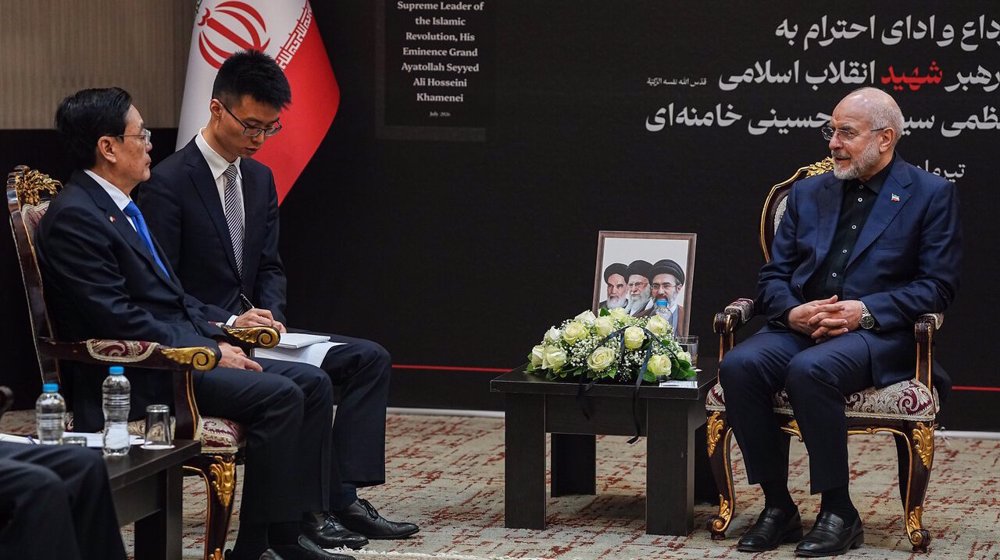
Parliament Speaker Mohammad Bagher Qalibaf says Iran will not allow any US intervention in the Strait of Hormuz, while declaring that the recent US-Israeli war against Iran failed to achieve its objectives.
Qalibaf made the remarks during separate meetings with senior officials from China, Belarus and Turkmenistan on the sidelines of funeral ceremonies for Leader of the Islamic Revolution Ayatollah Seyyed Ali Khamenei, which have drawn high-level foreign delegations to Tehran.
"I state clearly that the Islamic Republic of Iran will not allow any US interference in the Strait of Hormuz," Qalibaf said in a meeting with He Wei, vice chairman of the Standing Committee of China's National People's Congress.
Qalibaf said Iran has ensured the smooth passage of Chinese vessels through the strategic waterway and that Tehran and Muscat have agreed, under Article 5 of the Islamabad Memorandum of Understanding, to regulate maritime traffic through the strait.
“The conditions facing Iran and China in regional affairs have changed, and we hope to deepen communications between our two countries,” Qalibaf said, adding that closer strategic ties would help reduce global tensions.
He added that Washington continues to pursue unilateral policies worldwide, making closer political and economic coordination between Tehran and Beijing increasingly important.
He Wei, Vice Chairman of the Standing Committee of China's National People's Congress, and Igor Sergeyenko, Chairman of the House of Representatives of Belarus, met with Iran's Parliament Speaker Ghalibaf on the sidelines of the farewell ceremony for the martyred Leader. pic.twitter.com/OcPK2h4iyT
— PressTV Extra (@PresstvExtra) July 3, 2026
He added that Tehran will also consult other Persian Gulf littoral states on implementing the arrangements.
He said Iran's regional deterrence will prevent another war despite Israeli efforts to undermine the Iran-US memorandum.
He Wei conveyed China's condolences over the death of Iran's leader, saying he was attending the ceremonies on behalf of Beijing.
“The friendship between China and Iran is longstanding, and we will further develop relations between our two countries,” he said.
Belarus: 'Military action against Iran has failed'
In talks with Igor Sergeyenko, chairman of Belarus' House of Representatives, Qalibaf thanked Minsk for supporting Iran during the US-Israeli aggression.
“The United States and the Zionist regime failed to achieve any of their objectives in the Ramadan War, and today everyone has concluded that military action against Iran has failed,” he said.
Although Iran had lost “the wise, courageous leader and spiritual father of the Islamic world,” Qalibaf said the country had emerged victorious both militarily and politically, while praising the Iranian people's unity during the war.
He reiterated that Iran would respond forcefully to any future aggression while insisting on the full implementation of the understandings reached after the war.
“If the United States and the Zionist regime fail to honor their commitments, the Islamic Republic of Iran will resume its proportional measures,” he said.
Qalibaf said that Washington had realized it could not confront Iran militarily. Despite attempts to involve NATO and other allies, he added, the campaign failed, while Iranian missiles continued striking their intended targets.
📸 Political, religious, and academic figures pay tribute to the martyred Leader of the Islamic Revolution, Ayatollah Seyyed Ali Khamenei
— PressTV Extra (@PresstvExtra) July 3, 2026
Follow: https://t.co/7Dg3b41hTx pic.twitter.com/lsL7ApjL63
He also said Iran was strengthening coordination with neighboring countries to prevent any US interference in the region and called for expanded cooperation among countries opposing American unilateralism through forums such as BRICS and the Shanghai Cooperation Organization.
In a separate meeting with Gurbanguly Berdimuhamedov, the national leader of the Turkmen people and chairman of Turkmenistan's People's Council, Qalibaf emphasized the development of economic, transit, energy and border cooperation between the two countries, removal of bureaucratic obstacles, and strengthening of strategic ties between Tehran and Ashgabat.
"We have recognized our friends and enemies in difficult times and will never forget your support during the war," Qalibaf said.
He expressed hope that the joint border market between Iran and Turkmenistan will yield results, calling it a valuable cultural and economic opportunity for both countries.
He said he will seriously pursue the development of bilateral relations, particularly in infrastructure, electricity, energy and transportation, and take necessary steps to remove obstacles in the path of expanding ties.
Berdimuhamedov, for his part, offered condolences and said Ayatollah Khamenei had always considered Turkmen people not just neighbors but relatives.
He praised Iranian diplomacy, saying that "while people talk about Chinese philosophy, Iranian diplomacy is top-tier" and expressed confidence that Iran will achieve favorable results in future negotiations.
Iran urges UK, France to heed veteran diplomats’ warning on Israel
Iran to neutralize econ. pressure, keep Hormuz closed until US meets commitments: Security chief
'US economic terrorism' cannot change Iranian people's resolve: VP



Iran urges UK, France to heed veteran diplomats’ warning on Israel
Iran to neutralize econ. pressure, keep Hormuz closed until US meets commitments: Security chief
VIDEO | New security arrangements in region
VIDEO | Lebanese authority ignores Israeli aggression: Political analyst
Putin says Ukraine’s strikes opened 'Pandora’s box,' vows retaliation
VIDEO | Israeli regime could secure so-called Litani River via Ali al-Tahir: Analyst
Qatar cuts government budget amid massive hit from US war on Iran
VIDEO | Gaza’s cash crunch: Repairing worn-out banknotes


 PressTV NEWSLETTER
now
PressTV NEWSLETTER
now
 This makes it easy to access the Press TV website
