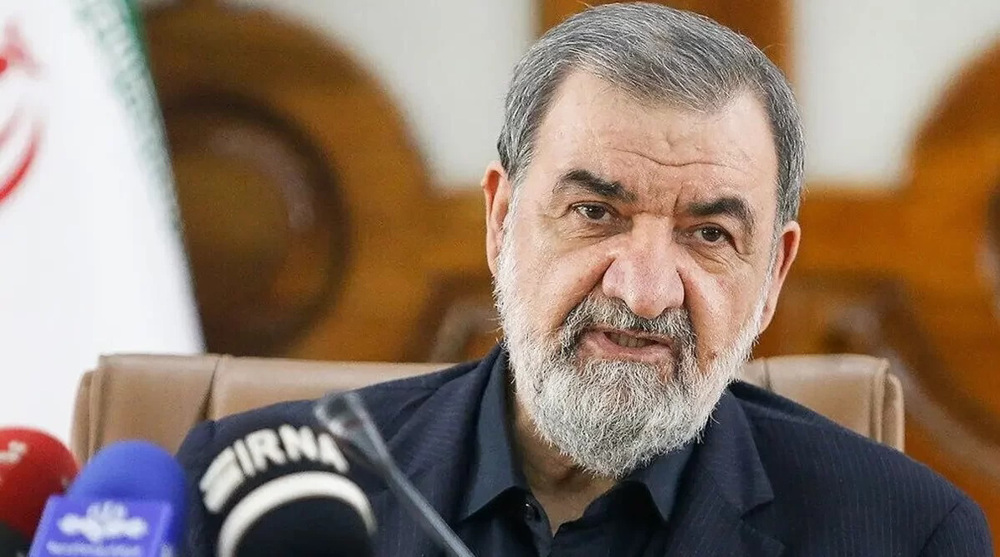
Iran’s security chief says the Islamic Republic will neutralize the United States’ economic pressure, including by responding to countries that join an American “economic war” against the country.
“We will neutralize the economic war. America is backed into a corner. Either they honor their commitments, or they will have to struggle to get out of that corner, which will make the situation worse,” Secretary of Iran’s Supreme National Security Council, Mohsen Rezaei said during a televised interview on Saturday.
‘Same bull. Different bullies’: Araghchi says US economic pressure doomed to failhttps://t.co/qJgyS0zHor
— Press TV 🔻 (@PressTV) August 21, 2026
He was citing the requisites for Washington to meet such obligations as cessation of all instances of aggression and refusal to interfere in maritime traffic in the region.
“We tell all neighboring countries not to enter the economic war against Iran. Anyone who does so will be considered a hostile country,” he said, adding, “First, we will negotiate with them and ask them not to do this; if they continue, we will target that country.”
According to the official, Iran could prevent oil from passing through the entire Persian Gulf if such measures were pursued.
“If they start such an action, we will not allow a single drop of oil to pass through the Persian Gulf. Oil will leave neither through the Strait of Hormuz nor through the Persian Gulf. For now, we have closed the Strait of Hormuz, while we are not targeting the oil in the Persian Gulf,” he said.
Rezaei, meanwhile, said reopening the Strait of Hormuz was not currently under consideration and that the United States would have to act first by living up to its commitments.
‘Strait of Hormuz part of Iranian identity’
The official said Iran and Oman had agreed on a commercial route through the strait, although a joint statement had not yet been prepared.
“This commercial route is shared by Iran and Oman,” he stated, but noted that, for now, the route existed “only on paper” and reiterated that the strait would be reopened once the US fulfilled its commitments.
“There is another identity [here] that belongs to us. The Strait of Hormuz is the gateway into the Persian Gulf, and Oman has no presence in the Persian Gulf. Therefore, we cannot relinquish control over the Strait of Hormuz.”
‘Iran’s military, diplomatic approach has changed’
Rezaei said Iran’s defense strategy and diplomatic conduct has undergone a change following the most recent bout of American-Israeli aggression targeting the Islamic Republic that was followed by the country’s determined reprisal and retaliatory closure of the strait.
Production of strategic military equipment tripled during US-Israeli aggression: Defense Ministry https://t.co/vVZKt71MDi
— Press TV 🔻 (@PressTV) August 22, 2026
“Iran today will not be the Iran it was before the war. Of course, the overconfident United States is not the same America it was before the war either. Iran’s patterns of behavior in the international arena have undergone a transformation. The entire world now looks at us differently, and we have no choice, but to evolve our behavior [in this context].”
According to Rezaei, Iran would incorporate lessons from the war into its future military planning and continue developing technology and adjust its diplomatic conduct in response to US violations of commitments.
“The decision by the Leader of the [Islamic] Revolution to bring in experienced commanders means that we will certainly apply the lessons we have learned in the next battle,” the official noted, referring to Ayatollah Mojtaba Khamenei’s recent appointment of several people to key military positions, including Rezaei himself.
“Certainly, changes will be made in the way Iran manages and conducts war, as well as in its diplomatic conduct. The reason is clear: The Americans betrayed the negotiations and reneged on their own signature.”
Rezaei characterized the current US approach as an attempt to use economic pressure after the failure of military action.
He, however, described the economic measures as propaganda and argued that Iran had continued exporting oil.
“Take the issue of the [American] naval blockade. This is not something new. In the past one or two months alone, we have shipped 70 million barrels of oil.”
Despite the warnings, Rezaei said Iran remained committed to diplomacy, while stressing that Tehran would approach negotiations differently.
“We are serious about diplomacy, but we have changed our method… We are waiting for [the other side] to honor its commitments. We want the wars in Iran, Lebanon, Gaza, and Yemen to end,” the security chief said, referring to the Islamic Republic’s insistence on cessation of aggression on all fronts.
Warning US against increasing military presence
Iran does not seek war, but would continue to resist what it regards as hostile action, he said. “We are not warmongers, but we will never surrender. We will sacrifice every last drop of our blood for the people and Iran.”
“We advise the Americans not to increase their forces; if they do, we will strike them. Every meeting they hold with the counter-revolutionary elements, we will strike. Our attacks are now targeted.”
 This makes it easy to access the Press TV website