
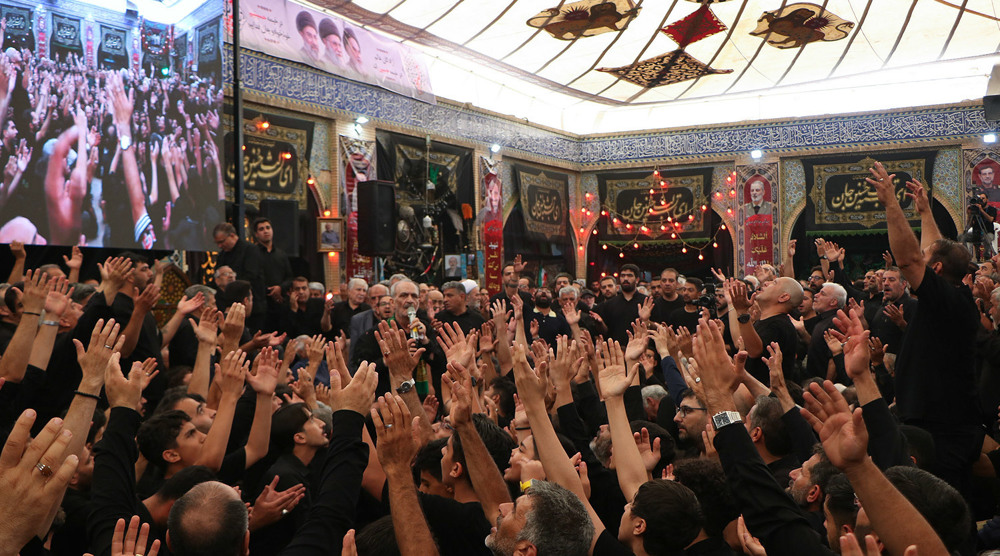
Millions of mourners clad in black observe Ashura, marking the martyrdom anniversary of Imam Hussein (AS), the third Shia Imam, and the grandson of Prophet Mohammad (Peace be upon Him), whose sacrifice in the desert of Karbala has become the eternal symbol of resistance against oppression.
Ashura, the 10th day of the lunar month of Muharram, fell on Thursday in Iran this year.
Massive crowds of grieving devotees held mourning rituals such as beating their chests in rhythmic unison, listening to soulful elegies, and weeping over the tragedy that unfolded in 680 AD. On that fateful day, Imam Hussein (AS), along with his 72 loyal companions, were martyred in the Battle of Karbala, in southern Iraq, after fighting courageously for justice against thousands of soldiers of the Umayyad caliph, Yazid I.
Mourning groups gather at the Shrine of Fatima Masumeh (PBUH) in the holy city of Qom on the day of Ashura, marking the anniversary of the martyrdom of Imam Hussein (AS).
— PressTV Extra (@PresstvExtra) June 25, 2026
Follow: https://t.co/0EMmcJs6DL pic.twitter.com/MI4nN10snz
In Iran, mourning processions filled cities and villages across the country while benefactors distributed votive food, known generically as nazri, to mourners and the needy, a tradition embodying the spirit of generosity and solidarity that Imam Hussein (AS) championed.
The rhythmic sound of chest-beating and the haunting melodies of elegies echoed across the country as millions paid homage to Imam Hussein (AS).
For the millions mourning Imam Hussein (AS), this Ashura carries an added layer of grief as it is the first Muharram since the martyrdom of Leader of the Islamic Revolution Ayatollah Seyyed Ali Khamenei, who was assassinated in an unprovoked US-Israeli war of aggression that erupted on February 28. During over 40 days of unlawful attacks, the nation lost not only its revered Leader but also several senior commanders and thousands of civilians.
The atmosphere among mourners of Imam Hussein (AS) following the Ashura noon ceremony on the street leading to the site of the martyrdom of Ayatollah Seyyed Ali Khamenei.
— PressTV Extra (@PresstvExtra) June 25, 2026
Follow: https://t.co/0EMmcJs6DL pic.twitter.com/IFA7H4S6NU
The mourning ceremonies observed during the first ten days of Muharram culminate in Ashura.
On the eve of Ashura, known as Tasu’a, mourners remember Abbas ibn Ali (PBUH), Imam Hussein’s half-brother, who was martyred shortly before Imam Hussein as he tried to bring water to women and children in Imam’s camp, who had had no water to drink for days due to a siege by the enemy forces.
Shia Muslims across the globe likewise hold mourning rituals, while hundreds of thousands of pilgrims from Iran and other nations travel to the holy city of Karbala in Iraq -- home to Imam Hussein's sacred shrine -- to mark Ashura.
More than mere rituals, the Muharram ceremonies represent the eternal confrontation between truth and falsehood, embodying humanity's timeless struggle against oppression and tyranny, the cause that Imam Hussein (AS) embraced with his ultimate sacrifice.
Traditional mourning ceremonies, elegy recitation, and nakhl-gardani (palm procession) are held in the historic village of Estark, Kashan, where local groups maintain centuries-old Muharram traditions.
— PressTV Extra (@PresstvExtra) June 25, 2026
Follow: https://t.co/0EMmcJs6DL pic.twitter.com/DPmvn6uBoe
 This makes it easy to access the Press TV website