Iran, Pakistan forge blueprint for Islamic economic integration
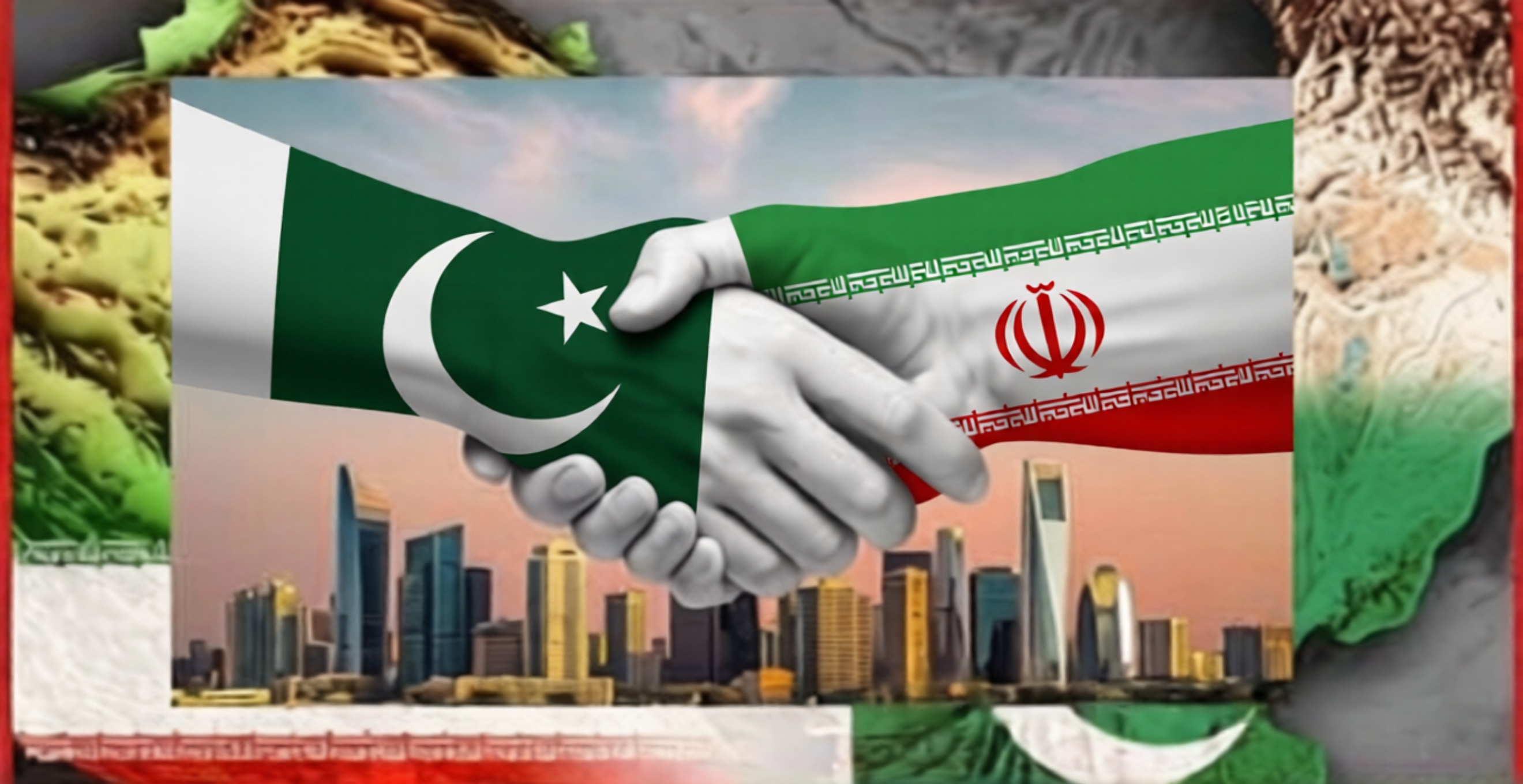
President Masoud Pezeshkian arrived in Islamabad on Tuesday at the head of a high-ranking delegation that includes the ministers of interior, foreign affairs, roads and urban development, and agricultural jihad.
The one-day visit is taking place at a moment when Tehran-Islamabad relations have transcended traditional neighborhood ties to assume strategic convergence in the domains of transit, energy, and border security.
What distinguishes this visit from earlier meetings is the new geopolitical context amid the Iran-US negotiations which Pakistan's Prime Minister Shehbaz Sharif and Army Chief Field Marshal Asim Munir personally attended in Switzerland as key mediators.
With President Pezeshkian’s visit, Iran is signaling that Islamabad has become politically invested in the outcome of the process.
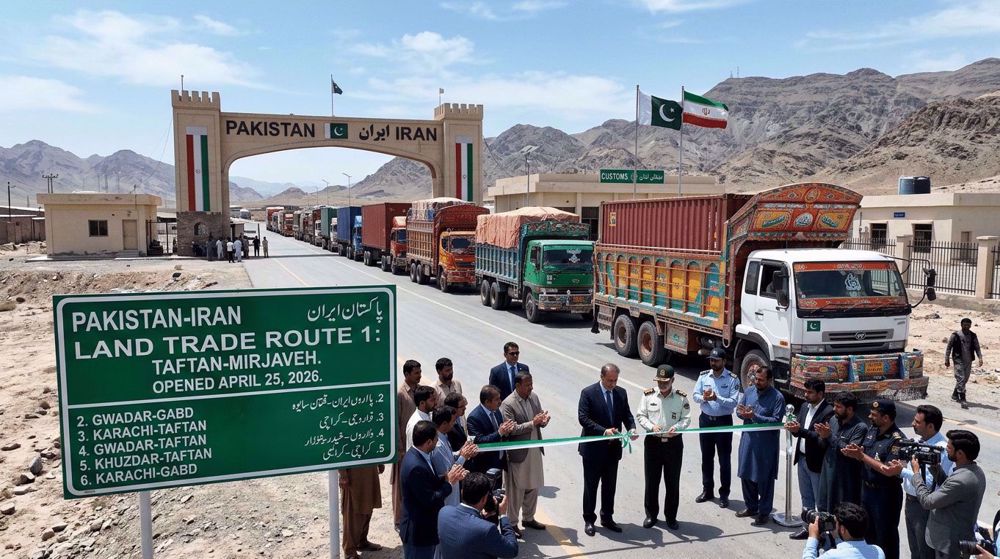
Pakistan opened its land transit routes to Iranian commercial shipments when Iran's ports were under US naval blockade, effectively becoming a lifeline for Tehran's economy.
Pakistan's Ministry of Commerce, citing the 2008 Road Transport Agreement, authorized the transit of Iranian goods through six land routes connecting Karachi Port to the Gabd-Rimdan and Taftan border crossings.
These routes, dormant for nearly two decades, suddenly became vital arteries for Iran's trade. According to estimates from Iran's Chamber of Commerce, approximately 20,000 containers had traversed the route by May.
President Pezeshkian's visit to Islamabad is taking place at a moment when Pakistan has been elevated from an eastern neighbor to a strategic partner and geopolitical anchor for Iran.
Iran and Pakistan share a 900-kilometre border, yet bilateral trade has historically remained far below its potential. Both governments now appear determined to change that trajectory.
Discussions during the visit center on expanding trade volumes toward multi-billion-dollar targets, formalizing cross-border markets, and reducing friction in customs and logistics systems. The tone is increasingly forward-looking.
In their previous meeting in Tehran on May 17, 2025, Pakistan's Interior Minister Mohsin Naqvi and President Pezeshkian discussed new transit routes, border security, and the barter mechanism.
Iran's Ambassador to Islamabad Mohammad Ali Hosseini has explicitly stated that the barter system is an efficient mechanism for circumventing sanctions and increasing trade, and that the two countries have agreed to establish three new border markets to boost exchanges.
The announced target of increasing bilateral trade to $10 billion within a two-year requires fulfillment of fundamental conditions. Current figures show significant trade growth, approaching $3.2 billion, but the gap to $10 billion demands a leap in infrastructure and security.
Pezeshkian in this visit is seeking not only immediate economic openings but also the institutionalization of north-south and east-west corridors with Pakistan as their axis.
Energy cooperation is one of the most promising pillars of this renewed engagement. Pakistan’s growing energy demand and Iran’s significant natural gas reserves create a natural economic complementarity.
The Iran-Pakistan (IP) Gas Pipeline, stalled for three decades due to sanctions, has now returned to the negotiating table following the shift in political atmosphere and the US announcement of a 60-day waiver on Iran's oil sanctions.
To preempt a potential $18 billion penalty, Pakistan has initiated construction of an 80-kilometer segment of the pipeline from the Iranian border to Gwadar, and with the new political environment, the possibility of completing the project is greater than ever before.
Another area gaining renewed attention is borderland economic development. The Iran–Pakistan frontier, particularly around Balochistan, has long been economically underdeveloped despite its strategic location.
The current diplomatic momentum is pushing for the expansion of border markets and special trade zones that could formalize informal commerce, create jobs, and integrate local economies into broader supply chains.
Beyond border trade, there is growing interest in regional connectivity corridors. Both countries sit at the crossroads of South Asia, West Asia, and Central Asia, making them natural participants in broader transit and logistics networks.
What makes the current phase particularly notable is the tone of optimism surrounding it. The focus has shifted from abstract agreements to practical mechanisms with border infrastructure, logistics coordination, and sector-specific cooperation.
Iran and Pakistan together represent nearly 350 million people and are the two most strategically positioned Muslim-majority states at the crossroads of South Asia, West Asia, and Central Asia.
Their alignment signals a shift in how Muslim-majority nations are approaching regional integration through concrete economic interdependence, infrastructure connectivity, and coordinated security frameworks that transcend sectarian divisions.
President Pezeshkian has explicitly cast the partnership within a larger vision of Islamic world solidarity. He has called for the expansion of economic, scientific, and cultural ties among Islamic nations as an essential necessity.
He has also proposed reviving historical trilateral economic agreements between Iran, Pakistan, and Turkey with a fresh approach, suggesting that solidarity among Islamic countries could serve as a global model against the hegemony of major powers, with Iran and Pakistan positioned to take a leading role.
Pakistan's leadership has reciprocated this vision. Prime Minister Shehbaz Sharif has emphasized that Pakistan and Iran, as brotherly Muslim nations, share a strong commitment to global peace and unity within the Muslim Ummah.
In previous high-level meetings, Sharif has stated that strengthening cooperation between Iran and Pakistan, as two important Islamic countries in the region, can be effective in solving regional problems.
This partnership carries unprecedented implications for the Islamic world in several specific dimensions.
Iran, with its Shia-majority identity, and Pakistan, with its Sunni-majority population, are building a model of cooperation that demonstrates that shared economic and security interests can override confessional divisions.
The economic dimension extends beyond bilateral trade to encompass broader Islamic economic integration. Iran connects Pakistan to Turkey, Azerbaijan, and the Caucasus, and through those routes to Europe and Eurasia, while Pakistan connects Iran to China and South Asia.
Iranian officials have emphasized that this connectivity is about creating a new geo-economic order in which Muslim-majority nations are active architects of their own integration.
Iran has supported Pakistan's membership in BRICS and is working toward a free trade agreement, moves that would further embed this partnership in broader South-South cooperation frameworks.
For the broader Islamic world, this partnership offers a template for how Muslim-majority nations can assert their interests collectively by building the economic and security infrastructure necessary to engage from a position of strength.
ECO can play greater role in regional peace, economic integration: Araghchi
Iran says international flights continue despite US sanctions pressure
Iran slams US for blaming Tehran over rising fuel prices, Strait of Hormuz closure



VIDEO | Cuba's health system severely struggling due to US sanctions
VIDEO | Press TV's news headlines
VIDEO | Large pro-Palestine demonstration held in western Germany
VIDEO | 'US violating international law, going further down the wrong road': Analyst
‘Surprises in store’: Iran vows to counter any fresh aggression with ‘new technologies’
VIDEO | Iraqis mark second anniversary of Hezbollah leader's martyrdom
Strait of Hormuz authority warns ship owners over attempts at forcing vessels onto illegal routes
Iran FM: Restoring trust in UN requires ending impunity for those behind grave intl. crimes


 PressTV NEWSLETTER
now
PressTV NEWSLETTER
now
 This makes it easy to access the Press TV website
