
The US-Israeli war against Iran has sent serious shocks through the market for strategic metals and rare earth elements, triggering price surges in materials that form the backbone of global military and technology industries.
With the increased consumption of weapons and defense systems during the war, the prices of metals such as tungsten, germanium, graphite, cobalt, lithium, and lanthanum have risen significantly.
These are metals that have critical applications in the production of missiles, fighter jets, air defense systems, and advanced military equipment.
The sudden surge in military demand from the United States and its allies, combined with declining global reserves, has delivered a major shock to the market.
China which controls the bulk of global extraction, refining, and processing of rare metals has imposed export restrictions on rare earth elements and related processing equipment in recent months, citing national security concerns.
The country accounts for approximately 70 percent of global extraction of certain rare earth elements and over 90 percent of refining capacity and related magnet production. Strategic metals now play the same role that oil played in the 1970s.
The world has entered the era of mineral nationalism, with countries defining these materials as tools of geopolitical deterrence and components of national security.
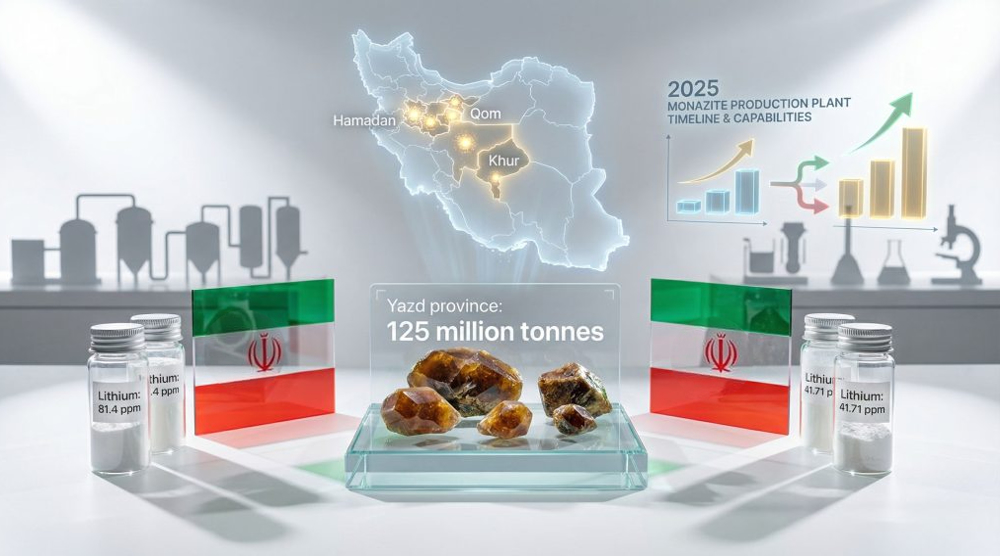
At the heart of these developments stands Iran. Until two years ago, the country was classified among those lacking rare earth processing capacity. That changed in April 2025 with the opening of its first monazite processing plant on the outskirts of Tehran.
The facility was built without foreign equipment or foreign technical personnel. Iranian engineers designed, manufactured, and installed every component.
The country now has a pilot facility that can test and process approximately ninety percent of its major minerals and officials have discussed doubling or tripling the plant's capacity for mass production.
Iran's geological endowment provides the raw material foundation. When discussing Iran's potential, reference is often made to the two mines in Yazd province, where Chah-e Mir and Gazestan together hold approximately 125 million tonnes of iron-apatite ore reserves.
But the geographical scope of this potential is vast.
Iran's Geological Survey, in recent years, has employed remote sensing and geochemical methods to identify approximately 30 promising zones in central regions, the northwest, and even the Sanandaj-Sirjan zone, containing significant concentrations of heavy rare earth elements such as gadolinium, dysprosium, and holmium.
These heavy elements, which command prices of up to $60,000 per kilogram as with lutetium, are significantly more valuable than light elements like cerium or lanthanum.
A key point is that Iran's identified deposits, unlike those in many countries that predominantly contain light elements, contain a notable proportion of heavy elements.
This characteristic, if combined with appropriate separation technology, could provide Iran with a competitive advantage. Nevertheless, it must be acknowledged that the comprehensive exploration of Iran's rare earth deposits remains in its early stages.
The technical milestone achieved at the Tehran plant represents the transition from laboratory success to pilot production. The project required thirty-six months of investment before opening.
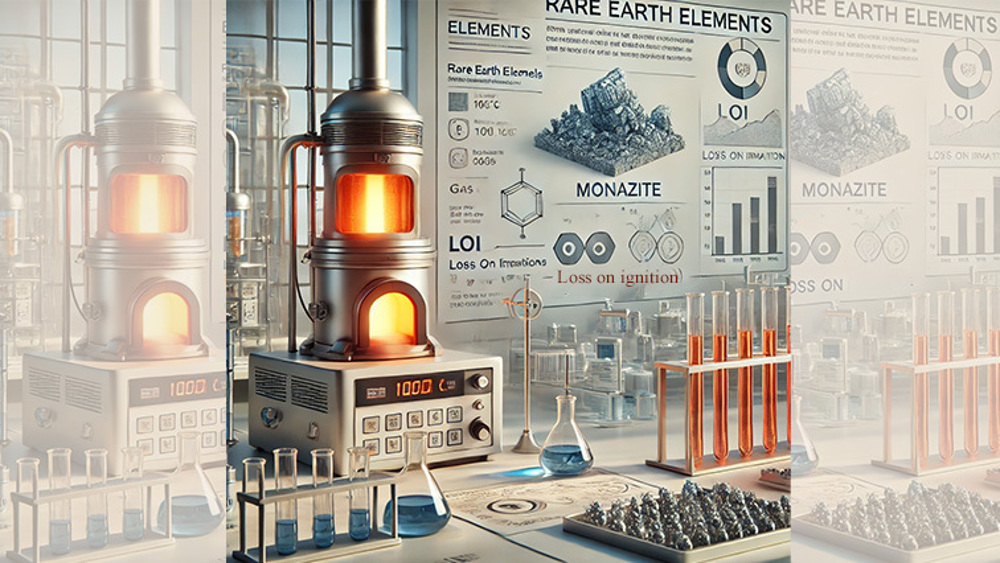
Iranian experts were able to economically isolate all seventeen rare earth elements with high purity using new methods. Depending on the grade, it can take anywhere from six to eighty-six tonnes of ore to produce a single tonne of rare earth mineral.
This ratio explains why rare earth processing is not simply a matter of mining but requires advanced separation technology that only a handful of countries possess.
A peer-reviewed study published in July 2025 by researchers from Iranian and British universities examined optimal rare earth extraction conditions from an apatite sample from a mine in northwest Iran.
The sample contained 3,665 grams per tonne of light rare earth elements and 531 grams per tonne of heavy rare earth elements.
The researchers found that mechanical activation followed by leaching with thirty percent nitric acid achieved recovery rates of approximately sixty-eight percent for light rare earths and seventy-seven percent for heavy rare earths.
Further separation using solvent extraction achieved an extraction efficiency of approximately ninety-seven percent. These figures are promising at the laboratory scale, but for mass production, recovery rates must reach industrial standards.
Iran's strategic positioning extends beyond its domestic reserves and processing capacity. The war has disrupted global supply chains to such an extent that consuming nations are urgently seeking alternative sources.
In this reshuffling of the global supply chain, Iran occupies a unique position. It possesses both geological resources and, now, the technical capability to process them.
It is geographically proximate to major consuming markets in Europe, Turkey, and the broader West Asia. It also has established trade relationships with emerging economies in Asia.
In 2025, Iran's Ministry of Industry, Mining, and Trade identified and compiled a list of approximately thirty to forty strategic and critical elements. This was the first time such a list had been officially announced.
The stated purpose is the use of these elements in domestic production, the development of downstream industries, and the reduction of import dependence.
The list will be reviewed annually to track scientific and industrial developments and adjust national strategy. This systematic approach signals that Iran is moving beyond ad hoc mineral development toward an integrated industrial policy for critical materials.
Beyond extraction and processing, Iran has the opportunity to capture value further downstream. The greatest value addition in the rare earth value chain lies not in selling raw material or even its separation, but in converting it into final products such as ultra-strong permanent magnets, rechargeable batteries, and industrial lasers.
Iran is currently heavily dependent on imports of these products, spending billions of dollars annually on magnets used in electric motors, wind turbine generators, and medical equipment.
If the Tehran plant achieves sustainable production, it could provide the raw material needed to establish a magnet industry in Iran.
However, launching these downstream industries requires substantial investment, advanced technical knowledge, and the development of domestic and export markets.
Another underexplored opportunity is the circular economy and recycling of rare earth elements.
Due to its relatively young population and high consumption of electronic devices, Iran produces thousands of tonnes of e-waste annually, containing significant quantities of elements such as neodymium, praseodymium, and dysprosium.
Recycling these elements from waste is significantly cheaper and less polluting than mining.
Developing a rare earth recycling industry in Iran could create a parallel industry that enhances supply security under sanctions and provide a new export advantage under normal conditions.
The geopolitics of rare earths also present Iran with strategic choices, the best of which is cooperation with neighboring countries or emerging blocs such as BRICS.
Iran could position itself as a regional supplier for countries lacking these resources such as Turkey, Pakistan, or the UAE creating new export markets less subject to Western geopolitical pressures.
Iran now possesses the essential tools namely technical knowledge, geological resources, and a functioning pilot plant. The next step is to convert these tools into a productive and sustainable industry.
The war's supply chain tremors have only quickened Iran's irreversible dive into rare earths, granting it a strategic foothold that will drive its technological rise for generations to come.
 This makes it easy to access the Press TV website