Lavrov warns NATO-Russia clash could trigger 'catastrophic' nuclear exchange
Russian Foreign Minister Sergey Lavrov has warned that a direct military confrontation between NATO and Russia could quickly spiral into a nuclear conflict with "catastrophic" consequences.
In an article titled Ukraine, Europe and Global Security, Lavrov said Europe’s current course toward confrontation with Moscow and continued military expansion was creating serious risks for global stability.
“This state of affairs [regarding Europe’s course towards confrontation with Russia and further expansion] poses serious threats to global security. A direct confrontation between NATO and Russia could rapidly escalate into an exchange of nuclear strikes, with catastrophic consequences,” he wrote.
The article was initially scheduled for publication by the Brussels-based outlet Politico Europe, but the publication was canceled following a last-minute editorial decision, according to Tass News Agency.
Lavrov argued that European powers continue to pursue geopolitical expansion despite growing tensions on the continent.
“The united Europe continues to dream of expansion. It intends to absorb Ukraine and Moldova, while pulling Armenia into its sphere of influence. NATO has already expanded eastward, swallowing up Finland and Sweden,” he wrote.
Putin vows Russia will win against NATO-backed aggression at Victory Day paradehttps://t.co/4y69ZojZms
— Press TV 🔻 (@PressTV) May 9, 2026
According to Lavrov, some European leaders increasingly view Ukraine as a future military asset.
“As for Ukraine, it is increasingly eyed as the 'striking fist' of a future European military force, independent of the United States and independent of NATO,” he stated.
The Russian foreign minister warned that European governments have been preparing for a prolonged confrontation with Moscow.
“It is widely known that European elites have invested their 'political capital' in the confrontation with Russia, pouring hundreds of billions of dollars into propping up the Kiev regime and on ramping up the military budgets of EU member states and NATO,” Lavrov said.
He added that Europe aims to achieve military readiness against Russia by the end of the decade.
“Europe now aims to achieve 'defense readiness' against Russia by 2030. Until then, they mean to buy time by whatever means available,” he wrote.
Russia has repeatedly argued that lasting peace can only be achieved by addressing the root causes of the conflict, including NATO’s eastward expansion, the rights of Russian-speaking populations in eastern Ukraine and the need for long-term security guarantees.
A major drone attack hit Russia today. According to reports, Ukraine launched hundreds of drones targeting Moscow and several Russian regions. pic.twitter.com/p759e4fGxM
— Press TV 🔻 (@PressTV) May 17, 2026
Ukraine launches major drone attack on Moscow
Meanwhile, Ukraine carried out on Thursday what appeared to be its largest drone assault on the Russian capital since the start of the conflict more than four years ago.
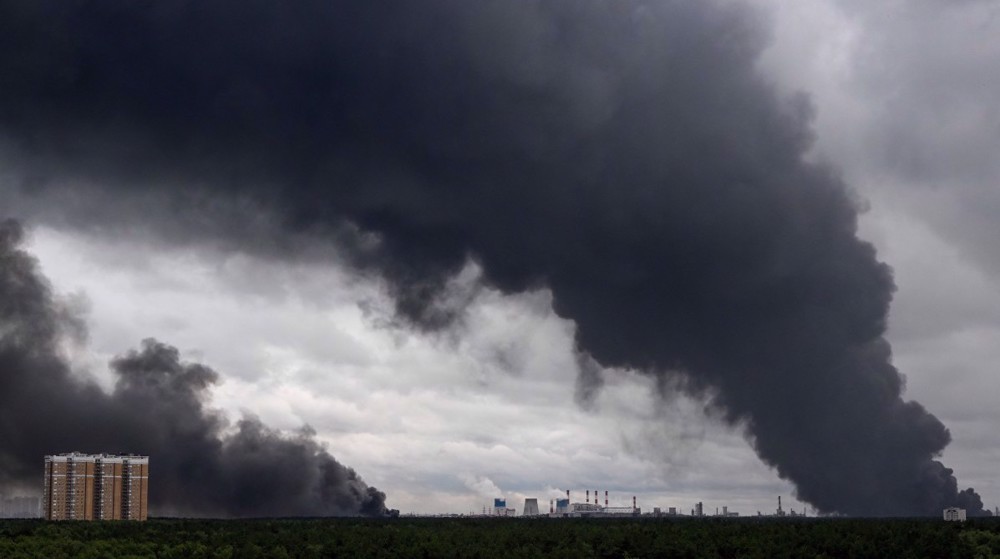
Black smoke rose over Moscow after a strike on an oil refinery, while all four of the city's airports were temporarily shut down and part of the ring highway around the capital was closed.
The Russian Defense Ministry said its forces intercepted 992 drones across the country during the attack, describing it as the largest such assault since the conflict began.
Authorities reported no fatalities, though at least 17 people were injured in the Moscow region, according to regional governor Andrei Vorobyev.
The targeted refinery supplies roughly 40 percent of Moscow’s gasoline needs, raising concerns about potential disruptions to fuel supplies. City officials, however, said gas stations continued operating normally.
Ukrainian President Volodymyr Zelensky signaled Kiev’s determination to intensify attacks on Russia.
“If Ukraine burns, then your Moscow will burn as well,” Zelensky said in a voice message shared with journalists.
In recent months, Ukraine, backed by the United States and its Western allies, has expanded drone strikes against Russian energy facilities and infrastructure deep inside Russian territory, as the conflict shows little sign of easing despite repeated international calls for a negotiated settlement.
Russia, China veto US backed anti-Iran resolution at UN Security Council
‘Outrageous’: Russia condemns Austria for blocking Iran’s nuclear chief from IAEA meeting
Russia’s Rosatom says Iran remains top priority in West Asia



Iran, Pakistan FMs discuss regional developments, energy supplies
VIDEO | Black smoke, flames rise near Riyadh airport amid Yemen strikes
VIDEO | Hundreds of thousands of people in Tehran attend rally, parade dubbed 'Sacrifice for Iran'
Remembering Sabra and Shatila massacre: Why memory is the ultimate shield against erasure
Syria’s HTS declines Saudi bid for militants against Yemeni forces: Report
VIDEO | Pentagon criticized for failing to release real number of US troops casualties
Araghchi: Military intervention cannot create security; coercion cannot bring peace
VIDEO | US president using Greenland as foreign policy success


 PressTV NEWSLETTER
now
PressTV NEWSLETTER
now
 This makes it easy to access the Press TV website
