5 kms of failure: How South Lebanon’s Beaufort Castle laid bare Israeli military weaknesses
By Ali Hammoud
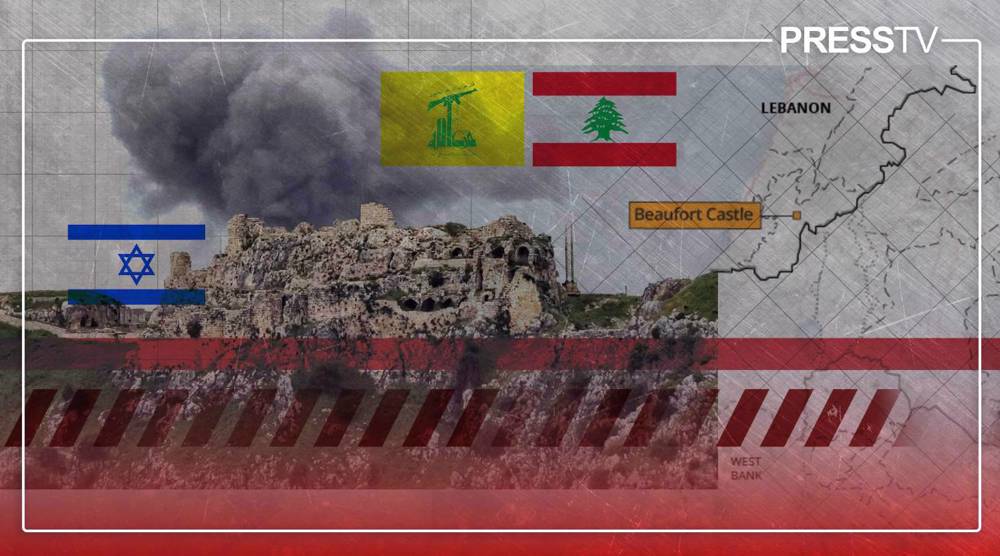
Israeli military's arrival at the perimeter of Beaufort Castle, sitting atop a strategic hill near Nabatieh city in South Lebanon, has been presented as a landmark achievement.
Yet measured in raw distance, the operation amounts to an advance of just five kilometers – from the border settlement of Metula to the ancient fortress perched above the Litani River.
Five kilometers. A stretch of ground that took over three months of direct ground combat, preceded by fifteen months of continuous aerial bombardment, to secure. That simple geographic fact transforms a supposed triumph into an uncomfortable mirror, reflecting the profound weaknesses of an over-technologized and risk-averse army now struggling to overcome them.
The scale of the forces thrown at this narrow axis exposes a deep institutional anxiety. To move a mere five kilometers, the Israeli command did not deploy a single brigade or even a division. It assembled a stacked task force that reads like a roll-call of its most prized formations.
The 98th "Fire" Division, Israel's premier paratrooper and commando formation, was deployed alongside the 36th Armored Division, normally reserved for major conventional breakthroughs.
The Golani Brigade and Givati Brigade, the backbone of Israeli infantry, were committed in full. The 7th Armored Brigade, the country's oldest and most storied tank unit, also rolled in.
The "Fire" Brigade layered on precision artillery and drone networks, while the multi-dimensional Unit 888 – a boutique hybrid force experimenting with networked robotics and AI-driven targeting – was given a live-fire audition.
Overhead, combat drones and loitering munitions saturated the sky. On the ground, unmanned robots were pushed forward to avoid risking soldiers against anticipated counter-fire.
Watch: This is how Hezbollah's FPV drones are reshaping the battlefield in southern Lebanon
— Press TV 🔻 (@PressTV) May 23, 2026
Follow Press TV on Telegram: https://t.co/LWoNSpkc2J pic.twitter.com/aPicPlB91K
This was not a scalpel operation. It was the entire toolbox emptied onto a single, five-kilometer-deep strip of south Lebanon.
And still the advance stalled.
The initial frontal push along the Yohmar-Beaufort axis – prepped with hundreds of airstrikes and relentless artillery barrages – bogged down badly. Israeli occupation forces were forced to abandon direct mechanized assault in favor of painstaking dismounted infiltrations by special infantry units slipping through the eastern river valleys.
That the most technologically drenched army on earth had to resort to quiet, boots-on-the-ground infiltration to cover a distance a civilian could jog in under thirty minutes is not a testament to tactical flexibility. It is a confession that supremacy in the air, in cyber, and in intelligence did not translate into usable control of the ground.
What makes this disproportion between effort and outcome even more damning is what was absent from the battlefield.
Before Israeli troops ever crossed the border, the Lebanese Armed Forces had spent weeks confiscating weapons caches and systematically destroying military infrastructure and equipment belonging to Hezbollah in the very sector around Beaufort.
Israeli occupation forces did not walk into a fully wired, prepared defensive system. They entered a zone where a significant portion of the resistance movement's underground networks, weapons stores, and fortifications had already been degraded by a third party.
The environment was, by any reasonable military assessment, pre-softened.
Yet the Israeli advance still required the full weight of multiple elite divisions to push forward at a crawl. This raises a devastating question: if a pre-degraded five-kilometer stretch demanded this magnitude of firepower and took these many months, what exactly is the sustainability of the entire ground offensive?
Video released by Hezbollah shows that the resistance forces targeting an Israeli troop carrier in southern Lebanon with an attack drone. pic.twitter.com/eFTxUIzPLB
— Press TV 🔻 (@PressTV) May 17, 2026
The answer points directly to the Israeli military's core weakness. Its doctrine has become trapped in a contradiction it cannot resolve.
Overwhelming technological dependence – sensors, drones, satellites, precision-guided munitions, robotic scouts – has not produced decisive battlefield speed or shock. Instead, it has bred a profound risk aversion.
Commanders use technology not primarily to destroy the enemy with economy and surprise, but to sanitize the battlefield and insulate troops from direct contact.
The result is a military that consumes stunning quantities of expensive munitions to inch forward, terrified of the human cost that any real encounter might bring.
It is an army that has trained itself to see the ground as something to be burned before it is walked on. That mindset turns even a trivial tactical advance into a vast, slow-moving logistical and psychological operation.
Beaufort Castle, for all its symbolic weight, stands as an indictment of that paradigm.
A force structure that requires two divisions, the nation's most decorated brigades, and an endless airborne armada to secure five kilometers of terrain – after a rival army had already degraded the defenses – is not a force demonstrating power. It is a force revealing its limits.
Technology, it turns out, cannot substitute for the willingness to close with the enemy. And a five-kilometer crawl is still a crawl, no matter how many flags are raised at the end of it.
Ali Hammoud is a Lebanese writer and researcher.
(The views expressed in this article do not necessarily reflect those of Press TV)

Hezbollah leader: Iran thwarted US-Israeli war goals; ultimate victory belongs to resistance

Remembering Sabra and Shatila massacre: Why memory is the ultimate shield against erasure
Two years after Israel’s pager terrorism in Lebanon: Scars, loss, and the will to carry on



313,000-strong ‘Jan-Fada’ drill signifies Iran’s popular mobilization and social readiness amid war
VIDEO | Algeria-UAE rupture: From electoral interference claims to broader regional dispute
Leader’s advisor: Any foreign forces attempting to land in Iran ‘will certainly be destroyed’
VIDEO | Press TV's news headlines
VIDEO | Priests rally in Rome to honor Palestinian, Lebanese children murdered by Israel
Iran’s military warns of ‘unpredictable blows’ in response to US threats
VIDEO | US economic war on Iran
Iran FM meets with US envoy on UN meeting’s sidelines at American side’s insistence: Report




 PressTV NEWSLETTER
now
PressTV NEWSLETTER
now
 This makes it easy to access the Press TV website
