
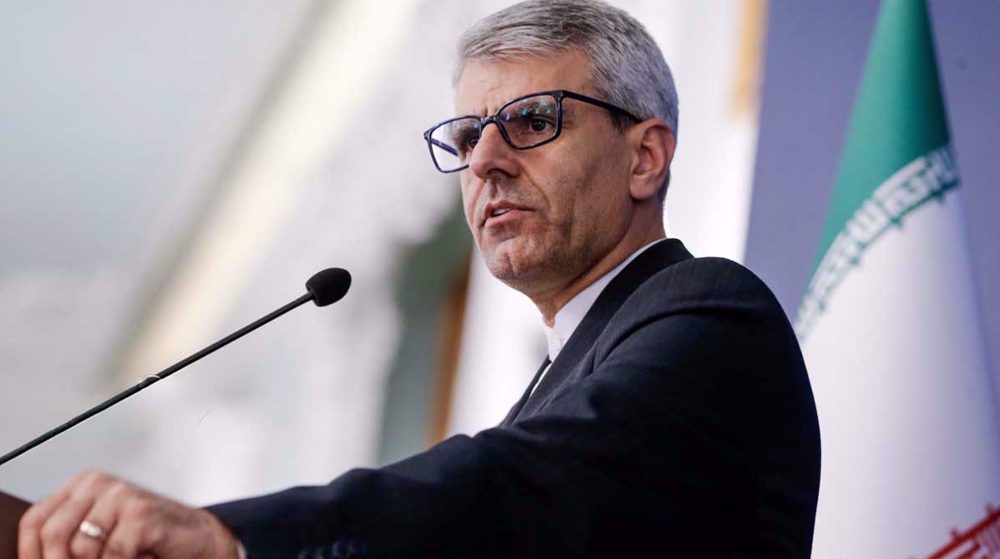
Iran’s Foreign Ministry spokesman cites a historical instance of the Roman Empire's failing to secure victory against Persia amid the prospect of realization of a memorandum of understanding between Iran and the US following unfaltering Iranian retaliation and resistance.
Esmaeil Baghaei invoked the example in a post on X after reporting that Iran and the United States had edged closer to finalizing an MoU to end unprovoked American aggression against the Islamic Republic, halt an illegal American naval blockade, and secure the release of Iran’s frozen assets.
Iran, US moving closer to 'finalizing memorandum of understanding': Baghaeihttps://t.co/FzJ3vZh9BQ
— Press TV 🔻 (@PressTV) May 23, 2026
"In the Roman mind, Rome was the undisputed center of the world. Yet the Iranians shattered that illusion; when Marcus Julius Philippus (Philip the Arab) marched east against Persia, the campaign did not result in Roman victory — it ended in a peace established on Sasanian terms," he wrote.
"The emperor had to come to terms!" the post went on.
Iran’s resistance has already proven a profound truth: war not only failed to force Iran into surrender but granted it strategic advantages it could not have achieved in peacetime. Every war imposed on Iran has left the enemy weaker and Iran stronger.https://t.co/czqWG1A8LM https://t.co/mxr7WPv8W8
— Press TV 🔻 (@PressTV) May 23, 2026
The United States and the Israeli regime launched their latest bout of unprovoked aggression against Iran on February 27.
US President Donald Trump announced a unilateral ceasefire on April 7 following at least 100 waves of decisive and successful Iranian retaliation and after the Islamic Republic closed the Strait of Hormuz to enemies and their allies.
Throughout its course, the aggression fell far short of overthrowing Iran's Islamic establishment, while the closure of the waterway began unleashing shockwaves onto global energy markets, including in the US, where soaring gas prices started chipping away at Trump's already record low popularity levels.
 This makes it easy to access the Press TV website