Pezeshkian: Pakistan’s effective and responsible role in ending war is commendable
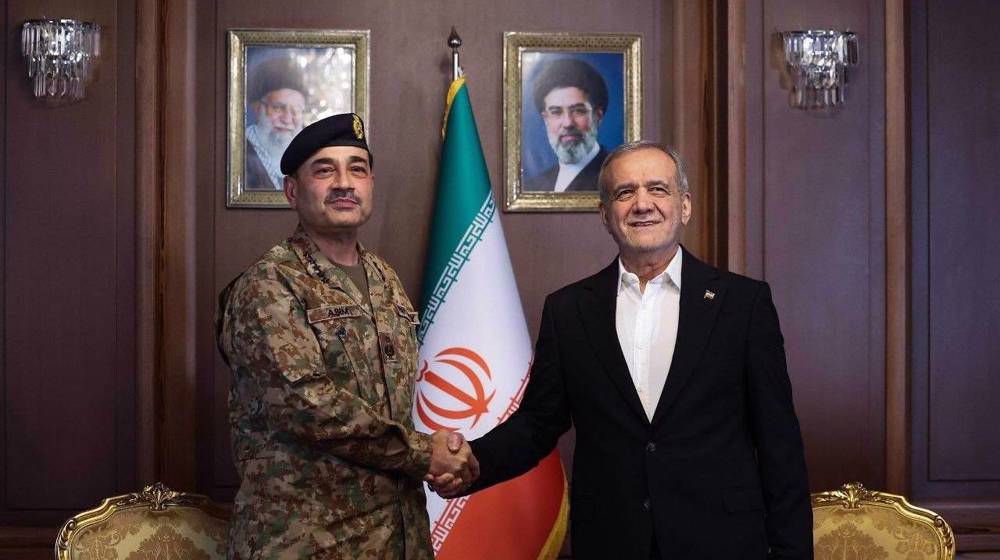
Iranian President Masoud Pezeshkian has applauded Pakistan’s constructive mediation in brokering the ceasefire, describing Islamabad’s efforts as “effective and responsible” while reaffirming Tehran’s firm commitment to lasting peace and stability in the region.
In a meeting with Pakistani Army chief Asim Munir, on Thursday night, President Pezeshkian expressed appreciation for the role played by both Munir and Pakistani Prime Minister Shahbaz Sharif in facilitating the ceasefire and for the warm hospitality extended to the Iranian delegation during the Islamabad talks.
“The Islamic Republic of Iran seeks lasting peace and stability in the region and emphasizes the realization of the rights of the Iranian nation within the framework of international law,” Pezeshkian stated.
He stressed that the Islamic Republic views all Islamic countries as brothers, a principle deeply rooted in the noble character of the Holy Prophet (PBUH).
Defensive action and call for Islamic unity
The Iranian president made it clear that the recent targeting of US military bases in Persian Gulf Arab states by Iran’s armed forces was carried out strictly within the framework of legitimate self-defense in response to the aggression imposed on the country.
Pointing to the root cause of regional instability, Pezeshkian said the Zionist regime is behind many wars and acts of division among Islamic countries.
“The Islamic Ummah must, through convergence and cooperation, prevent the Zionist regime from exploiting Islamic lands against Muslims themselves,” he emphasized.
“Undoubtedly, if Islamic countries unite, the possibility of this regime pushing the region towards war will disappear,” he stated.
Iran's President Masoud Pezeshkian meets with Pakistan's Chief of Army Staff Field Marshal Syed Asim Munir in Tehran.
— Press TV 🔻 (@PressTV) April 16, 2026
Follow Press TV on Telegram: https://t.co/LWoNSpkc2J pic.twitter.com/qhzWINq9eV
Pezeshkian strongly condemned the criminal and illegal aggression by the United States and the Zionist regime, which resulted in the martyrdom of the Leader of the Islamic Revolution, the destruction of schools and hospitals, and the killing of innocent children and civilians.
“These actions were carried out with what authorization and for what reason?” he asked.
Iran seeks brotherhood, not instability
President Pezeshkian reiterated that since assuming office, all efforts of the Islamic Republic have been directed toward strengthening friendship and brotherhood both inside the country and across the region.
Despite this, the US and the Zionist regime responded with hostile and provocative actions from the very beginning.
“Iran does not seek instability in the region and wants to develop brotherly relations with neighboring countries,” Pezeshkian affirmed.
He expressed particular satisfaction with Pakistan’s responsible and consistent efforts to end the war, urging other Islamic countries to follow the same path.
“In that case, the enemies of the Islamic Ummah will not be able to advance their goals,” he said.
Pezeshkian stressed Iran’s adherence to international law, noting that the Islamic Republic seeks to secure the rights of its people within that framework.
He added that after the war ends, regional countries must enhance mutual cooperation to pave the way for lasting peace and security.
Questioning why regional countries cannot guarantee their own security independently, the president said: “Just as Europe manages its security through mechanisms such as NATO, Islamic countries can also resolve their issues within the framework of collective cooperation by relying on their religious and cultural commonalities.”
He warned that war serves no one’s interest. “America will not win this conflict; it is the countries of the region and the world that will suffer serious losses, while only the Zionist regime seeks to fulfill its desires.”
Despite the Iranian people’s deep distrust of the United States — caused by repeated violations of commitments, attacks during negotiations, and assassinations — the Islamic Republic has pursued this path of dialogue through brotherly relations with friendly countries such as Pakistan, while firmly defending its national interests, Pezeshkian concluded.
He asked General Munir to convey the warm greetings of the Iranian leadership and people to Pakistani Prime Minister Shahbaz Sharif and the noble nation of Pakistan.
Pakistani Army chief’s response
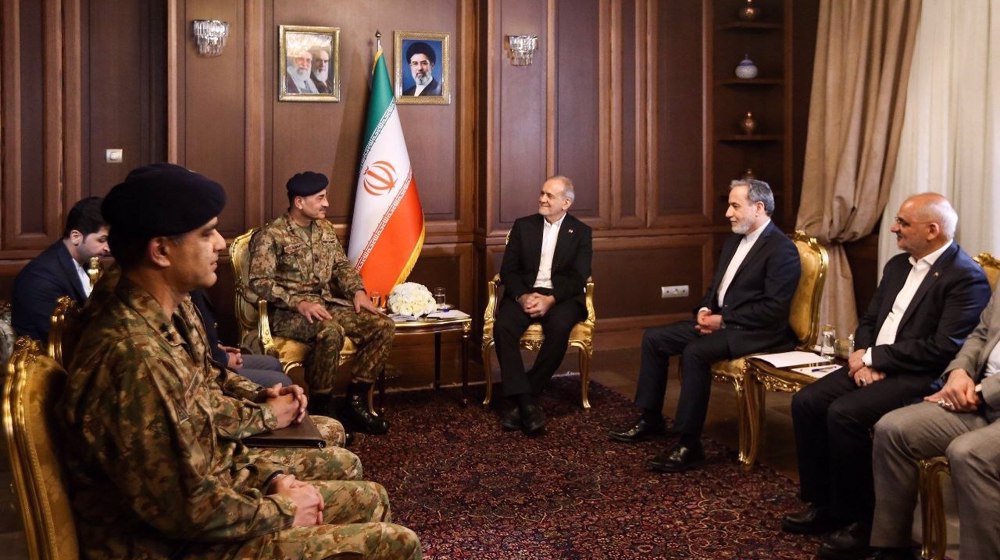
General Munir expressed pleasure at the meeting and thanked Iran, the Supreme Leader of the Islamic Revolution, and the Iranian nation for their hospitality.
He conveyed deep condolences from the Pakistani prime minister and people over the martyrdom of Ayatollah Seyyed Ali Khamenei, Iranian commanders, and citizens.
Referring to regional developments, Munir stated that although the war will end, the region will not return to pre-war conditions.
He stressed the need for collective cooperation in reconstruction, stability, and peace, noting the support of countries such as China, Saudi Arabia, Egypt, and Turkey for the diplomatic process.
The Pakistani Army chief added that relations between countries become even more important during times of crisis and war than in peacetime, describing the visits as a clear sign of sincerity in friendship.
He highlighted the deep religious, historical, and cultural commonalities between Iran and Pakistan.
Iran FM: Our first task in New York is to defend the just cause of Iranian people
US visa ban on Iranian president’s media team is bid to hide the truth: FM spokesman
US aggression, economic warfare amount to crimes against humanity: Iran's UN envoy



Iran’s military warns of ‘unpredictable blows’ in response to US threats
VIDEO | US economic war on Iran
Iran FM meets with US envoy on UN meeting’s sidelines at American side’s insistence: Report
UN chief warns Israeli violence in West Bank raises ‘specter of ethnic cleansing’
VIDEO | ‘Korea gets nothing, loses everything, with Hormuz deployment’
Iran parliamentary commission approves penalties for violators of Hormuz laws
VIDEO | Trump’s war disrupts the world
Araghchi urges world to hold US accountable for ‘war crimes’ at UNGA


 PressTV NEWSLETTER
now
PressTV NEWSLETTER
now
 This makes it easy to access the Press TV website
