
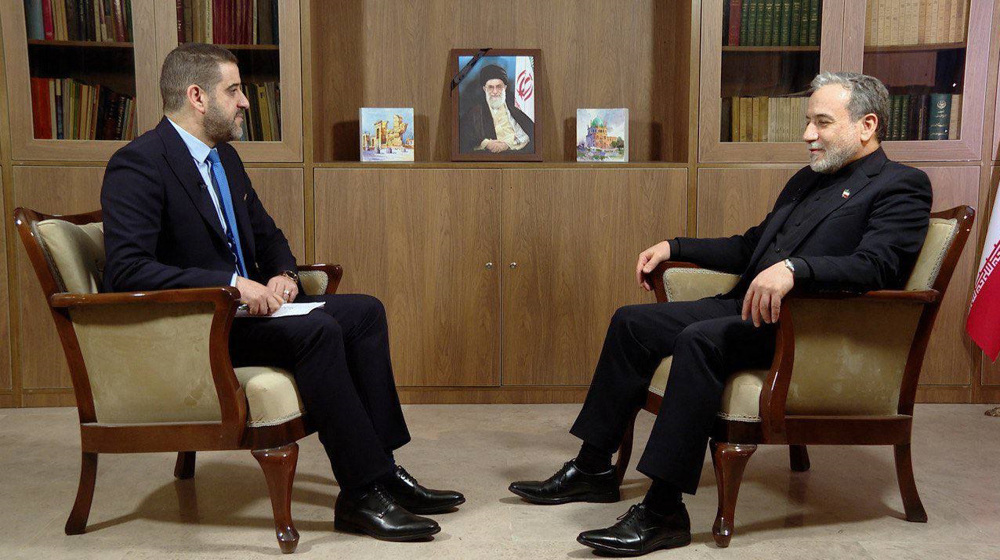
Foreign Minister Abbas Araghchi has said that Iran has "zero" trust in the United States and dismissed the effectiveness of any potential American ground operation targeting the Islamic Republic.
Speaking in an interview with Al Jazeera, the top diplomat said messages had been exchanged with the United States, either directly or via regional intermediaries, but stressed that these contacts did not constitute negotiations.
"I receive messages from [US envoy Steve] Witkoff directly, as before, and this does not mean that we are in negotiations," he said, according to remarks published by the network on Tuesday.
"There is no truth to the claim of negotiations with any party in Iran," he added, categorically rejecting American officials' claims of being engaged in such process with Iranian authorities.
Araghchi pointed to historical experience as a reason for Iran’s distrust. "We do not have any faith that negotiations with the US will yield any results. The trust level is at zero. We don’t see honesty," the official stated.
As a case in point, he cited the US's withdrawal during Donald Trump's former tenure as president from a 2015 nuclear deal with Iran and others.
He also pointed to the Islamic Republic's having entered diplomatic engagement with the US twice over the past year, noting how both processes were interrupted by American aggression.
Araghchi clarified that Tehran had not responded to a 15-point proposal sent by the US, nor had it submitted any proposals or conditions of its own.
He also dismissed the notion of plurality or multiple decision-making centers in Iran as alleged by US officials.
'I don't think they'd dare'
Regarding reports of a possible US ground operation targeting Iran, the foreign minister reiterated the Islamic Republic’s readiness and dismissed any apprehension on the part of Tehran in this regard.
"We are waiting for them. I don’t think they’d dare to do such a thing. There will be a lot of strength waiting for them," he stated.
"We know very well how to defend ourselves. In a ground war, we can do it even better. We are completely ready to confront any sort of ground attack. We hope they do not make such a mistake."
Elsewhere in his remarks, Araghchi addressed the situation in the Strait of Hormuz, which Iran has closed to adversaries and those aiding them in their February 28-present aggression against the Islamic Republic.
Araghchi emphasized that the waterway lied within Oman’s and Iran’s territorial waters and was therefore subject to strategic use.
"Only for the ships of those who are at war with us, this strait is closed. That is normal during war – we cannot let our enemies use our territorial waters for commerce," he said.
"Ships linked to other countries – because of security concerns, because of high insurance prices, or whatever other reason – they have decided not to use the Strait," he added, noting that some countries had negotiated with Iran on the matter.
Araghchi also noted that the post-war security of the strait would be determined by Tehran and Muscat, but said the waterway could function as a "peaceful waterway."
Any ‘provocative act’ in Strait of Hormuz will further complicate situation: Iran FM https://t.co/u3bOlT0fji
— Press TV 🔻 (@PressTV) March 30, 2026
Iran's conditions for ending retaliation
According to Araghchi, Iran's conditions for ending its retaliatory strikes was "clear."
"We do not accept a ceasefire, but seek a full end to the war, not only in Iran, but across the entire region. We also want guarantees that such aggression will not be repeated and that the damage inflicted on the Iranian people will be compensated."
At the present, however, the Islamic Republic's priority rests in defending the rights and interests of the Iranian people against the aggression of foreign enemies, especially the United States and the Zionist regime.
Araghchi ruled out Tehran's potential acceptance of third-party guarantees, noting that experience had shown that not even guarantees provided by the United Nations Security Council could prove sufficient as far as securing a definitive end to foreign aggression was concerned.
'Iran won't accept any deadlines'
Elsewhere in his remarks, the top diplomat pointed to so-called deadlines issued by US President Donald Trump for Iran to submit to aggressors' demands.
"They have tested us many times. We do not accept deadlines. What matters to us is safeguarding the security and rights of the Iranian people. No one can impose a deadline on us. Artificial deadlines serve no purpose other than making matters more difficult, and as you have seen, those deadlines have already been extended twice," he stated.
Araghchi advised Trump to "fundamentally" change his approach. "The Iranian people cannot be spoken to in the language of threats and deadlines. The people of Iran are great, independent, and possess a rich civilization and culture. They must be addressed with respect; otherwise, they will respond on the battlefield."
The official reiterated Iran's dismissal of allegations of its striking targets in the region that do not have to do with American or Israeli interests, saying the Islamic Republic's reprisal is only aimed at enemy targets.
Iran's FM Araghchi on US military presence in Saudi Arabia:
— Press TV 🔻 (@PressTV) March 30, 2026
"High time to eject US forces."
Follow: https://t.co/mLGcUTSA3Q pic.twitter.com/TvY89V2CWI
Iran is after "respectful and friendly" ties with the regional countries, he added, and expressed certainty that the Islamic Republic and those states would be capable of restoring their relations in the post-war period.
 This makes it easy to access the Press TV website