Herzog visits Ethiopia to expand Israeli footprint in Africa
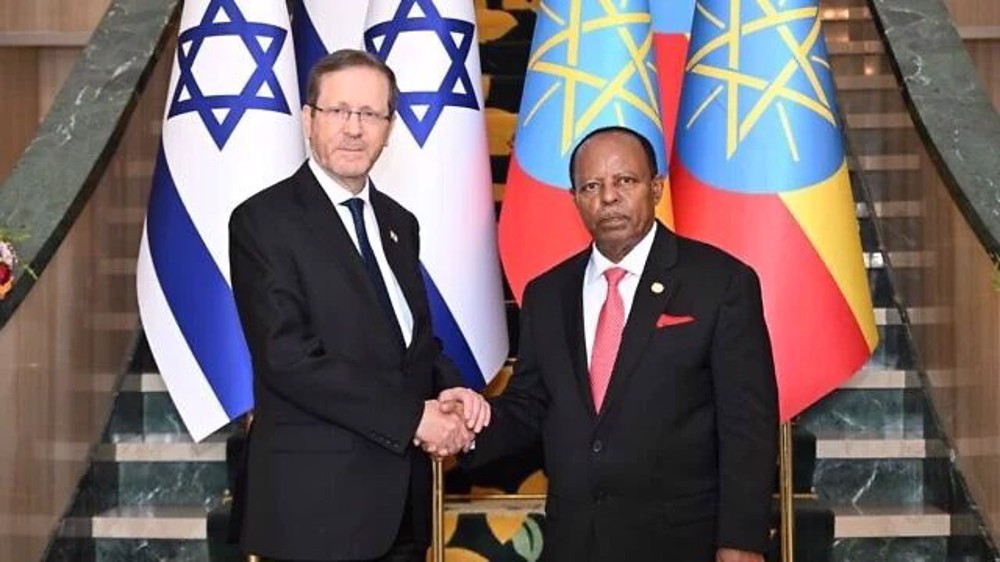
Israeli president Isaac Herzog has been on a two-day visit to Ethiopia as part of Tel Aviv’s regime’s renewed push to expand its footprint in Africa.
Herzog met with Ethiopian President Taye Atske Selassie and Prime Minister Abiy Ahmed, who said the two sides talked about “ways to improve collaboration in areas of mutual interest,” without revealing further details.
In Addis Ababa, Herzog told Abiy that some in Africa and beyond are trying to undermine Israel’s relationships in Africa.
Israeli authorities have framed the latest trip as strengthening and expanding cooperation with African nations.
Herzog’s office emphasized longstanding diplomatic and cultural ties, including the migration of Ethiopian Jews to Israel.
The visit follows Israel’s December 2025 decision to recognize Somaliland as an independent state, which opened the door to direct institutional engagement between the two sides.
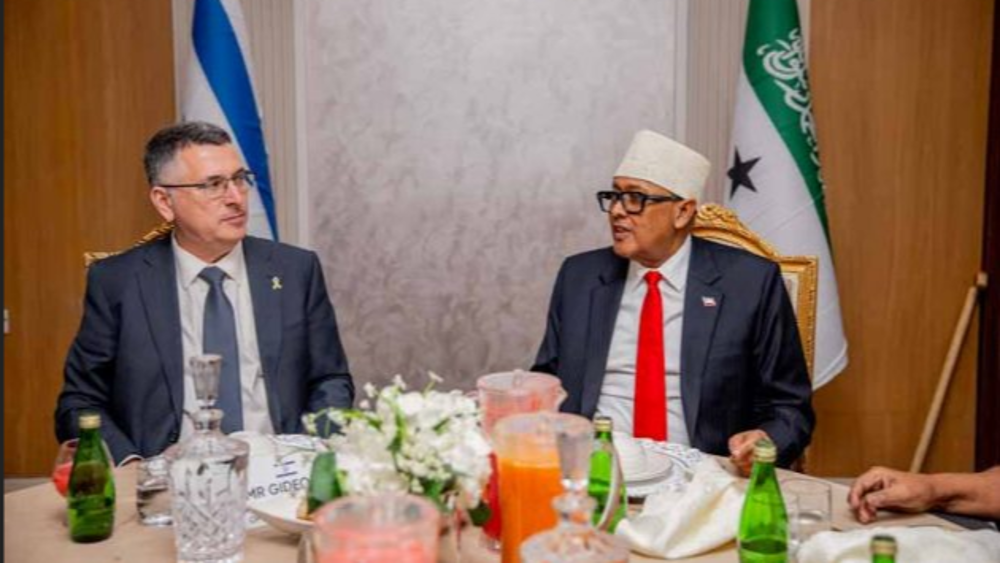
The first official delegation from Somaliland arrived in Israeli occupied territories on Tuesday marking the first official visit by the breakaway Somali territory since Israel recognized it as an independent state late last year.
Somaliland President Abdirahman Mohamed Abdullahi previously said that the territory is seeking a “partnership agreement” with Israel centered on its “very rich” mineral resources in exchange for Israeli technology.
The recognition of Somaliland appears to be part of a wider attempt to establish a forward presence near sensitive shipping routes.
Strategically, Somaliland sits near the Bab el-Mandeb Strait, a chokepoint linking the Red Sea and the Indian Ocean.
Control and monitoring of this corridor have become central to Israeli calculations, particularly amid Red Sea tensions connected to the Israeli brutal aggression in Gaza.
Senior Israeli authorities, including foreign minister Gideon Sa'ar, have stated that Israel's decision to recognize Somaliland is closely tied to countering threats posed by the Ansarallah resistance movement in Yemen.
The recognition of Somaliland has already triggered strong condemnation from Somalia, the Organization of Islamic Cooperation, and several Arab and African states.
Mogadishu described the move as a violation of its sovereignty.
On December 31, Somali President Hassan Sheikh Mohamud said that Somaliland agreed to resettle Palestinians expelled from Gaza, host an Israeli military base on the Gulf of Aden, and join the so-called Abraham Accords in exchange for recognition, calling the move “very unexpected and strange.”
He warned that the move could destabilize the Horn of Africa and facilitate the forced displacement of Palestinians, citing intelligence that Somaliland accepted conditions including resettlement and Israeli military access near the Gulf of Aden.
Observers say securing deeper ties with Addis Ababa, a key actor in Red Sea and Nile Basin politics, serves Israel’s broader strategy of projecting influence along critical maritime corridors.
Egypt’s foreign minister earlier warned counterparts in Somalia, Turkey, and Djibouti of “dangerous developments” in the Horn of Africa.
Cairo said recognizing breakaway regions undermines Somalia’s “unity and territorial integrity” and threatens “international peace and security.”
Turkish officials have likewise warned that the Horn of Africa should not become a “battlefield of foreign forces,” a pointed critique of Israeli maneuvering.
Beyond maritime strategy, Israel’s outreach to Ethiopia intersects with the contentious Grand Ethiopian Renaissance Dam (GERD) dispute involving Egypt and Sudan.
At the same time, Israel has pursued broader re-engagement with African states. This includes reopening embassies and offering military assistance to select governments.
Israel has now formally accepted the appointment of Somaliland’s first ambassador to Israel, Mohamed Hagi, who was an advocate for Israel-Somaliland relations.
The campaign comes amid efforts to counter growing African criticism of the Israeli brutal aggression in the besieged Palestinian territory.
South Africa, in particular, has emerged as a leading critic, drawing parallels between apartheid-era policies and Israel’s war against Palestinians.
By strengthening bilateral ties with countries such as Ethiopia, Zambia, South Sudan, and Nigeria, Israel appears to be attempting to fracture African consensus and dilute diplomatic pressure.
‘Governments continue to fail’: Freedom Flotilla sails again to break Israel’s Gaza blockade
Israeli soldiers who gang-raped Palestinian abductee file lawsuit for $6 million
Israeli military bars activists from aiding Palestinians in besieged West Bank village



VIDEO | ‘US escort a big lie’: IRGC unveils decisive targeting of non-compliant vessels in Strait of Hormuz
IRGC strikes 3 US-linked vessels, 3 trespassing oil tankers in retaliation for American attacks
VIDEO | Trump downplays costs, consequences of war on Iran
VIDEO | News Review: Trump downplays war on Iran, calling it 'small potatoes'
Iran condemns US attacks on oil tankers as violation of international law
VIDEO | News Review: US attacks Iran oil tankers
VIDEO | Nuclear madness: Who can stop Trump?
Iran military warns US of ‘more severe blows’ to warships if aggression continues



 PressTV NEWSLETTER
now
PressTV NEWSLETTER
now
 This makes it easy to access the Press TV website
