

Iran’s security chief says while Tehran pursues negotiations, it keeps deterrence in place in the face of any act of aggression against the country.
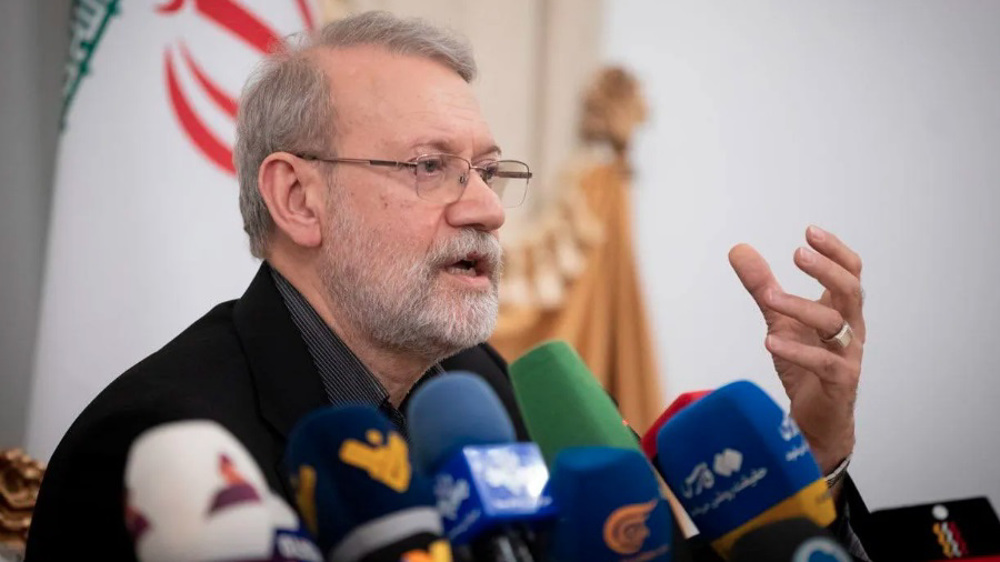
"Iran is not seeking war, but will not surrender in the face of threats, and it relies on a combination of negotiations and deterrence," Secretary of Iran’s Supreme National Security Council (SNSC) Ali Larijani said in an interview with al Jazeera on Sunday.
He added that Iran has increased its level of preparedness and is currently ready to engage in fair negotiations about its peaceful nuclear program to remove concerns without harming national security.
Larijani noted that he had not delivered any written response on the part of Iran concerning US demands during his visit to Oman last week, saying what took place was an exchange of views that is still going on.
He reiterated that regional countries support the achievement of a political solution to Iran's nuclear issue.
During his visit to Muscat on Tuesday, Larijani held talks with senior Omani officials, including Sultan Haitham bin Tariq and Foreign Minister Badr bin Hamad Al Busaidi. The visit came amid preparations for further indirect nuclear talks between Iran and the United States.
Discussions mainly focused on the latest regional and international developments, as well as ways to strengthen bilateral cooperation between the two countries.
Iranian and American delegations, led by Foreign Minister Abbas Araghchi and US Special Envoy Steve Witkoff, resumed nuclear talks in Muscat on February 6, months after Israel’s aggression in June 2025. The Omani foreign minister was shuttling between the sides, with the talks being held indirectly as before.
Larijani further said Tehran regards the negotiations with Washington as positive, provided that they are fair and reasonable and do not serve as a tool for buying time or imposing issues outside the nuclear framework.
He noted that these negotiations should only be about the nuclear issue and nothing else.
He said Iran's missile program has nothing to do with the negotiation and was not discussed during the recent talks with the US, as it is a matter of national security, saying, “Defensive deterrence is non-negotiable.”
"What Mr. Trump announced was that Iran should not move towards [obtaining] nuclear weapons. They (West) should address our concerns. We also completely agree on not moving towards [obtaining such] weapons, so there is a common and reasonable issue that can be the subject of discussion between the two sides," he added.
The top security official emphasized that Iran accepts the International Atomic Energy Agency’s monitoring of its nuclear sites but only as per the Nuclear Non-Proliferation Treaty (NPT).
He rejected “unrealistic” talks about Iran’s "zero enrichment", adding that the country has legitimate medical and research needs and that nuclear knowledge cannot be eliminated by political decisions.
Larijani pointed to the possibility of a large-scale war and said that based on past experience, escalating tensions has not been to the benefit of the initiators.
He, however, emphasized that Iran is prepared for all scenarios but does not seek to fuel the conflict.
The SNSC secretary added that the positions of Saudi Arabia, Turkey, and Egypt in opposing military action against Iran showed their understanding of its dangers to the entire region and expressed Tehran’s readiness to strengthen relations based on mutual respect.
On Iran’s cooperation with China and Russia, he said that such cooperation is based on shared interests, saying their support for Tehran at the UN Security Council reflects a political partnership.
Iran’s pivot to the East has been a result of the West’s failure to fulfill its promises, he pointed out.
US President Donald Trump has escalated his rhetoric in recent months and repeatedly threatened military action against Iran.
Trump has deployed military forces to the region, heightening concerns about possible new military action. US officials said on February 12 that the Pentagon was sending an additional aircraft carrier to the region, adding thousands more troops along with fighter aircraft and guided-missile destroyers.
In late January, Trump spoke of “another beautiful armada” of warships heading toward Iran and claimed that failure to reach a deal would bring consequences “far worse” than the strikes on Iranian nuclear facilities in June 2025. Anti-war organizations, however, caution that another confrontation would be disastrous, pointing to the 12-day war as a stark example.
On June 13, 2025, Israel launched strikes on Iran, killing civilians and senior commanders and nuclear scientists.
The US also joined the war by attacking three of Iran's nuclear facilities.
The Islamic Republic, however, managed to impose a halt to the criminal aggression through its successful retaliatory attacks.
 This makes it easy to access the Press TV website