
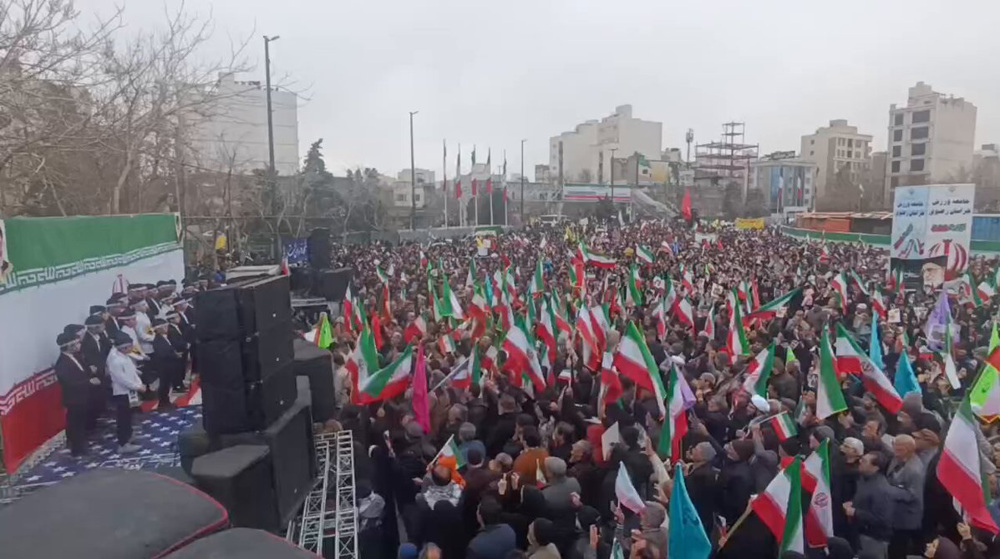
The large crowds marking the 1979 Islamic Revolution anniversary show Iran's strength and authority, offering firm backing to the country’s representatives in ongoing diplomatic efforts, senior Iranian officials say.
Foreign Minister Abbas Araghchi said the public presence carried a clear message to the world and strengthened Iran’s position in diplomacy and negotiations.
“We are encouraged in the fields of diplomacy and negotiations by our people and our armed forces,” he stated.
He said the participation reassures officials that they have the nation’s support and that the armed forces of the Islamic Republic remain firmly committed to defending the country.
Araghchi described the anniversary as a “good day,” pointing to the “magnificent” participation and public backing of the Islamic Republic’s diplomatic path.
“Our hearts are warmed by the people, the armed forces, and the leadership,” he said, adding that such support would translate into a stronger presence in diplomatic arenas.
He also noted that the time and location of the next round of negotiations have not yet been determined.
Minister of Petroleum Mohsen Paknejad, speaking on the sidelines of the rallies, congratulated the nation on the anniversary and said the Iranian people have consistently stood by the ideals of the Revolution.
Referring to oil sanctions, viewed in Tehran as part of a broader campaign of economic pressure led by the US and supported by Israel, he said his fellow colleagues in the energy sector have developed solutions to remove existing restrictions.
“We will not face serious problems,” he said, stressing that oil sales will continue despite the measures imposed on the country.
Defense Minister Brigadier General Aziz Nasirzadeh described this year’s turnout as unprecedented.
“I have never seen such an enthusiastic presence in any year,” he said. He added that the Iranian people are fully aware of global developments and took part with clear understanding.
According to Nasirzadeh, “this presence is more powerful than any bomb or missile.” Addressing threats from hostile powers, he said Iran would respond with full strength in ways “the enemies cannot imagine.”
Intelligence Minister Esmail Khatib said the rallies gave concrete expression to national unity, a principle repeatedly emphasized by the president. He stated that unity has now moved from mere words to reality through public participation.
Asked how cohesion can be preserved, Khatib said the best path forward is mutual support, constructive engagement, and respectful tolerance of differing views.
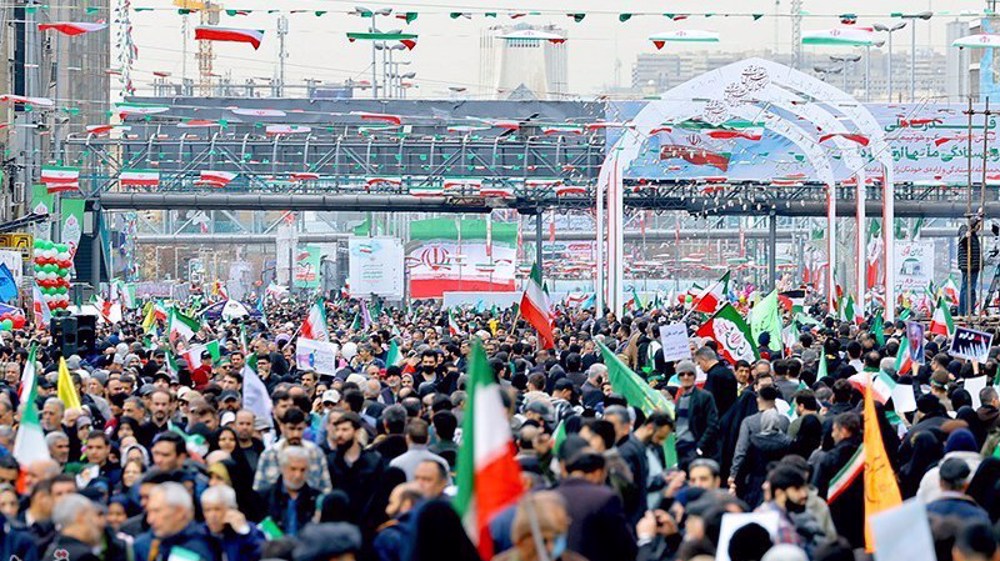
Education Minister Alireza Kazemi described the demonstrations as a manifestation of national authority and legitimacy.
He said the turnout serves as the “best response” to hostile rhetorics and plots in the international arena, particularly from Israel and its Western supporters.
According to Kazemi, alignment between the military, law enforcement, and the public provides strong backing for the government and its diplomatic efforts, with positive outcomes abroad.
Judiciary Chief Gholamhossein Mohseni-Eje'i joined marchers in Tehran and renewed allegiance to the ideals of the Revolution’s founders.
He said people across Iran created an epic scene “more magnificent than in previous years,” and displayed their determination in support of the establishment, Islam, and the country.
Eje'i said the rallies carried two clear messages. The first, he said, was directed at “treacherous and oppressive enemies” who have recently resorted to insults and threats.
“The people of Iran today delivered a firm and crushing response to these empty words,” he said, adding that citizens signaled readiness to defend their homeland more than ever.
The second message, he noted, was aimed at officials themselves. He said authorities must intensify efforts to address public concerns, work tirelessly to resolve problems, and ensure security and welfare.
“We must never separate ourselves from the people,” he said, adding “These people, who have always stood by the Revolution, deserve the highest level of service.”
During the march in Tehran, the head of the Judiciary spoke directly with participants and listened to their concerns, underscoring efforts to present the anniversary not only as a symbolic event but also as a sign of continued public engagement in the face of sustained foreign pressure.
 This makes it easy to access the Press TV website