Israeli agricultural exports face looming 'collapse' amid global boycotts over Gaza genocide
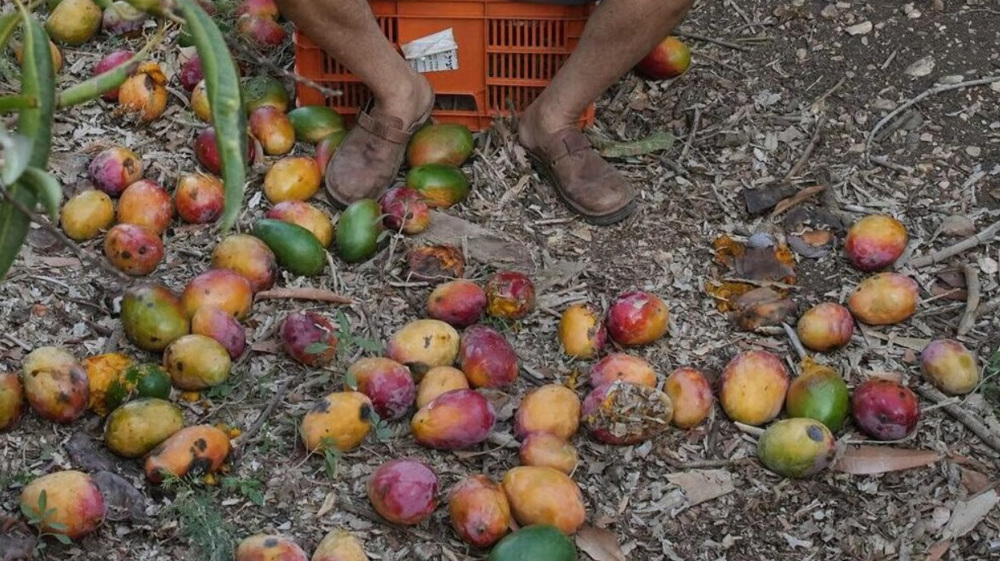
The Israeli regime’s agricultural export sector is facing a severe downturn, with farmers and industry representatives warning of a looming “collapse” as overseas markets increasingly reject Israeli products in the wake of the genocidal war on the Gaza Strip.
In recent months, the regime’s public broadcaster, Kan 11, has aired multiple reports documenting growing difficulties in exporting fruits, particularly citrus and mangoes, to Europe and Asia.
Farmers interviewed in the reports described widespread order cancellations, mounting financial losses, and unsold produce rotting in fields and storage facilities.
According to the broadcaster, international buyers turn away from Israeli goods, with growers saying European importers increasingly avoid the produce when alternatives are available.
“They don’t want our mangoes,” one grower told Kan 11. “They talk to us only if they’re missing something. If they have an alternative, they avoid buying from us.”
The export crisis has also been compounded by shipping disruptions linked to retaliatory and solidarity operations by Yemen's Ansarullah resistance movement.
The Yemeni missile and drone units began conducting hundreds of such operations since the launch of the genocide in October 2023. The strikes would prompt Israeli ships, and ships headed either towards or out of the occupied territories, to take longer routes, which would significantly raise import and export costs for the regime.
Eilat port ‘almost completely paralyzed’ due to Yemen’s pro-Palestinian operations: Reportshttps://t.co/1IxP7ZHJka
— Press TV 🔻 (@PressTV) January 13, 2026
Farmers said the rerouting has undermined access to Asian markets, with shipments arriving weeks late and suffering quality damage.
Citrus growers have been particularly affected. In a late November report titled “End of the Orange Season,” Kan 11 documented orchards at Kibbutz Givat Haim Ichud in the occupied territories, where growers warned that entire plantations could be uprooted due to a lack of export orders. Orchard manager Nitzan Weisberg said European cancellations since the war had left growers selling at a loss.
“Israeli fruit, despite its high quality, is currently less desired in Europe,” Weisberg said. “If this continues, it will lead to collapse.”
At nearby Kibbutz Ein Hahoresh, third-generation grower Gal Alon said his family decided not to export at all after the war began, relying instead on local markets.

In Hibat Zion, elsewhere in the occupied territories, farmer Ronen Alfasi said warehouses were full, while fruit exceeded export size limits and had to be sold inside the territories for juice.
Daniel Klusky, secretary-general of the Israeli citrus growers’ association, said exports had come to a halt. “Before the war, we were exporting to Scandinavia,” he said. “After the war, we haven’t exported even a single container.”
Some farmers interviewed, meanwhile, said they would rather incur losses than sell produce to war-torn and starving Gaza, some citing alleged “security” concerns.
Since it began in October 2023, the Israeli genocidal war on Gaza has killed at least 71,550 Palestinians and left 171,365 others injured.

Yemen's control of Bab al-Mandab 'deepens crisis' in Israel

US senator slams ‘bogus’ spy claims, demands immediate release of Press TV journalist

Israeli occupation court extends detention of Press TV journalist Naqaa Hamed



Blast rocks military site in Syria’s Dayr al-Zawr, killing 11 HTS forces
EU urges US to reconsider visa denial for Palestinian UN delegation
Iran dismisses White House accusations as ‘flight from reality,’ ‘act of projection’
Pentagon probe finds ‘cascade of preventable failures’ behind US strike on Minab school
Iranian CO2 recovery project named a finalist of 2026 WPC Energy Excellence Awards
BRICS paving way for alternative world order, not a war machine against West: Analyst
Iran, Pakistan FMs discuss regional developments, energy supplies
VIDEO | Black smoke, flames rise near Riyadh airport amid Yemen strikes



 PressTV NEWSLETTER
now
PressTV NEWSLETTER
now
 This makes it easy to access the Press TV website
