Gen. Soleimani fought terrorism and exposed the fallacy of West's 'war on terror'
By Dina Y. Sulaeman
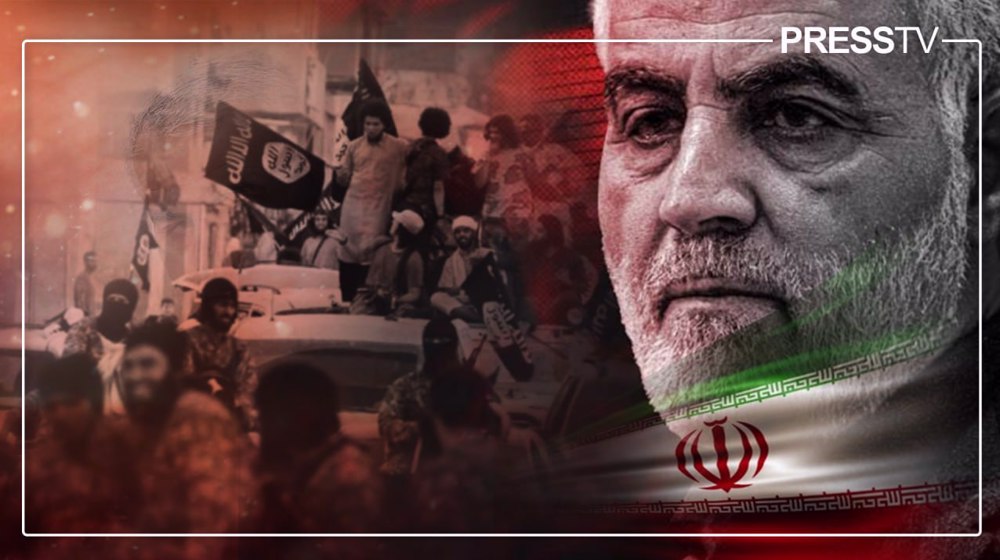
This week marks the sixth anniversary of the martyrdom of General Qassem Soleimani, a pivotal figure in the contemporary West Asia (Middle East) and a steadfast defender of the region's security and sovereignty.
More than a celebrated military commander, General Soleimani was a brilliant strategist, instrumental in curbing the spread of chaos, particularly in countering the rise of Takfiri extremist and terrorist groups.
His assassination was not merely the loss of a key anti-terror figure but also exposed a striking paradox at the heart of the Western narrative on the so-called “war on terror.”
For Iran and its allies, involvement in Syria was never a project of territorial or ideological expansion, but a strategic effort to prevent regional disintegration fueled by the rise of Takfiri terrorist groups.
These extremist militia groups operated with the support of — and in the interests of — the United States and the Israeli regime.
General Soleimani consistently emphasized that Syria represented the “front line of resistance” against forces capable of undermining regional peace and stability.
In his view, the fall of Syria would not only devastate the Arab country itself but also open the door to far-reaching chaos across West Asia. It was within this context that General Soleimani helped build what is today known as the Axis of Resistance — a political, military, and social network linking Iran, Iraq, Syria, Lebanon, and Palestine.
The objective was never the expansion of Iranian political or ideological influence, but the establishment of a defensive line against terrorist groups exploiting sectarian divisions to widen their reach, acting on behalf of external powers who thrive on regional destabilization.
A look into the life of Martyr Lieutenant General Qassem Soleimani and his role as a chief strategist of a multi-national front against global arrogance.
— Press TV 🔻 (@PressTV) January 2, 2026
Follow: https://t.co/LWoNSpkJSh pic.twitter.com/C8LhRh7pxO
Through this approach, he aimed to contain the spread of terrorism and extremism that could cross borders and undermine the broader movement to defend Palestine.
The assassination of the top anti-terror commander in January 2020 marked a decisive turning point. Following his death, the dynamics of the region shifted dramatically. In the ensuing years, groups operating under the banners of Daesh and al-Qaeda were bolstered to serve the interests of Western powers and the Israeli regime.
By the end of 2024, Hay’at Tahrir al-Sham (HTS) — long designated as a terrorist organization — managed to seize power and overthrow Bashar al-Assad’s government, aided by certain regional and international actors who had long plotted Assad's fall.
Ironically, HTS, once considered a global threat, is now treated as a legitimate political partner by the United States and many European countries. It has been welcomed in international forums, hosted by major nations, and gradually legitimized as a “rational” and “collaborable” political actor.
This “normalization of terrorism” illustrates how fluid the standards for defining terrorism have become. Labels once applied with certainty can now be revoked at a moment’s notice, depending entirely on the shifting geopolitical interests of Western powers.
Syria, once a cornerstone of the resistance against the illegitimate Israeli regime, has now become one of the West’s vassal states, either unwilling or unable to act against Israel’s illegal occupation of the Golan Heights and southern regions of Syria, including the strategically vital Mount Hermon.
Beyond the battlefield: General Soleimani’s strategic and diplomatic legacy
— Press TV 🔻 (@PressTV) January 2, 2026
Follow Press TV on Telegram: https://t.co/LWoNSpkc2J pic.twitter.com/LsXmGbqj7z
The new Syrian regime, having won favor with US President Donald Trump, also appears largely passive in the face of the ongoing genocide in Gaza, which has claimed more than 71,000 lives so far.
This shift in posture has eroded moral legitimacy. The narrative that once inspired support from across the globe, including tens of thousands of foreign fighters from countries such as my own, Indonesia, has gradually lost its appeal, as reality exposes a willingness to compromise with forces it had previously denounced.
The global community is increasingly recognizing that the term “terrorism” often reflects a political position rather than an action.
The clearest evidence lies in the West’s continued labeling of Palestinian resistance groups — such as Hamas and Islamic Jihad — as well as Lebanon's Hezbollah and Yemen’s Ansarullah, as “terrorist organizations.”
From the outset, the assassination of General Soleimani exposed the absurdity of US rhetoric on terrorism and the so-called “war on terror.” Why target a figure who devoted his life to fighting terrorism in the region, by a country that claims to lead the global fight against it?
The West’s double standards have become so blatant that public awareness is growing, creating space for a more critical reading of global security discourse.
It is within this context that the martyrdom of General Soleimani assumes a deeper meaning. He gave his life as part of a resistance movement against a global order willing to sacrifice millions in the region to protect the true perpetrators of terrorism — the Zionist regime.
His assassination laid bare the real criminals and exposed the West’s project of a “war on terror” for what it truly is: a “war for terror.”
(Dina Y. Sulaeman is an Assistant Professor in the Department of International Relations at Universitas Padjadjaran, Indonesia)
(The views expressed in this article do not necessarily reflect those of Press TV.)
New resolution and UNSC referral show IAEA continues to be weaponized by US, Europe against Iran

The farce of ‘war on terror’: How US military-industrial complex bred terrorism after 9/11 attacks

How US imperialism dehumanizes the 'other' to justify ghastly war crimes and escape accountability



VIDEO | Press TV's news headlines
VIDEO | Austria bars Iranian nuclear chief from IAEA conference
Iran FM, Lebanese speaker discuss Zionist aggression, reaffirm support for resistance
VIDEO | Mokha residents welcome Sana'a forces after 9 years of proxy rule
Saudi regime seeks British strikes on Yemen after US refusal
No talks until Iran’s conditions are met: SNSC chief
Supertanker explodes after hitting mines on illegal route south of Hormuz: IRGC Navy
VIDEO | Global economy suffers Hormuz closure


 PressTV NEWSLETTER
now
PressTV NEWSLETTER
now
 This makes it easy to access the Press TV website
