From Zionism to Daesh, the battles that defined Gen. Soleimani's illustrious legacy
By Chris Williamson
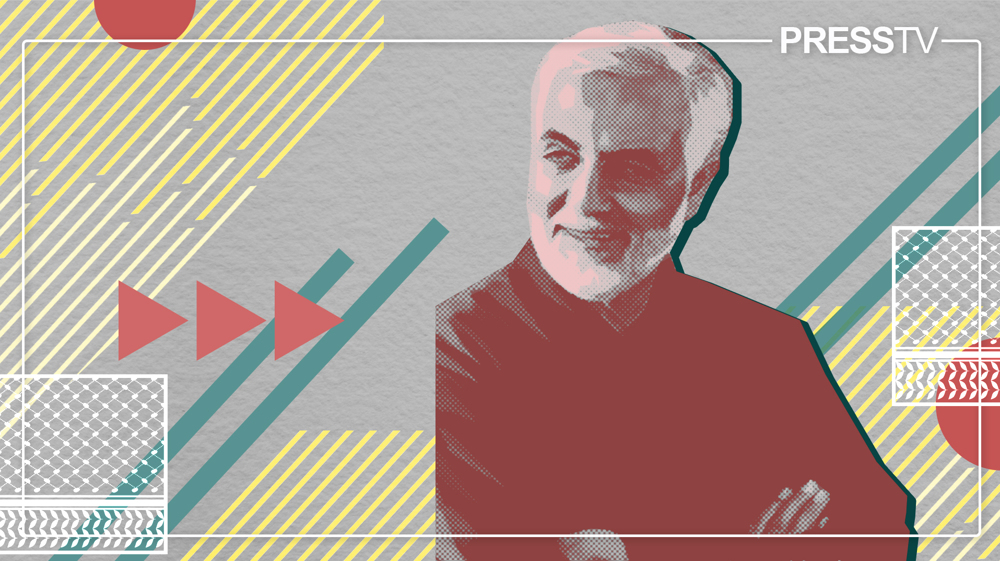
General Qassem Soleimani was a contemporary of mine, who was born just six months after I was, and we both lived through tumultuous worldwide change.
Although I never had the privilege of meeting the great man, I still felt a real affinity with him. I was enormously impressed and inspired by his leadership in the struggle against two of the twenty-first century’s greatest evils, namely Zionism and Wahhabism (Takfirism).
Indeed, less than a year before he was assassinated, General Soleimani spoke about the threat posed by Wahhabism in the West Asian region.
He said Wahhabism was linked to Zionism, and highlighted how Daesh (ISIS) had embraced it, resulting in the deaths of hundreds of thousands of innocent civilians and the demolition of over 3,000 mosques.
General Soleimani was widely regarded as a genius of asymmetric warfare, and he masterminded the battle against the Daesh terrorist group (ISIS), which led to its ultimate defeat. Before his involvement, Daesh (ISIS) had made substantial territorial progress, seizing large parts of northern and central Iraq, including the strategic city of Mosul.
He became directly involved in the battle against Daesh in mid-2014 as commander of the Islamic Revolution Guards Corps (IRGC) elite Quds Force.
For that reason alone, the civilised world has every right to be thankful to General Soleimani for his strategic brilliance in leading the fight back against Daesh on behalf of humanity.
By contrast, the Zionist entity was providing medical assistance to Daesh terrorists as the anti-terror commander was leading the efforts to defeat and decimate them.
But rather than honouring General Soleimani for the pivotal role he played in protecting civilisation from the marauding Daesh savages, US President Donald Trump outrageously sanctioned his assassination on January 3, 2020, near the Baghdad International Airport while he was in Iraq at the invitation of the Iraqi government.
Even though Trump is an unpredictable maverick, I was still shocked to the core that he would sanction such an atrocity.
🇮🇷
— Press TV 🔻 (@PressTV) December 31, 2025
WATCH: Assassinated in Baghdad, immortalized in history: General Soleimani’s name refuses to fade. pic.twitter.com/JC3uhlFUD3
It displayed an arrogant disregard for international law, and despite their denials, it was undertaken with the connivance of the Zionist entity, whose intelligence agencies reportedly provided critical information to facilitate Trump’s murder mission.
In fact, Israel’s involvement was confirmed the following year by the former chief of its military Intelligence Directorate, Tamir Heyman, who was in post at the time.
Agnes Callamard, the United Nations special rapporteur on extrajudicial, summary or arbitrary executions, said that the assassination of General Soleimani was a clear violation of the UN Charter.
In her report, she concluded that “the targeting of General Soleimani, and the deaths of those accompanying him, constitute an arbitrary killing which, under international human rights law, the US is responsible."
But it wasn’t so much the part the Iranian commander played in defeating Daesh that made him a target. It was his unshakeable and practical support for the Palestinian people’s struggle against Zionist brutality.
He enabled the Palestinian resistance in Gaza to obtain the weapons, ammunition and missiles to respond to the Zionist entity’s occupation and tyrannical aggression.
He even asked that the Russian-made Kornet missiles belonging to the Hezbollah resistance movement in South Lebanon be transferred to Gaza instead. He also helped to dig the network of tunnels in Gaza that has proved so effective in frustrating the Zionist entity’s attempt to crush the resistance.
General Soleimani’s selfless support for the Palestinian people was recognised by top leaders of the Palestinian resistance, including Ismail Haniyeh and Yahya Sinwar, both of whom were martyred last year.
Sinwar paid a particularly moving tribute to General Soleimani in 2020 when he said: “In 2017, Major General Soleimani communicated with the Izz ad-Din al-Qassam Brigades and the al-Quds Brigades, confirming that Iran, the Revolution Guards, and the al-Quds Force all stand with our people with everything they possess, in defence of al-Quds so that it remains the State of Palestine’s capital. He clearly stated that all our capabilities and potential are at your disposal in defence of al-Quds. Soleimani did not stipulate (any conditions) or ask for anything in return.”
Iran holds intl. event to mark 6th martyrdom anniversary of General Soleimani@TillDLastBreath reports from Tehran.
— Press TV 🔻 (@PressTV) December 31, 2025
Follow: https://t.co/mLGcUTS2ei pic.twitter.com/94eXil2CJ6
Sinwar added, “I sat with the man when I visited Tehran in 2012. I saw a man who loves Palestine, loves Jerusalem (al-Quds), and loves anything that could bolster the steadfastness of our people.”
Haniyeh was also effusive in his praise of General Soleimani.
“The martyr commander Soleimani sacrificed himself for Palestine and its people, so he is ‘The Martyr of al-Quds’,” he said at the late Iranian general's funeral.
It is obvious that General Soleimani had been a thorn in the side of Israel and its Western backers for many years. This included resisting illicit attempts to eject President Bashar al-Assad in Syria, who was a strong supporter of the Palestinian resistance factions.
This predictably resulted in a relentless campaign by Israel, MI6 and the CIA to facilitate a coup against Assad. All three have a long and reprehensible record of illegitimate clandestine activities in other countries around the world to destabilise legitimate governments that they didn’t like.
But much to their chagrin, General Soleimani successfully thwarted their repeated attempts by orchestrating a disparate range of pro-government forces in Syria to repel their attempts to overthrow Assad.
One prominent Syria analyst at the Institute for the Study of War, said, “Qassem Soleimani is the man who saved Bashar al-Assad from a fate like Gaddafi. Soleimani was the architect of a ‘foreign internal defence’ strategy in 2012 that stabilized the Syrian government's internal security posture at a time when Damascus was either losing or ceding territory to the rebels throughout the country.”
But it wasn’t just General Soleimani’s military acumen in defeating Daesh and saving the pro-Palestinian Assad administration, for which he was renowned. He was also instrumental in defeating the Zionist military interlopers when they were ousted from Lebanon back in 2006.
He sent military assistance to Hezbollah and was present in Lebanon himself to help oversee the operations against the Israeli regime. Hezbollah called him the field commander of the Axis of Resistance.
🎥 The Good Commander
— Press TV Documentary (@presstvdoc) December 28, 2025
🔻Who was General Qassem Soleimani, and why was he so popular?
📺Tune into Press TV
🗓 Premieres Tue, Dec. 30 | 06:30 GMT
📺 Rebroadcasts:
Wed 10:30 & 20:30 | Thu 01:30 | Fri 07:30 | Sat 14:30 |Sun 04:30 GMT pic.twitter.com/WhDa8YqUOr
It is for these reasons that a remotely controlled US Reaper drone from a US air base in Nevada fired three Hellfire missiles at the two-vehicle convoy carrying General Soleimani. The deputy leader of the Iraqi Popular Mobilisation Forces, Abu Mahdi al-Muhandis was also assassinated along with eight others who were accompanying Soleimani in the convoy.
When General Soleimani’s death was announced, Daesh claimed it was an “act of divine intervention” rather than a cold-blooded murder by the US military, aided and abetted by the Zionist entity.
Then, just under five years after General Soleimani’s assassination, Assad was toppled by a combination of former Daesh and al Qaeda fighters with the blessing of Israel and the US.
He was replaced as Syria’s president by Abu Mohammad al-Jolani, who in 2021 stated that he was seeking a new relationship with the West because he said his fight was with Assad, not the US. The subsequent events that unfolded in Syria would have been unthinkable had Soleimani still been around.
Although he has been taken from us, his legacy lives on and will continue to inspire resistance against tyranny long into the future.
From his humble beginnings as the son of a farmer, he joined the IRGC after the 1979 Islamic Revolution against the brutal Shah of Iran, who was installed after MI6 facilitated a coup in 1953 against prime minister Mohammad Mosaddegh’s democratically elected government, to enable Western oil companies to continue pillaging Iran’s oil reserves.
General Soleimani went on to serve in the Iran-Iraq war (Holy Defense war) and rose through the ranks until he was appointed commander of the IRGC’s elite Quds Force in 1998. It was in that role that he became a symbol of hope, courage and defiance in the face of adversity.
That spirit of hope, courage and defiance is alive and kicking throughout West Asia, particularly in Gaza, where despite everything that the genocidal Zionist entity has thrown at them, the Palestinian resistance remains undefeated.
When Zionism is consigned to the dustbin of history, General Soleimani will still be remembered and venerated as a beacon of hope that enabled the people to vanquish the forces of darkness.
Chris Williamson is a former Labour MP and Shadow Minister, who served in British Parliament from 2010–2015 and 2017–2019. He also hosts Palestine Declassified show on Press TV.
(The views expressed in this article do not necessarily reflect those of Press TV.)
200 nights, one resilient nation: Iranian people’s epic in defense of homeland and Revolution
Iran’s nuclear industry will survive war and strikes as knowledge cannot be obliterated by force
New resolution and UNSC referral show IAEA continues to be weaponized by US, Europe against Iran



Handala hacker group publishes selfie images of 700 Israeli ‘security’ personnel
Iran Judiciary issues indictments against US, Israeli officials over assassinations
VIDEO | Intl. Nuclear Medicine Congress wraps up in Tabriz
Man convicted of spying for Israel, providing information on missile sites executed in Iran
ICRC: Palestinians in Gaza experience ‘death, destruction’ on daily basis
Trump announces ‘security’ agreement on Greenland after threatening to annex it
CPJ slams Israel’s abduction of Press TV journalist, demands her immediate release
‘Stop your crocodile tears’: Araghchi hits back at French FM over human rights allegations


 PressTV NEWSLETTER
now
PressTV NEWSLETTER
now
 This makes it easy to access the Press TV website
