
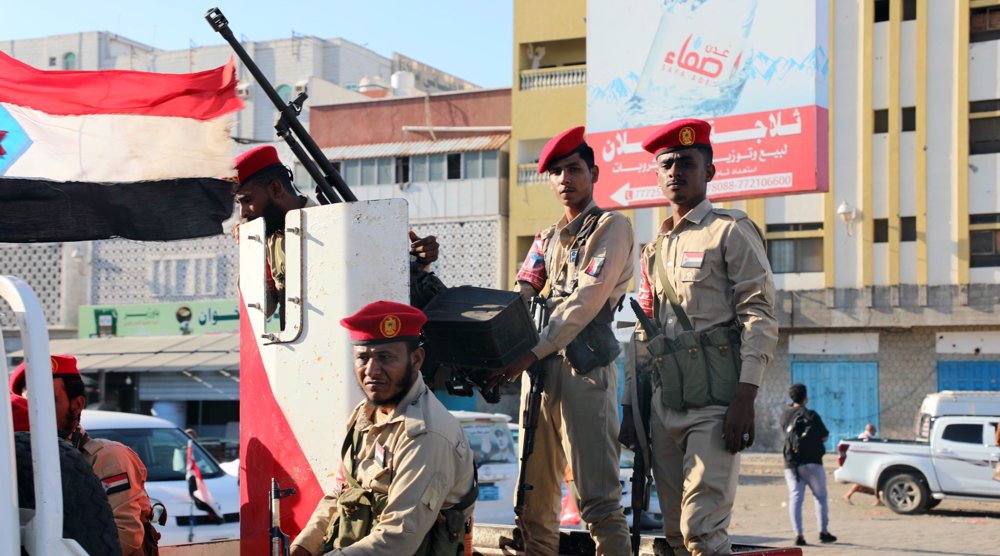
The Saudi-led military coalition says it would respond directly to any military activities by the UAE-allied Southern Transitional Council (STC) that disrupt ongoing de-escalation efforts in southern Yemen.
Colonel Turki al-Maliki, the spokesman for the alliance, said that the warning was issued following a request from Rashad al-Alimi, Chairman of the Saudi-backed fugitive government, to urgently implement measures allegedly aimed at safeguarding civilians in Hadramout.
Maliki said the request followed “serious and shocking humanitarian violations against civilians by armed elements affiliated with the Southern Transitional Council.”
The Saudi-led coalition's military spokesman noted that any military movements by STC that contravene de-escalation efforts will be dealt with directly and immediately.
He asserted that the objective is to safeguard civilian lives and support the success of initiatives to reduce tensions.
The coalition reaffirmed its “firm and continued” support for Yemen’s fugitive government, calling on all parties to uphold their national responsibilities, practice restraint, and engage with peaceful initiatives aimed at maintaining security and stability.
Saudi Defense Minister Khalid bin Salman Al Saud on Saturday warned the STC to withdraw from military camps in two Yemeni governorates and hand them over to local authorities.
At this critical juncture, the STC needed to prioritize rationality, wisdom, the greater public good, and unity by cooperating with Saudi-Emirati mediation efforts. This involved de-escalating tensions, vacating military camps in the governorates of Hadramout and al-Mahrah, and peacefully transferring control to the National Shield Forces and local authorities, the Saudi minister wrote on the social media platform X.
Tensions in Yemen intensified on December 3 as STC forces seized control of Hadramout after clashes with Saudi-backed militants. The STC subsequently extended its reach into the eastern governorate of al-Mahrah without encountering any reported resistance and has been recruiting local forces in both regions.
After the recent military expansion of the STC, Saudi Arabia carried out airstrikes on Friday, targeting STC positions. These included several sites used by the Hadrami Elite Forces in the Ghayl bin Yamin area near key oil fields. Reports indicate no casualties or damage to military equipment as a result of the strikes.
The STC announced on Friday that it is open to collaboration or agreements aimed at protecting what it referred to as mutual interests with Saudi Arabia, while addressing the aspirations of the southern Yemeni population.
The UAE has been a pivotal partner in the US-supported, Saudi-led war against Yemen and the Ansarallah-led government in Sana’a, which began in 2015. At the same time, Riyadh and Abu Dhabi have been engaged in a rivalry for control over Yemen’s resources and critical ports.
Critics argue that both countries are collaborating to divide Yemen in ways that align with their own agendas. They suggest that the push for local autonomy is merely a façade, concealing a deeper quest for influence, with Hadramout becoming a focal point of this competitive power struggle.
Yemen has experienced external interference for decades. Ansarullah wields significant authority in the northwestern territory, including the capital city of Sana’a.
The resistance movement has garnered global attention due to its actions aimed at Israel and its maritime operations in the Red Sea, especially in light of Israel's genocidal campaign in Gaza.
The United States and Israel have conducted deadly attacks in Sana’a, resulting in civilian casualties.
 This makes it easy to access the Press TV website