Iran unveils advanced simulator covering 300 civilian, military ships
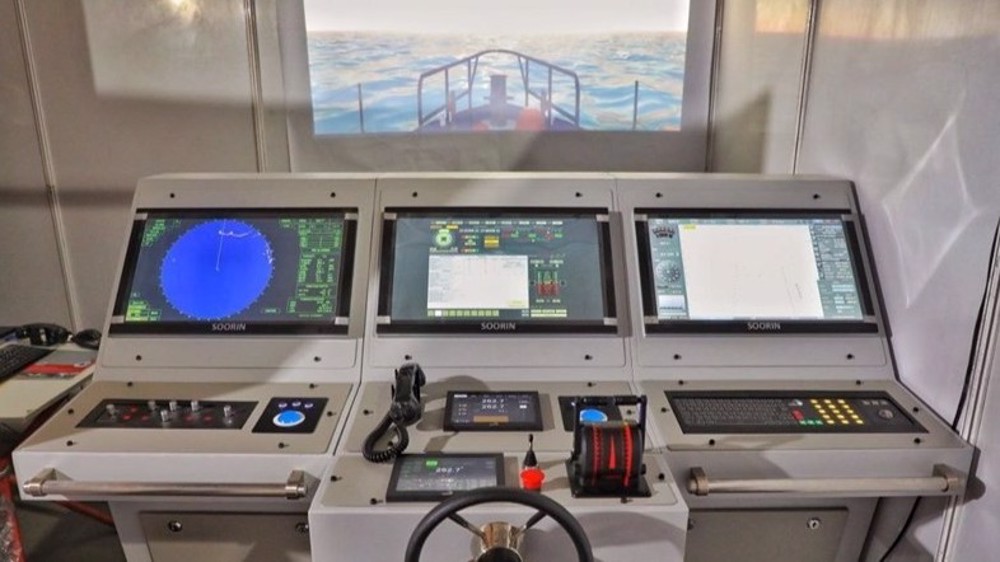
Iran has developed a domestically built command bridge simulator capable of replicating operations for 300 different civilian and military vessels, highlighting the country’s technical expertise in maritime training and simulation technologies.
The advanced system has been presented as a comprehensive educational reference for navigation and seafaring. It is capable of modelling 300 different types of vessels, ranging from lifeboats to large bulk carriers and military warships, according to those involved in the project.
Mohammad-Hossein Kardar, the operator and technical supervisor of the simulator, explained its capabilities in an interview with Tasnim News Agency on Friday, describing the system as a multi-purpose tool designed for a wide range of civilian and military applications.
“At present, we have data for 300 light and heavy vessels, covering everything from lifeboats to bulk carriers and warships,” Kardar said. “We have also successfully completed 14 projects.”
Kardar noted that four maritime training schools in the southern and northern port cities of Bandar Abbas, Khorramshahr, Bandar Torkaman, and Chabahar have been equipped with the system.
In addition to civilian use, he said the technology has been adapted for military purposes. “Two advanced military models, equipped with a combat information center (CIC) and a combat version, have also been launched for the army in Bushehr and Bandar Abbas,” Kardar said.
“Users can learn up to 90 percent of the required skills in this simulated environment and then enter real sea conditions with full readiness,” he added.

The simulator is designed to replicate real-world maritime scenarios, allowing trainees to gain hands-on experience without the risks and costs associated with live training at sea.
Such systems are widely used globally to improve safety standards and operational efficiency in both commercial shipping and naval operations.
Kardar added that four new projects are currently being implemented this year in the southern ports of Bushehr and Bandar Abbas.
He also pointed to the economic advantages of the domestically produced simulator. “The total cost of this simulator is variable, but on average it is about one-third the price of comparable foreign models.”
Iran has increasingly focused on developing indigenous technologies in recent years, particularly in sectors linked to transportation, defence, and strategic infrastructure, partly in response to the cruel sanctions that have limited access to foreign equipment.
Kardar said that while the simulator has not yet been exported, current efforts are focused on meeting domestic demand. “At present, there has been no export, and the focus is on internal customers, both military and educational,” he said.
He added that the system is continuing to evolve. “In addition to the command bridge, other sections such as an engine room simulator, liquid cargo loading operations, and cargo handling workshops are being added to this comprehensive system,” Kardar said.

Iran defeated US in 'Trump’s third war' midway: Leader's advisor
US military asks for ‘new’ ideas to deal with Iran after its crushing defeat: Report
How Iran’s two-week retaliatory strikes exposed cracks in US military architecture in Persian Gulf



VIDEO | Report: Around 80% of interceptors for US key missile defense system depleted
'Crime against civilians': Iran health minister condemns US attack on Lamerd stadium
Pezeshkian: Iran will support any negotiating decision by Palestinian leaders
VIDEO | Yemen will expand attacks if Saudi-led blockade continues: Analyst
Iran-Oman shipping talks unrelated to immediate Hormuz reopening: Report
Yemeni Armed Forces target another Saudi oil tanker in Red Sea
US pressuring African states to abandon ICC or face consequences: Report
UK court protects anti-Zionist beliefs


 PressTV NEWSLETTER
now
PressTV NEWSLETTER
now
 This makes it easy to access the Press TV website
