108 years of dispossession: How Balfour Declaration paved the way for Gaza genocide
By Press TV Website Staff
Earlier this week, marauding Israeli occupation soldiers killed siblings, Masa Muhammad Eid and Shaʿban Muhammad Eid, in central Gaza. Their cold-blooded murder came amid the so-called ceasefire that has been violated by the regime nearly 150 times in three weeks.
Like children elsewhere in the world, Masa and Sha’ban brimmed with joy and curiosity, despite the hell that the regime has wreaked in the besieged Gaza Strip since October 2023.
Nearly 70,000 Palestinians have been killed in Gaza — nearly half of them children, like Masa and Sha’ban. The besieged territory, often described as the world’s largest open-air prison, has been the epicenter of grief and devastation.
Yet the ordeal of the Palestinian people did not begin two years ago. Their suffering has roots that reach back more than a century — grounded in the illegal confiscation of their land, the demolition of their homes and livelihoods, the stripping of their rights, and the continued project of ethnic cleansing and extermination.
A “promise” that changed a nation’s fate
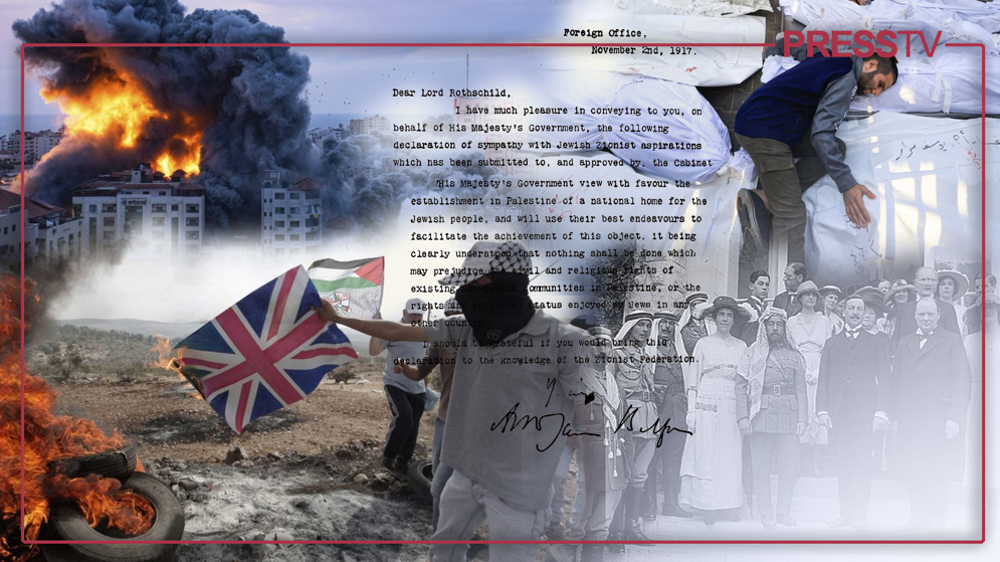
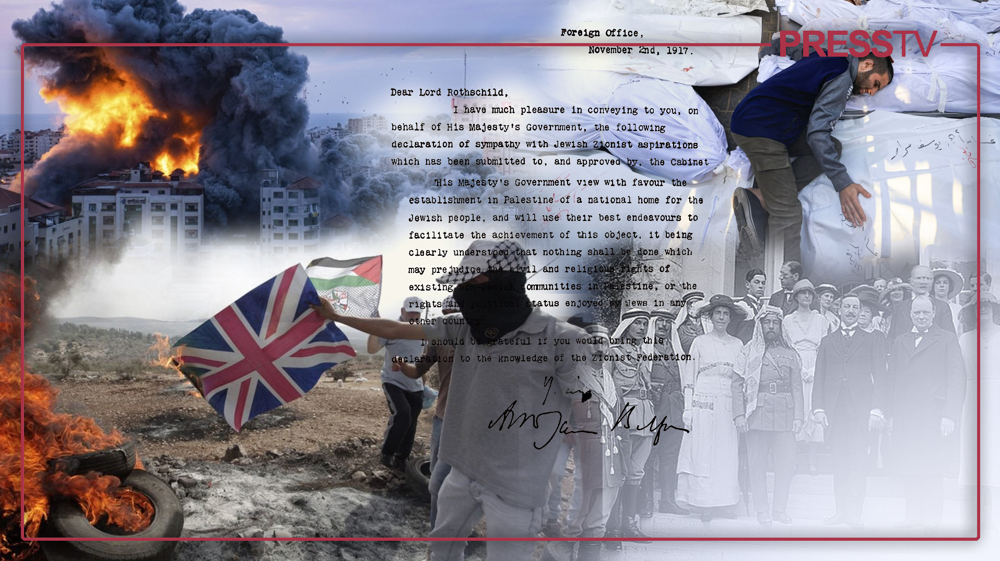
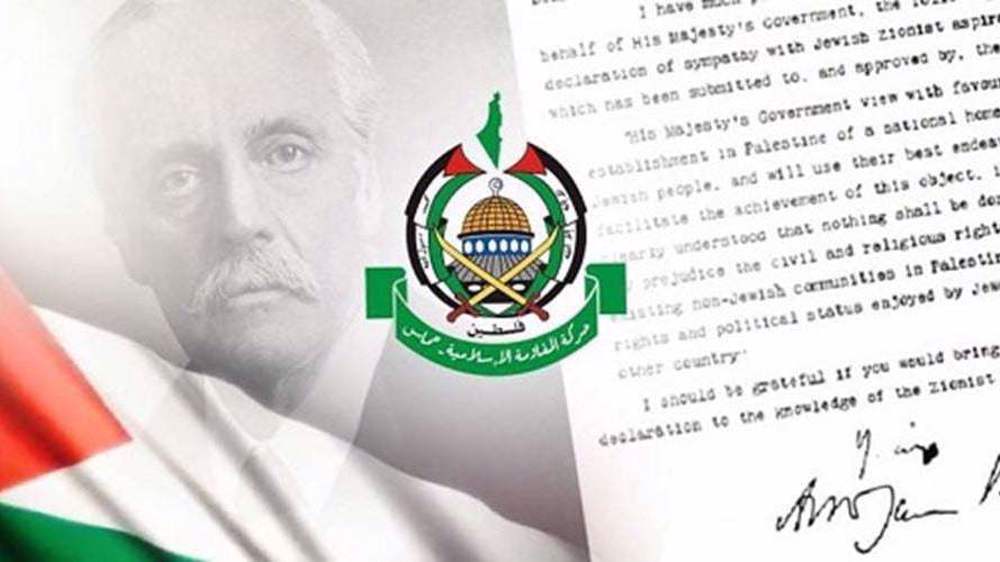
In 1917, Arthur James Balfour, then British foreign secretary, sent a letter to Lionel Walter Rothschild, a leader of Britain’s Zionist community, supporting the establishment of a so-called “Jewish homeland” in Palestine. Dated November 2, 1917, the document became known as the Balfour Declaration — a short letter that would permanently change the destiny of Palestine.
Drafted in the middle of World War I (1914–1918), the declaration became a cornerstone of the British Mandate that followed the collapse of the Ottoman Empire.
It was for Palestinians the beginning of a new chapter — one defined by occupation, oppression, apartheid, segregation, and colonial domination.
Palestinian political leader Awni Abd al-Hadi, in his memoirs, described the declaration as an agreement “between two foreigners — one who did not own the land and another who had no right to it.” His words captured the injustice of a colonial arrangement that ignored the existence of the native population.
Following the First World War, the defeated powers were required to hand over their territories to the victors under a mandate system supposedly designed to prepare nations for independence. However, in the case of Palestine, this principle was deliberately ignored.
Instead of guiding the land toward self-rule, Britain implemented policies that favored Zionist expansion and the dispossession of the native people.
Israel’s 2023 Gaza genocide has roots in 1917 Balfour Declaration#GazaGenocide pic.twitter.com/uIXAmxFMGQ
— Press TV 🔻 (@PressTV) November 3, 2023
From a “homeland” to a colonial project
The Balfour Declaration made a public pledge to create what it described as “a national home for the Jewish people” in Palestine — at a time when Jews constituted less than 10 percent of its inhabitants. Earlier drafts of the letter went further, speaking of “reconstituting Palestine as a Jewish state,” clearly signaling plans for the displacement and extermination of Palestinians.
In 1920, the third Palestinian Congress held in Haifa vehemently rejected the British declaration, calling it illegal and unjust. Delegates denounced it as a violation of international law and the inalienable rights of the native population.
Their protests were ignored. In 1922, Arthur Balfour, alongside British Prime Minister David Lloyd George, met Zionist leader Chaim Weizmann and openly confirmed that the declaration had “always meant the eventual establishment of a Jewish state.”
The British government then facilitated the mass immigration of European Jews into Palestine. Between 1922 and 1935, the Jewish population rose dramatically — from around 9 percent to nearly 27 percent — as land was seized and transferred to settlers.
Palestinian peasants were expelled from their farms, villages, and ancestral lands, laying the groundwork for future conflict.
Revolt and repression under British rule
As dispossession deepened, resentment among Palestinians also grew. The Arab Revolt of 1936-1939 erupted as a direct response to British colonialism and the influx of settlers. It began with a general strike demanding independence and an end to illegal Jewish immigration.
The uprising was met with overwhelming military suppression. Britain, in collaboration with Zionist militias, crushed the rebellion through collective punishment. Homes were demolished, curfews enforced, and villages flattened. Thousands of Palestinians were killed, wounded, or imprisoned to force them into submission.
Zionist paramilitary groups such as Haganah, Irgun, and Lehi joined the British campaign under a joint “counterinsurgency” framework. These same organizations would later merge into the Israeli military establishment.
By the end of 1939, Britain had effectively declared an open war on Palestinian nationalism. Entire communities were razed, activists were executed or jailed, and the infrastructure of resistance was destroyed — all to make room for the expanding Zionist project.
Israel's genocidal war on Gaza has roots in 1917 Balfour Declarationpic.twitter.com/uIXAmxFMGQ
— Press TV 🔻 (@PressTV) November 2, 2024
Partition and the birth of a catastrophe
When the United Nations passed Resolution 181 in 1947, calling for the partition of Palestine into separate Arab and Jewish states, Palestinians were once again excluded from the decision-making process. Despite making up the majority of the population, they were allotted only 45 percent of their own land, while 55 percent was handed to illegal Jewish settlers.
As World War II ended and the British Mandate expired in 1948, Zionist militias launched violent campaigns to seize even more territory. Between 1947 and 1949, hundreds of Palestinian villages were destroyed and their inhabitants massacred or expelled in a systematic campaign of ethnic cleansing.
More than 750,000 Palestinians were driven from their homes, forced into exile in neighboring countries, or into refugee camps. The event became known as Al-Nakba — “the catastrophe.” By the time it ended, Zionist forces had seized 78 percent of historic Palestine.
On May 15, 1948, the establishment of the Israeli regime was officially declared. The Arab states — including Egypt, Jordan, Syria, and Lebanon — entered into war with the new entity, but the damage had already been done. Gaza fell under Egyptian administration, while the West Bank came under Jordanian control.
From Nakba to Naksa — the ongoing dispossession
The Nakba was only the beginning. In 1967, during the Six-Day War, Israel captured the remaining Palestinian territories — the West Bank, Gaza Strip, and East Jerusalem — as well as the Golan Heights and Sinai Peninsula.
Following the occupation, the regime began constructing illegal settlements across these areas, institutionalizing an apartheid system where Jewish settlers enjoyed full rights while Palestinians were subjected to military law, checkpoints, and restrictions on movement.
This colonial and repressive order sparked the First Intifada in December 1987, a grassroots uprising against occupation and apartheid. The Israeli response was brutal: soldiers were instructed to “break their bones,” and thousands of Palestinians were killed or severely injured. During this period, the Gaza-based resistance movement Hamas was founded.
In September 2000, the Second Intifada began after the Israeli regime’s opposition leader, Ariel Sharon, made a provocative visit to the Al-Aqsa Mosque compound in Jerusalem. Violence surged once again, as Israeli forces intensified settlement construction and imposed collective punishment on Palestinians. Roads were segregated, communities isolated, and infrastructure demolished.
After the uprising subsided in 2005, Israel withdrew its settlers from Gaza but imposed a devastating blockade on the territory. The 2006 legislative elections, which brought Hamas to power, triggered further restrictions, effectively trapping over two million people under siege.
Britain’s 1917 Balfour Declaration has made the country morally responsible for the current genocide in Gaza, and it’s doubling down with its full support for the Israeli regime, says @DerbyChrisW. pic.twitter.com/XvtgT63FDG
— Press TV 🔻 (@PressTV) November 3, 2023
Gaza under siege
For nearly two decades, Gaza’s residents endured chronic shortages of electricity, food, clean water, and medical supplies. The crippling blockade strangled the economy, forced mass unemployment, and made reconstruction nearly impossible.
During this period, Israel repeatedly waged wars on Gaza — in 2008, 2012, 2014, 2021, and now again in 2023 — each time killing thousands of civilians and leaving entire neighborhoods reduced to rubble. Hospitals, schools, and refugee camps were targeted, and generations of children grew up knowing nothing but bombardment and loss.
Despite the passage of more than a century since the Balfour Declaration, the core reality remains unchanged: a people continue to be uprooted, confined, and punished for their mere existence on their ancestral land.
A century-long wound
The events unfolding in Gaza since October 2023 are not isolated. They are the latest chapter in a story that began 108 years ago, when a colonial power sold a land that was never its own.
What started with a letter — a few lines written by a British statesman in 1917 — has become an unending tragedy of occupation, apartheid, and war. The systematic erasure of Palestine continues in the form of bombings, blockades, and brutal displacement.
Families like those of Masa and Sha’ban are not the first, and tragically, they may not be the last. Their deaths echo a century of suffering — of dreams buried beneath rubble, of generations robbed of peace, and of a nation still fighting to exist.
As the world marks the 108th anniversary of the Balfour Declaration, Palestinians remain caught in the shadow of that imperial decree — living, resisting, and dying in a struggle that began long before our time, and, heartbreakingly, continues to this day.
Israeli soldiers who gang-raped Palestinian abductee file lawsuit for $6 million
Israeli military bars activists from aiding Palestinians in besieged West Bank village
Three killed, 23 wounded in fresh Israeli strikes on Lebanon



VIDEO | Press TV's news headlines
Syria’s Suweida: Fresh fighting reported between HTS forces, Druze fighters
US military claims it struck three Iranian oil tankers in Persian Gulf waters
IRGC busts US-Israeli-linked team planning to stage 'terrorist acts' in southeastern Iran
VIDEO | ‘US officials looking for someone to blame over leaks’: Analyst
Hezbollah blames Lebanon govt.’s ‘failure’ as Israel escalates ‘killing and destruction’
VIDEO | Israel on alert fearing an Iranian attack
Israel's Ali al-Taher ‘operational control’ claim aims to shape perceptions than reflect reality


 PressTV NEWSLETTER
now
PressTV NEWSLETTER
now
 This makes it easy to access the Press TV website
