COP30 Brazil: Say 'no' to greenwashing indigenous ecocide, including in Gaza
By Tim Anderson
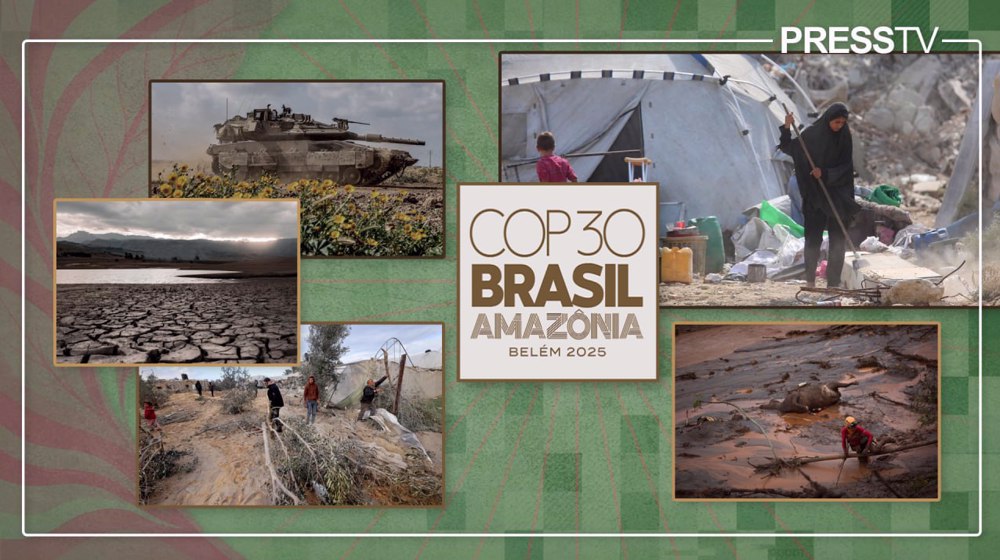
For Brazil to “showcase indigenous territories as part of the fight against the climate crisis” (COP30 2025) at COP30 might be nothing more than an insulting trivialisation of the role of indigenous peoples in ecological management.
How can indigenous peoples and culture be made simply wallpaper for the latest “emissions” deal? They must be protected and included at the centre of any and all agreements.
Can COP30 live up to the promises of Brazilian officials – and the aspirations of indigenous leaders – to build “leadership” and “protagonism” (COP30 2025) by indigenous communities?
Failure to do so would allow the ongoing colonial and neocolonial greenwashing of ecogenocide or ecocide.
For example, the Israeli regime would keep presenting its reforestation over the ruins of destroyed Arab villages and orchards in Palestine as some sort of lesson in ecological management, to present it as consistent with climate change commitments.
We should not allow the fraud of “green colonialism” to pollute genuine environmental measures.
‼️INFOGRAPHIC – Ecocide in Gaza: Homes destroyed, forests erased, water poisoned, air choking as millions face death by environmental bomb.
— Press TV 🔻 (@PressTV) September 22, 2025
Follow: https://t.co/mLGcUTS2ei pic.twitter.com/CQerzEsh6y
Certain basic principles should underwrite the centrality of indigenous peoples to any and all climate change and ecological agreements.
1. Human beings are part of the natural environment
Global ecological care should not be reduced to technical measures like “emissions”. Ecologically sustainable human communities and the practices of human custodians should remain central.
2. Indigenous communities have unique experience and knowledge in ecological care
The destruction of indigenous communities is both a crime against humanity and against the global environment – a crime we could call ecogenocide, but which has also been described as a “holocide”, “the deliberate annihilation of an entire social and ecological fabric”.
It is important to recognise the environmental contamination (chemical soil and water contamination and degradation) of ethnic cleansing such as that in Palestine, but that is not sufficient.
The indigenous communities, their land care priorities and livelihoods should be protected and included.
3. Environmental agreements should place indigenous peoples at the centre
Indigenous leaders from the Amazon Basin and all Biomes of Brazil, who are effectively hosting COP30, have pointed out that they have protected this land for millennia “keeping its ecosystems intact to ensure the balance of climate, biodiversity and life cycles.”
What they say applies to every continent on earth. Their entirely logical and appropriate demand is that “there will be no possible future without indigenous peoples at the centre of global decisions”.
This is entirely in line with UNESCO Conventions on the Pr
Systemic ecocide: Israel’s 2-year war devastates Gaza’s environment
— Press TV 🔻 (@PressTV) September 21, 2025
Follow: https://t.co/B3zXG73Jym pic.twitter.com/wWO0OJFXan
otection of World Cultural and Natural Heritage (1972), on the safeguarding of Intangible Cultural Heritage (2003) and on a commitment to “the interdependence between the intangible cultural heritage and the tangible cultural and natural heritage” to ensure that “the experiences and needs” of indigenous peoples “play an important role in the production, safeguarding, maintenance and recreation of the intangible heritage” (UNESCO 2019).
Can COP30 live up to these UNESCO commitments?
4. Just reparations for crimes of dispossession are due to dispossessed communities
Alongside protection and incorporation of traditional custodians must be reparatory justice for those communities who have been dispossessed and abused in the process of colonisation and ecological destruction, in accordance with international law and with principles outlined by the Instituto Luis Gama. It is also supported by China’s reference to established principles of Global Governance (FMPRC 2025).
5. No participation in environmental agreements by those engaged in the genocide and ethnic cleansing of indigenous peoples
While the broadest consensus is desirable in ecological agreements, that consensus cannot be corrupted by those actively participating in the worst crimes against humanity and nature – as designated by international bodies.
There are examples on all continents, but perhaps the leading current example is that of the Israeli ecogenocide in Gaza.
After being branded as great crimes by the International Criminal Court (ICC), International Court of Justice (ICJ) and other UN bodies, COP30 cannot remain silent or normalise such perpetrators and their ecogenocidal practices.
Will COP30 commit to a declaration against the greenwashing of ecogenocide?
Tim Anderson is an Australian academic and activist.
(The views expressed in this article do not necessarily reflect those of Press TV.)
Gaza health system nears collapse amid shortages and fuel crisis
Hamas condemns Netanyahu’s illegal entry into Al-Aqsa Mosque

Poll: Over half of US Jews say Netanyahu fueling American anti-Semitism



US visa ban on Iranian president’s media team is bid to hide the truth: FM spokesman
US aggression, economic warfare amount to crimes against humanity: Iran's UN envoy
Protests erupt in US as ICE agent shoots Venezuelan driver
US pressure fuels cooperation among Muslim states: Pezeshkian
Major TV networks suspend White House pool coverage after Trump ban
US visa ban on Palestinian UN delegation violates international agreements: Hamas
VIDEO | Press TV's news headlines
Iran calls on France to respect law after suspending French cultural institute in Tehran


 PressTV NEWSLETTER
now
PressTV NEWSLETTER
now
 This makes it easy to access the Press TV website
