From siege to slaughter: 49 years since massacre of 3,000 Palestinians at Tal al-Zaatar
Press TV Website Staff
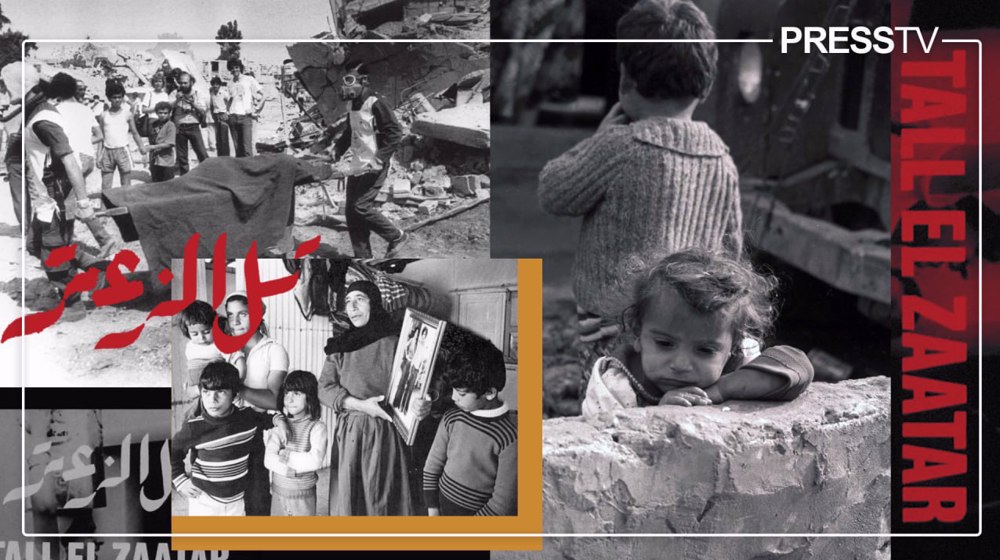
In a haunting black-and-white film, a young Palestinian boy, Younes Al-Iraqi, recalls the heart-wrenching day when his family was obliterated.
He speaks of how his mother, sister, and other close relatives were ruthlessly killed when a bomb tore through their home in Beirut’s Tal al-Zaatar refugee camp in August 1976, which left between 3,000 and 4,000 dead.
“My mother, sister, and cousin were baking bread when a shell hit the oven. My mother, sister, cousin, aunt, and cousin’s daughter were killed. We couldn’t bury them because of the ongoing shelling. We waited until evening, and when the shelling stopped, we buried them in the garden,” he said.
The 1977 documentary Tall El Zaatar features many such poignant testimonies by the survivors of the massacre committed against Palestinians and Lebanese in the Palestinian refugee camp, northeast of the Lebanese capital, Beirut.
Birth of Tal al-Zaatar
In the wake of Israel’s 1967 occupation of the West Bank, Jerusalem al-Quds, the Golan Heights, and Sinai, a massive humanitarian crisis unfolded as millions of Palestinians, driven from their ancestral lands by the occupying Zionist forces, sought refuge in neighboring countries, including Lebanon, Jordan, and Egypt.
Lebanon and Jordan hosted the majority of them, establishing large refugee camps to absorb the influx. Among them was Tal al-Zaatar, located in Dekwaneh.
The camp’s residents, numbering between 50,000 and 60,000, hailed predominantly from northern Palestinian villages such as Al-Khalisa, Al-Lazzaza, and Salha.
Administered by UNRWA, Tal al-Zaatar also became home to a Lebanese working-class community, many of whom had migrated from Lebanon’s impoverished south to work under harsh conditions.
📜 TODAY IN HISTORY | Aug 12, 1976
— Today In History (@TodayHistoryPTV) August 12, 2025
Thousands of Palestinian refugees were massacred in Tel al-Zaatar camp during the Lebanese Civil War by the Israeli occupation forces following weeks of siege and brutality.#TelalZaatur pic.twitter.com/H2IfTBmg89
Rising tensions and prelude to war
As displaced Palestinians rebuilt their lives, several resistance groups relocated to Lebanon, transforming it into a crucial staging ground for the struggle against Israeli occupation and aligning themselves with the Muslim and leftist forces of the Lebanese National Movement (LNM).
However, tensions escalated as Lebanese Muslims supported the Palestinian resistance, leading to the Lebanese Civil War, which erupted in 1975 between Muslim and Christian factions.
On April 13, 1975, an assassination attempt targeting Pierre Gemayel, leader of Lebanon’s Christian Kataeb Party, sharply escalated existing tensions, with both sides trading accusations and denials.
Later that same day, in a nearby area, Kataeb members launched a brutal attack on a bus heading to the Tal al-Zaatar refugee camp, indiscriminately opening fire on its passengers and killing 27 people.
The massacre served as a flashpoint, triggering Lebanon’s devastating 15-year civil war, as right-wing Christian militias declared war on the Palestinian presence in the country and their Lebanese allies.
Siege and fall
The Tal al-Zaatar massacre stands as one of the most brutal and haunting atrocities of the Lebanese Civil War.
The campaign against Tal al-Zaatar began in January 1976, when the right-wing Lebanese Front militias moved to expel Palestinians from northern Beirut, viewing them as a threat to political dominance, economic interests, and sectarian identity.
In June, the Syrian army entered the conflict, allying with the militias. The camp came under relentless tank and artillery fire, while its lifelines, water, electricity, and essential supplies, were severed.
Despite crippling shortages and constant shelling, the defenders fought on with improvised weapons and hidden passageways. Yet calls for international intervention went largely unanswered.
Over 52 harrowing days, 55,000 rockets rained down on the refugee camp, relief workers were barred, and hunger and disease spread.
On August 12, 1976, Christian militiamen from the Kataeb Party and allied factions massacred over 2,000 Palestinians in the Tel al-Zaatar refugee camp, northeast of Beirut, during the Lebanese Civil War.
— Press TV 🔻 (@PressTV) August 12, 2025
Follow: https://t.co/mLGcUTS2ei pic.twitter.com/jZVCXAQovC
On August 12, 1976, Tal al-Zaatar fell. What followed was a slaughter—indiscriminate killings, grotesque mutilations, and the merciless execution of children, women, and the elderly.
The death toll reached 4,280 Palestinians: half died during the siege, the rest in the chaotic, blood-soaked aftermath. Most were non-combatants. Thousands more were injured, and hundreds disappeared.
Bulldozers moved in to erase the camp from the map. Survivors were scattered to other Palestinian camps across Lebanon, their lives forever scarred by the horrors they had endured.
A lasting wound
The gory massacre of Tal al-Zaatar is carved deep into Palestinian collective memory.
It stands as both a grim emblem of displacement and loss and a testament to resilience and unity demonstrated by the Palestinian refugees in Lebanon.
For Palestinians, it remains a rallying symbol, reminding the world of their enduring struggle and unyielding will to survive in the face of Zionist occupation and extermination.
Israel to expand Gilo in occupied East al-Quds with 2,300 settler units
Israeli forces attack Press TV reporter covering Qalandiya raid in occupied West Bank

Emails show UN official repeatedly shared confidential information with Israeli diplomats



VIDEO | Another round of US-sponsored Israel-Lebanon talks in Rome ends without a breakthrough
VIDEO | Press TV's news headlines
Trump admits US weapons shortages, says Iran war ending ‘pretty soon’
VIDEO | Analysts: Washington holds key to Yemen escalation
Yemen warns Saudi regime: Persistence in colonial policies will lead to its collapse
Speaker Qalibaf: US strategy of bullying and broken promises has failed
VIDEO | Safe Hormuz shipping arrangements
VIDEO | Press TV's news headlines





 PressTV NEWSLETTER
now
PressTV NEWSLETTER
now
 This makes it easy to access the Press TV website
