
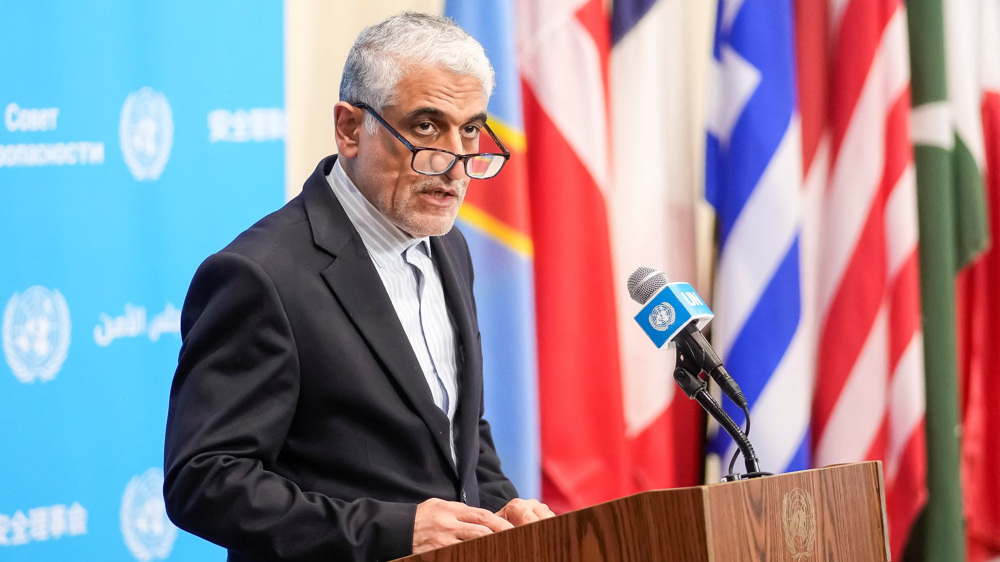
Iran’s ambassador to the United Nations has warned that Tehran will no longer consider itself bound by the Islamabad Memorandum of Understanding (MoU) if the United States continues to violate its commitments under the agreement, as Washington persists in launching strikes against Iranian territory and reimposing oil sanctions.
In a statement to reporters outside the UN Security Council on Friday, Ambassador Amir Saeed Iravani said the United States has repeatedly breached the MoU, including through large-scale military attacks on Iranian islands and southern cities on July 7 and 8.
These renewed attacks, he said, constitute a “flagrant violation” of the UN Charter and a material breach of the MoU’s first clause, which commits the US to ceasing all military action against Iran.
“In light of the United States’ persistent and ongoing violations of its international obligations, should the United States continue to violate its obligations under the MoU, Iran will no longer be bound to fulfil its obligations under the MoU,” Iravani stated.
The warning came after the Security Council held a meeting on Iran’s nuclear file at the request of the United States, Britain and France, a session that Iran, Russia and China say had no legal basis because Resolution 2231 expired on October 18, 2025.
Russia, China reject Western push to use UNSC against Iran after Resolution 2231 expiryhttps://t.co/wr2E9aNymj
— PressTV Extra (@PresstvExtra) July 10, 2026
“Resolution 2231 expired on 18 October 2025. From that date, it ceased to have any legal force or operative effect,” Iravani said, thanking Russia and China for opposing the meeting and Pakistan and Somalia for abstaining.
He rejected “politically motivated allegations” by the E3 and the US regarding Iran’s peaceful nuclear program, stressing that Iran has remained a responsible party to the NPT since 1970.
“The root cause of the current situation lies in the United States’ unlawful withdrawal from the JCPOA in 2018, the continued failure of the E3 to fulfil their commitments, and the unlawful military attacks carried out by the United States and Israel against Iran,” he said.
The E3 (Britain, France, and Germany), backed by the United States, has consistently demanded that Iran grant the International Atomic Energy Agency (IAEA) "all access" to inspect its nuclear sites that were hit in US-Israeli wars of aggressions.
Sun Lei, Deputy Permanent Representative of China to the United Nations, tells the UN Security Council that Resolution 2231 expired on October 18, 2025, and the Security Council's consideration of Iran's nuclear case has come to an end. pic.twitter.com/T7pveIiPiD
— PressTV Extra (@PresstvExtra) July 10, 2026
In response, Iranian officials have firmly ruled out any immediate access to nuclear sites attacked in the US-Israeli war of aggression, insisting that such matters can only be addressed within the framework of an agreement.
US violations of the ceasefire
The US has launched multiple waves of strikes on Iran since the MoU was signed.
On July 7, US Central Command claimed it struck over 80 Iranian targets, including air defence systems, coastal radar sites, and more than 60 IRGC small boats, in response to what it described as Iranian attacks on three commercial vessels in the Strait of Hormuz.
Washington also revoked a license allowing Iran to sell oil.
In response, Iran’s Islamic Revolution Guards Corps (IRGC) targeted 85 US military sites in Bahrain and Kuwait, including the US Fifth Fleet headquarters and Ali Al Salem Air Base.
Iravani also stressed that under the MoU, responsibility for maritime navigation through the Strait of Hormuz rests exclusively with Iran, and any attempt by external actors to interfere would violate the agreement and increase regional tensions.
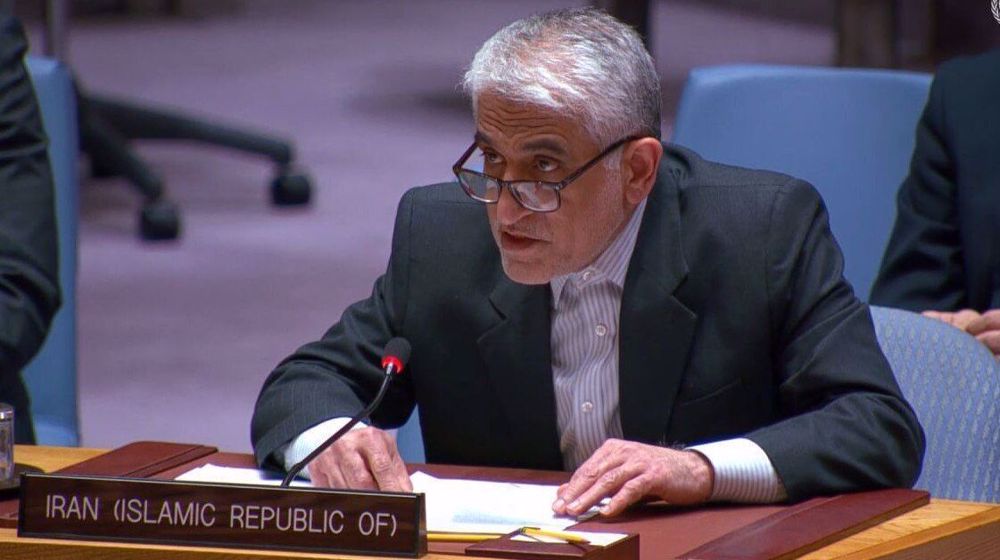
He reaffirmed that Iran remains committed to the MoU “provided that the United States fully and faithfully complies with its own obligations”.
Iran and the US signed a Pakistan-brokered ceasefire agreement in early April.
On June 17, Iran and the US signed a 14-point memorandum of understanding outlining a path toward a final peace deal.
The agreement committed the US to lifting its naval blockade within 30 days, allowed Iran access to frozen assets, and established a 60-day window to negotiate a final agreement.
 This makes it easy to access the Press TV website