
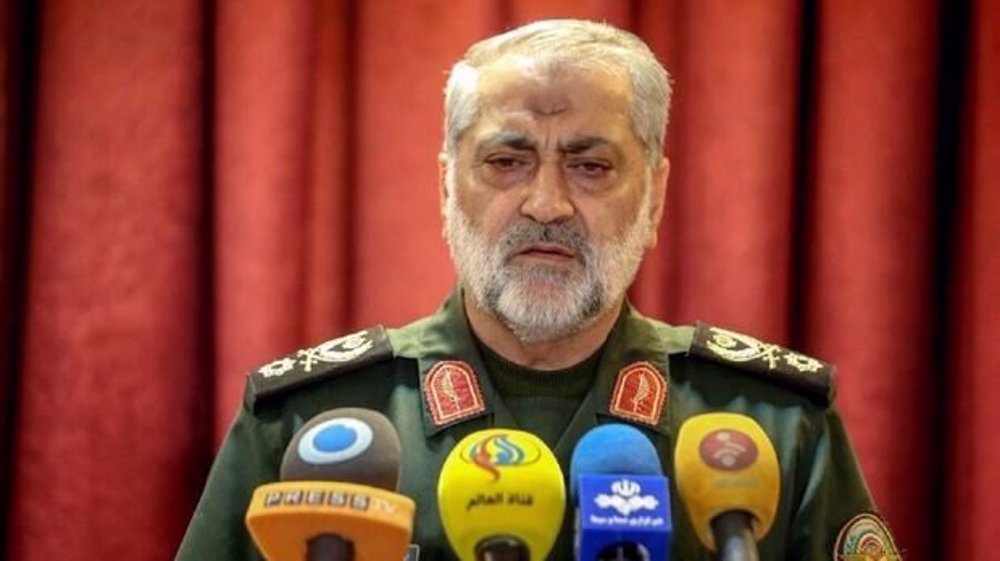
A high-ranking military commander says Iranian Armed Forces have the upper hand in the region, despite US acts of aggression and mischief.
“Despite the United States’ provocations, thankfully the initiative remains in the hands of the armed forces of the Islamic Republic of Iran, and the combat capabilities of Iran’s fighters are at a very high level,” spokesperson for the Iranian Armed Forces, Brigadier General Abolfazl Shekarchi, said on Sunday.
He also warned certain regional countries about the adverse consequences of siding with the "fascist" US military.
"Any county which takes action against Iran will face a decisive response from our country's Armed Forces," the general pointed out.
The remarks were also echoed by the commander of the Islamic Revolution Guards Corps (IRGC) Aerospace Force.
Brigadier General Majid Mousavi said the force’s missiles and drones have been locked onto enemy targets and are awaiting the order to fire.
“The (IRGC) Aerospace Force’s missiles and drones have been locked onto American targets in the region and the vessels of the aggressor enemy," Mousavi said in a message released on Saturday night.
🔺 To demonstrate Iran’s maritime deterrence, these submarines surfaced during an operation dedicated to the martyrs of the Dena destroyer in the Strait of Hormuz. After carrying out formation maneuvers, they submerged again to continue their missions.
— Press TV 🔻 (@PressTV) May 10, 2026
“We are awaiting the order to fire,” he added.
During the late hours of Thursday, May 7, and the early hours of Friday, May 8, the US military struck two Iranian oil tankers near the port of Jask and the Strait of Hormuz, and carried out assaults on several coastal areas overlooking the strategic waterway.
The attacks were met with a powerful response and a “heavy slap” by the Armed Forces of the Islamic Republic of Iran, as the aggressors failed to achieve their illegitimate objectives.
On February 28, following the assassination of Iran's late Leader of the Islamic Revolution Ayatollah Seyed Ali Khamenei and several high-ranking military commanders, the United States and Israel initiated a large-scale and unprovoked war of aggression against Iran.
In response, Iranian Armed Forces executed 100 waves of counterattacks over 40 days, targeting US and Israeli military assets, which resulted in significant damage.
A Pakistani-mediated two-week ceasefire was brokered on April 8, allowing for negotiations in Islamabad, where Iran proposed a ten-point plan seeking US troop withdrawal and the lifting of sanctions.
Despite 21 hours of intense talks on April 11 and 12, the Iranian delegation returned to Tehran without an agreement, citing deep mistrust regarding Washington's willingness to honor its commitments.
Iran has made clear that any return to ceasefire negotiations depends on the lifting of the US naval blockade. Officials have argued that the continued blockade constitutes a violation of the truce.
 This makes it easy to access the Press TV website