Iran dealt ‘heavy blow to Epstein empire’, something not seen since Vietnam: Analyst
By Press TV Website Staff
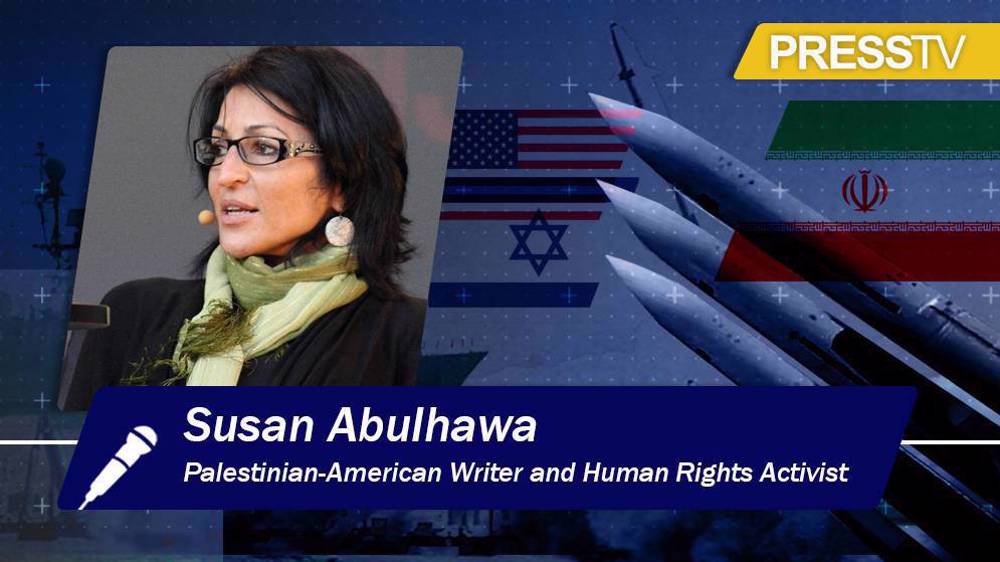
As the US-Israeli military aggression against Iran enters its 29th day, Palestinian-American scientist, writer, and activist Susan Abulhawa says the Islamic Republic has defended itself with “remarkable success.”
In an interview with the Press TV website, Abulhawa offered a searing assessment of the war, praising Iran’s steadfastness while condemning Western arrogance and the betrayal of Muslim nations.
Speaking on the rapidly expanding war, triggered by a “surprise and unprovoked attack” amid indirect nuclear talks between Tehran and Washington, Abulhawa rejected any suggestion that Iran should return to negotiations under the current circumstances.
“Despite facing two nuclear powers, with the most advanced death and surveillance technology; despite having been under decades of crippling sanctions; and despite the unforgivable betrayal of so many Muslim countries, Iran has defended herself with remarkable success,” said the author of the novel ‘Mornings in Jenin’ and founder of the children's organization ‘Playgrounds for Palestine.’
“They have dealt a heavy blow to the Epstein empire, something no other country since Vietnam has been able to accomplish.”
The war was launched on February 28 with the assassination of Iran’s top political and military leadership, including Ayatollah Seyyed Ali Khamenei, as well as more than 170 schoolchildren in southern Iran’s Minab city.
The death toll has risen to 1,900, most of them civilians, with civilian infrastructure bearing the brunt of the onslaught, including hospitals, schools, and sports facilities.
Abulhawa described Iran’s resistance as “the stuff of legends,” emphasizing its broader significance beyond the battlefield.
“The dignity, steadfastness, honor, strategy, and defiance that Iran has shown is the stuff of legends,” she said. “Regardless of what happens from now on, the world will never be the same after this. They have shown the world that it is possible to live without bending the knee or compromising one’s sovereignty. Iran inspires us all, gives us hope, and renews our resolve to fight for justice.”
✍ Feature - Silence of the stealth: How Iran shattered the 'invincibility' of US fighter jet F-35
— Press TV 🔻 (@PressTV) March 21, 2026
By Yousef Ramazani https://t.co/TVRx3GDXip
Addressing calls for Tehran to return to the negotiating table, Abulhawa said the Islamic Republic “does not owe the US anything.”
“Whether they choose to negotiate or fight, or a combination, or something else, is entirely Iran’s decision and they will be justified no matter what path they take,” she said.
Pertinently, both times Iran joined indirect negotiations with the US in the past year, under the Omani mediation, Israel and the US carried out unprovoked and illegal aggression.
The last war of aggression came in June last year, which lasted 12 days and claimed the lives of more than 1,000 people, most of them civilians.
Abulhawa pointed to years of US-Israeli provocations – including the downing of a civilian airliner, the assassination of top nuclear scientists, the assassination of Iran’s top anti-terror commander Qasem Soleimani, and the assassination of Hamas leader Ismail Haniyeh on Iranian soil – as a clear testament of Iran’s “extraordinary restraint.”
“Iran acted with restraint and negotiated in good faith with bullies who do not understand restraint, diplomacy, good faith, or honor,” she told the Press TV website.
Abulhawa noted that while she and others had anticipated Iran’s capacity for a powerful response, many in the West and the region had dismissed it due to arrogance and bias.
“After the 12-day war, in which Iran pummeled Israel, I think we all got a hint of their capabilities,” she said, referring to the war in June last year.
“They even told us that they were using outdated technology, getting rid of old missile inventory. Professor Marandi was explicit that Iran had far greater capacity. Of course, I believed him, and I think most reasonable people did too.”
However, she hastened to add, that many in the West and in the region were “too arrogant and too racist to contemplate the notion that Iran could stand up to the US and Israel.”
✍️ Viewpoint - Netanyahu lands Trump in a quagmire as ‘Shock and Awe’ strategy boomerangs in Iran
— Press TV 🔻 (@PressTV) March 22, 2026
By Iqbal Jassathttps://t.co/RXNm3LtWIj
“They mistook your willingness to stop the bloodshed and return to diplomacy as weakness. But now they know it was not weakness, but simply honor, integrity, and good faith,” the Palestinian-American analyst and author stated.
Iran has struck nearly all US military bases across the region in recent weeks, following through on pre-war warnings. Several host countries have since voiced complaints. Abulhawa questioned the legitimacy of such protests.
“I am not a scholar of international law or the norms of military confrontations, but it would seem to me that Iran had every right to attack US bases from which they were being attacked or surveilled,” she said, referring to more than 80 waves of Iranian retaliatory strikes as part of Operation True Promise 4.
She urged regional governments to reconsider their alignment and pursue a path of cooperation – away from foreign meddling.
“I sincerely hope these countries will come to their senses and extend the hands of friendship and good neighbors to Iran,” she said. “If countries of the area could find their way to such a regional union, the possibilities for security, scientific advancement, moral and spiritual evolution, and cultural renaissance are profound.”
Abulhawa also offered a critique of Western political and economic models, calling for a “new way of life” based on inherited values.
“It is clear that the Western model of unfettered capitalism and consumption is unsustainable,” she said. “It has proven to be an abject moral and environmental failure, a poison. Our region must imagine a new way of life, based on values we’ve inherited from our ancient civilizational presence in the world and based on our own moral imaginations.”
When asked whether the US and Israel could credibly claim the title of the world’s greatest military force after the ongoing war, Abulhawa dismissed the notion as hollow.
✍️ Investigation - Zionist takeover: Trump’s war on Iran reveals who really dictates US foreign policy
— Press TV 🔻 (@PressTV) March 22, 2026
By @Tracking_Power https://t.co/LTesRDmJlL
“That is a title that only the spiritually weak covet,” she said. “Military strength comes and goes. It gives people a fleeting sense of power, but countries like Israel and the US, which are founded on genocide, theft, and mass exploitation, are ultimately unstable. Military wares will eventually rust and turn to a pile of bloody scraps of metal.”
She contrasted what she described as the transient nature of Israeli and American power with Iran’s deep civilizational roots.
“When that happens, there will be nothing left of Israel—they have no roots, no culture, no history, no civilizational presence, neither in the present nor history,” Abulhawa said.
“They have no foundation except that bombastic military that depends on raping and torturing little girls to make sure other countries continue to prop it up.”
The Palestinian-American scholar said the Israeli-American coalition will “eventually fade to ash, while Iran will stand sturdy.”
“They will eventually fade to ash, while Iran will stand sturdy, however battered it might be, on roots that span the depths of the earth and history, and the breadths of science, poetry, beauty, architecture, food, dance, song, story, legend, folklore, scholarship, tradition, heritage, spiritual horizons, honor, and all that is human and real.”
During Mosaddegh's time, US pursued the same policy toward Iran as today: Filmmaker
Iran’s new military appointments signal ‘offensive’ posture toward US, Israel: Analyst
Colombia's right-wing win reflects deep polarization as US alignment and Israel ties loom: Analyst



VIDEO | Press TV's news headlines
VIDEO | Iran’s military, economic leverage challenges US pressure: Analysts
UN rights expert demands urgent international protection in Palestine amid settler attacks
VIDEO | Humanoid games showcase China’s AI rise, raising US concerns
Hamas condemns Zionist Regime’s use of children’s kites as flimsy pretext for genocide in Gaza
Iran’s heroic defense, assertive diplomacy source of pride for allies: Lebanese MP
Supporting US economic war is an 'act of war': Iran’s top security official warns
VIDEO | US-Canada trade war


 PressTV NEWSLETTER
now
PressTV NEWSLETTER
now
 This makes it easy to access the Press TV website
