
By Maryam Qarehgozlou
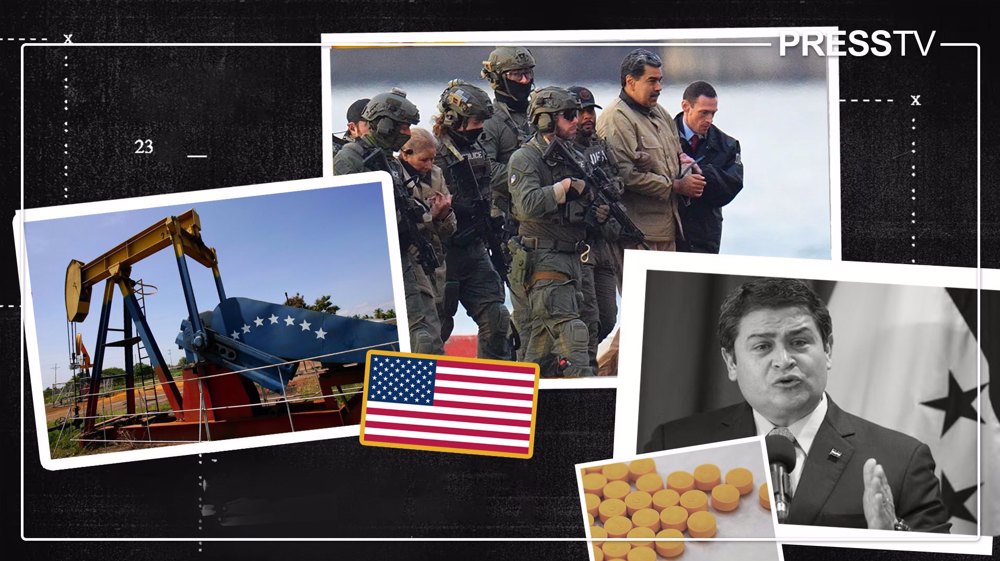
Claims that the US attacked Venezuela and kidnapped President Nicolas Maduro over narcotics collapse under scrutiny as President Donald Trump recently pardoned a convicted cocaine trafficker, and evidence shows fentanyl enters the US from Mexico, not Venezuela.
In the early hours of Saturday, US forces — including elite Delta Force units — launched a series of missile and drone strikes on Caracas, rattling residents and forcing them into the streets in fear.
Barely hours later, Trump announced that President Maduro and First Lady Cilia Flores had been “captured” by US troops and flown to New York, held at the Metropolitan Detention Center in Brooklyn.
Maduro faces US charges of so-called "narco-terrorism," along with allegations related to cocaine trafficking and weapons possession, claims Caracas has long rejected as politically driven.
In his first court appearance on Monday, Maduro rejected the charges and pleaded not guilty.
The attack on Venezuela followed months of escalating US aggression, including military deployments across South America, deadly strikes on vessels in the Caribbean and eastern Pacific, and open threats against Venezuela’s elected government.
Venezuelan officials had repeatedly warned Washington was pursuing “regime change” to gain control over the country’s vast energy wealth, especially oil resources.
Trump and other US officials have repeatedly invoked drug trafficking to justify strikes on vessels in the Caribbean and Pacific, the military buildup around Venezuela, and the kidnapping of President Maduro.
What has drawn intense international scrutiny and condemnation is the glaring contradiction in Washington’s narrative vis-à-vis narcotics and who is responsible for the US drug abuse crisis.
Trump recently pardoned former Honduran president Juan Orlando Hernández, a convicted drug trafficker, while well-documented evidence shows that fentanyl, the synthetic opioid driving most overdose deaths in the US, is produced largely in Mexico and smuggled across the US-Mexico land border, not through Venezuela.
According to The New York Times, the US Department of Justice has now dropped a claim that the Trump administration promoted last year, accusing Maduro of leading a drug cartel called Cartel de los Soles, which activists believe exposes the real motive behind the aggression against Venezuela.
US drops drug cartel claims against Maduro after invasion, kidnap https://t.co/5seGG5im3y
— Press TV 🔻 (@PressTV) January 6, 2026
Debunking the drug war claim
Opioids accounted for 73.4 percent of drug overdose deaths in the US in 2024, according to the Centers for Disease Control and Prevention’s State Unintentional Drug Overdose Reporting System. Of those deaths, 65.1 percent were linked to illegally manufactured fentanyl.
Yet the Trump administration’s latest military escalation has focused not on the routes through which fentanyl actually enters the country, but on maritime attacks in the Caribbean Sea.
Fentanyl is overwhelmingly trafficked into the US via southwest land routes from Mexico, where it is produced using precursor chemicals imported largely from China and India.
International law enforcement bodies, including the United Nations Office on Drugs and Crime and the US Drug Enforcement Administration, have repeatedly stated that Venezuela is not a principal source of either US-bound cocaine or fentanyl.
While the country may serve as a transit corridor for some South American cocaine, it is not a meaningful contributor to the overdose crisis inside the country.
Cocaine destined for the US typically originates in Colombia, Peru, and Bolivia and moves north through Central America.
There is little evidence that Venezuelan-produced or Venezuelan-routed drugs play a significant role in US overdose deaths, facts that directly contradict Washington’s public justification for the recent aggression against Venezuela.
Despite this, Trump has repeatedly made sweeping claims about the supposed life-saving impact of US attacks on alleged drug vessels. On Saturday, he again asserted that every strike prevents mass death inside the United States.
Claiming miraculous results without evidence, Trump said that 25,000 American lives are saved with every alleged drug boat the US strikes take out.
The arithmetic behind that claim collapses under even minimal scrutiny. The total number of overdose deaths in the United States each year is far lower than the number of lives Trump suggests his administration has saved through boat strikes alone.
According to the latest preliminary data from the CDC’s National Vital Statistics System, there were up to 76,516 drug overdose deaths in the 12 months ending in April 2025, a 24.5 percent decline from the up to 101,363 deaths recorded in the previous year.
Since September 2, the US military has attacked at least 35 boats in the Caribbean Sea and eastern Pacific Ocean, most recently on December 31. Using Trump’s own figures, those strikes would have prevented 875,000 overdose deaths, more than ten times the number of Americans who actually died from drug overdoses in recent 12-month periods.
It suggests an administration claiming to save more lives than could ever have been lost, exposing the war-on-drugs rationale as numerically incoherent and politically performative.
Protests erupt across US over military aggression against Venezuela, kidnapping of Madurohttps://t.co/6IX9dggyKg
— Press TV 🔻 (@PressTV) January 4, 2026
The irony of Hernández pardon
The contradiction deepens when examined alongside Trump’s other decisions. In December, he issued a full pardon for Juan Orlando Hernández, the former Honduran president who had been serving a 45-year federal prison sentence in the United States for cocaine trafficking and weapons offenses.
US prosecutors had presented extensive evidence that Hernández facilitated the importation of more than 400 tons of cocaine into the US and accepted millions of dollars in bribes from major drug cartels—the very conduct Washington claims now justifies its aggression against Venezuela.
The decision to absolve a convicted trafficker while branding Venezuela’s leadership as narco-terrorists underscores a glaring double standard.
That inconsistency was on display when US Secretary of State Marco Rubio was pressed on the contradiction.
Deflecting responsibility, Rubio said, “I don’t do the pardon file, I’m not against it or for it, I didn’t review the file, so I can’t speak to you about the dynamics that led the president to make the decision that he made.”
“He reviewed the file, he went through the arguments in it and he felt that the former president of Honduras was treated very unfairly by the previous administration,” he added.
Attempting to separate the pardon from Venezuela’s case, Rubio claimed, “whether you agree with that decision or not ... that doesn’t mean you leave Maduro in place.”
“The answer to that, whether you have a problem with it or not, is not to leave in play someone who has been indicted who hasn’t even faced American justice yet,” Rubio said, framing US aggression as a judicial necessity.
The hypocrisy of that position has also drawn criticism among politicians. Senator Mark Warner, the ranking Democrat on the Senate Intelligence Committee, condemned the logic underpinning the administration’s actions.
Calling out the contradiction, Warner said the “hypocrisy underlying this decision is especially glaring.”
“This same president recently pardoned former Honduran President Juan Orlando Hernández, who was convicted in a US court on serious drug trafficking charges, including conspiring with narcotics traffickers while in office,” Warner said.
“Yet now, the administration claims that similar allegations justify the use of military force against another sovereign nation. You cannot credibly argue that drug trafficking charges demand invasion in one case, while issuing a pardon in another.”
At a press conference on Saturday after Maduro’s kidnapping, Trump was also pressed on the pardon, showing little interest in reconciling the contradiction. He said Hernandez was “persecuted very unfairly.”
🇻🇪 Venezuela’s regime-change bid: failure in 2012, renewed in 2026. The fate of this latest operation now hangs in the balance.
— Press TV 🔻 (@PressTV) January 4, 2026
Follow: https://t.co/mLGcUTS2ei pic.twitter.com/4XCYvoD4fU
“He was treated like the Biden administration treated a man named Trump,” Trump said, drawing a personal parallel by referring to his own criminal prosecutions for hoarding classified documents and attempting to overturn the 2020 election after leaving office following his first term as president.
Trump then openly tied the pardon to political loyalty in Honduras, citing his support for the country’s president-elect, Nasry Asfura.
“He’s also a party member of the man who won, so obviously the people liked what I did,” Trump said. “And one of the reasons that was done is because of the fact that the party in power felt very strongly that that man was treated very badly.”
Trump had intervened in the Honduran election in November. He threatened to cut off aid to Honduras if Asfura did not win, and said there would be “hell to pay” if officials tampered with election results.
US Congresswoman Marjorie Taylor Greene, a top ally-turned-critic of Trump who is resigning from Congress this week, also publicly hit back at the claim that Venezuela was responsible for US overdose deaths.
“Mexican cartels are primarily and overwhelmingly responsible for killing Americans with deadly drugs,” she wrote in a lengthy post on X.
Greene further pointed to the Trump-issued pardon of former Honduran president Hernandez as an example of a contradiction of Trump’s policies.
“If prosecuting narco terrorists is a high priority, then why did President Trump pardon the former Honduran President Juan Orlando Hernandez, who was convicted and sentenced for 45 years for trafficking hundreds of tons of cocaine into America?”
Similarly, Congresswoman Alexandria Ocasio-Cortez rejected Trump’s claim that the attack on Venezuela was about drug trafficking.
“If it was, Trump wouldn’t have pardoned one of the largest narco traffickers in the world last month,” she wrote on X, referencing the pardon of Hernandez. “It’s about oil and regime change.”
Trump himself ultimately removed any remaining ambiguity. Hours after ordering the military strike on Venezuela and the kidnapping of its democratically elected president, he openly declared Washington’s intentions.
At a Mar-a-Lago news conference on Saturday, he said the United States would “run the country” temporarily, even if that required troops on the ground, that US companies would begin selling Venezuela’s vast oil reserves, and that the assault was part of a broader strategy of American dominance across the Western Hemisphere.
In doing so, the administration stripped away the drug-war pretext entirely, leaving naked power, resource extraction, and regime change as the true drivers of US aggression.
 This makes it easy to access the Press TV website