
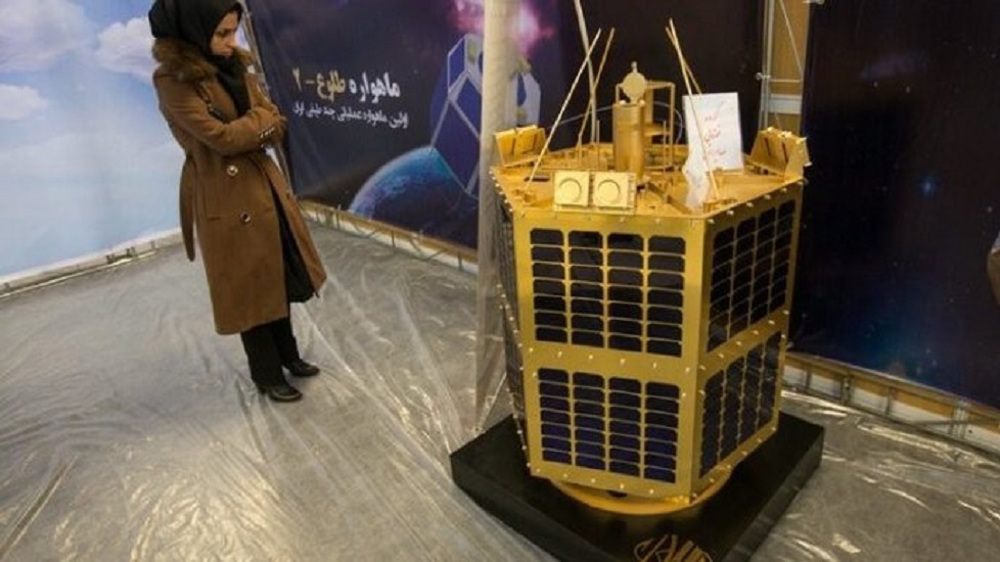
Iran is scheduled to simultaneously place three domestically manufactured satellites into orbit later this week, a report says.
Iran’s Mehr news agency reported on Monday that Tolou-3 (Paya), Zafar-2, and Kowsar-1.5 satellites would be launched at 1648 Tehran time (1318 GMT) on December 28 aboard a Soyuz rocket from the Vostochny Cosmodrome in Russia’s Far East.
On Sunday, the report added, Tolou-3 and Zafar‑2 satellites were successfully integrated onto the separation block of the Russian Soyuz launch vehicle.
🇮🇷🛰️
— Press TV 🔻 (@PressTV) December 22, 2025
Iran’s Zafar‑2 and Paya satellites were successfully integrated onto the separation block of Russian Soyuz launch vehicle. All related integration tests were completed successfully. On December 27, three domestically built satellites are scheduled to be launched into space pic.twitter.com/wpC95mrZuX
Tolou-3 is Iran’s heaviest Earth-observation satellite, weighing about 150 kilograms, with a resolution of around five meters for black-and-white images and about 10 meters for colored visuals.
Data obtained from the satellite can be used in areas such as agriculture and farm monitoring, water resource management, environmental mapping, as well as the tracking of natural hazards like floods and droughts.
Zafar-2 is developed by Iran University of Science and Technology. It is also an Earth-observation satellite intended for monitoring natural resources and the environment, observing natural disasters, and general mapping.
Kowsar-1.5 is the integrated version of Kowsar-1 and Hodhod-1 second generations. It has the Internet of Things (IoT) capability.
Last month, the head of the Iranian Space Agency (ISA), Hassan Salarieh, announced that his agency is updating the country’s 10-year space document, which focuses on expanding satellite-based services.

Iran first entered the global space arena in February 2009, when it launched its first homegrown satellite, Omid (Hope), aboard a Safir rocket. Designed for research and telecommunications, Omid marked the country’s initial step in satellite data processing.
Since then, Iran has made significant advances in its civilian space program, successfully launching several more satellites despite Western sanctions.
 This makes it easy to access the Press TV website