Unmasking AIPAC leadership: Power brokers behind America’s most influential Israeli lobby
By Ivan Kesic
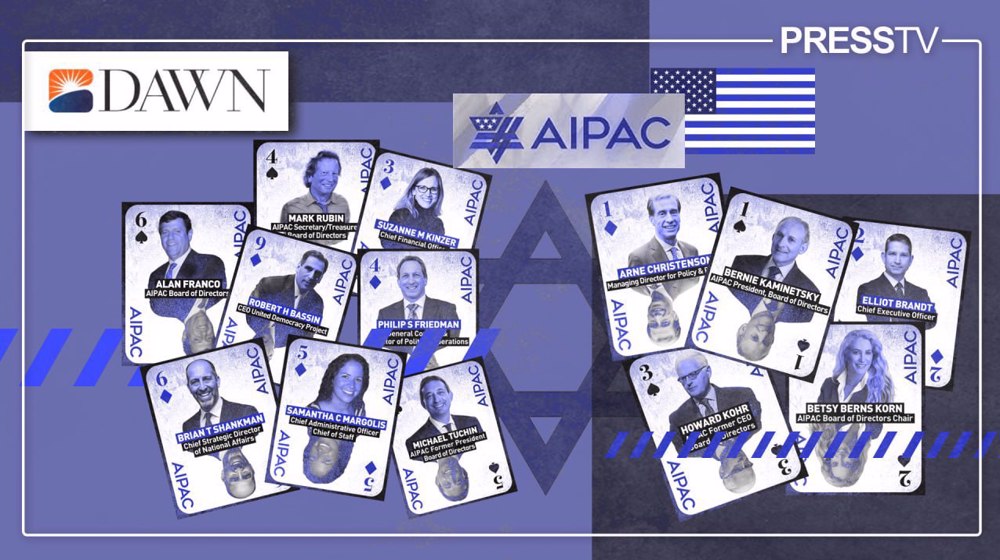
In a direct challenge to the long-opaque influence of the American Israel Public Affairs Committee (AIPAC), a new public database is dismantling its image as an abstract political monolith by identifying the individuals who oversee its operations.
On December 18, 2025, the advocacy organization Democracy for the Arab World Now (DAWN) launched The Faces of AIPAC, an online resource profiling the fifty individuals who govern the powerful Israeli lobbying group in the United States.
DAWN says the initiative addresses a significant transparency gap. Despite spending more than $126 million during the 2023-2024 election cycle and playing a central role in shaping US foreign policy, AIPAC does not publish a public directory of its leadership on its official website.
Drawing on publicly available records, including IRS Form 990 filings and lobbying disclosures, DAWN aims to demystify AIPAC’s internal structure.
The organization maintains that AIPAC “is not an abstraction,” but an entity directed by identifiable individuals with defined legal and fiduciary responsibilities.
It comes amid heightened scrutiny of US foreign policy and the role of well-financed advocacy groups, seeking to link institutional political power with the personal accountability of those who wield it.
Genesis of a transparency initiative
The Faces of AIPAC reflects a focused extension of DAWN’s broader mission.
Founded in accordance with the vision of the slain Saudi-American journalist Jamal Khashoggi, DAWN works to promote democracy, human rights, and government accountability across West Asia and North Africa, with a particular emphasis on reforming US foreign policy in the region.
Central to the organization’s approach is the belief that transparency is a prerequisite for accountability. DAWN has previously applied this principle through campaigns examining foreign government lobbying and advocating for conditions on US military assistance.
Mapping AIPAC’s leadership, the organization argues, is a natural continuation of this work, reframing a longstanding geopolitical debate around questions of governance, fiduciary responsibility, and public disclosure.
In this framing, DAWN characterizes the project not as an act of opposition but as an exercise in civic transparency, intended to fill what it views as a notable informational void surrounding one of Washington’s most influential lobbying organizations working on behalf of the Israeli regime.
Advocacy group DAWN launches website exposing 'Faces of AIPAC,' citing lack of transparency https://t.co/YtmEodkHFU
— Press TV 🔻 (@PressTV) December 19, 2025
From institutional monolith to identifiable leadership
A core objective of DAWN’s project is to reframe public perceptions of AIPAC – from a singular, monolithic force into a structured organization governed by a defined group of decision-makers.
The database identifies a governing body comprising 41 board members and an executive team of 9 officers. Together, DAWN notes, these 50 individuals authorize strategic direction, oversee political expenditures, and manage the notorious lobbying group’s widespread operations.
By rendering this leadership visible, the initiative challenges the anonymity that often surrounds large-scale lobbying efforts and advances the premise that influence exercised at this magnitude warrants scrutiny of those who direct it.
This approach is grounded in legal realities. Under the Washington, DC Nonprofit Corporation Act, board members and officers are bound by formal fiduciary duties – care, loyalty, and obedience – to the organization.
DAWN contends that AIPAC’s actions, from electoral endorsements to policy advocacy, are therefore not merely political expressions but acts of organizational governance carrying legal and ethical implications.
Apex of leadership and strategic direction
At the highest levels of AIPAC’s hierarchy, DAWN’s profiles focus on figures whose roles shape the organization’s strategic course.
Bernie Kaminetsky serves as AIPAC’s president and a board officer, bringing a background as a physician and medical entrepreneur to a role that includes guiding donor delegations abroad.
Betsy Berns Korn is the board chair and a former president of AIPAC. Her tenure oversaw the launch of the organization’s affiliated political action committee and super PAC.
She also chairs the Conference of Presidents of Major American Jewish Organizations, an umbrella body coordinating numerous advocacy groups.
AIPAC’s chief executive officer is Elliot Brandt, a veteran of more than three decades within the organization. His career trajectory reflects the increasing professionalization of AIPAC’s lobbying, fundraising, and donor-relations infrastructure.
Taken together, these profiles illustrate a leadership cadre defined by long-term institutional commitment, external professional success, and centralized strategic authority at the apex of one of Washington’s most influential Zionist lobbying organizations.
Noise protest bombards AIPAC as Israel destroys Gaza City@RaminMazaheri2 reports from Washington.
— Press TV 🔻 (@PressTV) September 23, 2025
Follow: https://t.co/mLGcUTS2ei pic.twitter.com/2WHKkJU8GK
Operational executives and institutional continuity
Beyond its most publicly visible leadership, DAWN’s research draws attention to executives whose operational roles are central to AIPAC’s day-to-day functioning and long-term stability.
Suzanne M. Kinzer, AIPAC’s chief financial officer, oversees all financial operations and regulatory compliance, including signing the organization’s annual tax filings.
Samantha C. Margolis serves as chief administrative officer and chief of staff, managing internal operations while acting as a principal aide to the organization’s executive leadership.
Brian T. Shankman holds the position of chief strategic director of national affairs, a role focused on national fundraising and donor development. His appointment follows a 30-year career within AIPAC, underscoring the organization’s emphasis on internal continuity.
Together, these profiles highlight that AIPAC’s sustained influence is underpinned not only by policy advocacy but by disciplined financial management, internal administration, and the systematic cultivation of donor networks that finance its political activity.
Legal strategy and governance oversight
The integration of legal counsel with political and operational strategy is exemplified in the profile of Philip S. Friedman, who serves concurrently as AIPAC’s general counsel and director of political operations.
His long tenure in this dual role places him at the nexus of legal compliance and political advocacy. Friedman has been involved in defending AIPAC’s activities and in political efforts opposing policies such as the Iran nuclear deal, illustrating how legal strategy is embedded within the organization’s broader political mission.
Another figure central to AIPAC’s institutional governance is Howard Kohr, whose nearly three-decade tenure as chief executive officer coincided with substantial growth in the organization’s budget, staff, and national reach.
Following his departure from the executive role, Kohr transitioned to a position on AIPAC’s board of directors.
The inclusion of these figures reinforces a core finding of the DAWN project: that legal guidance, political strategy, and long-term institutional stewardship are deeply intertwined within AIPAC’s leadership structure, shaping both its operational capacity and its enduring influence.
American comedian and political commentator @jimmy_dore, speaking on Press TV’s @Unscripted_PTV, exposed how AIPAC money and Zionist influence control US politicians and sustain Israel’s ongoing genocide in Gaza.
— Press TV 🔻 (@PressTV) October 29, 2025
Follow https://t.co/B3zXG73Jym pic.twitter.com/2Dsv4CZsgV
Board of directors: A confluence of influence
DAWN’s project profiles several members of AIPAC’s board of directors, illustrating the convergence of professional expertise, donor capacity, and political connectivity that underpins the Zionist lobbying organization’s governance.
Mark Rubin, who serves as secretary and treasurer, is a real estate executive whose political contributions reflect a bipartisan strategy, supporting candidates from both major parties aligned with AIPAC’s policy objectives, and by extension, the interests of the Israeli regime.
Michael Tuchin, a former AIPAC president and prominent bankruptcy attorney, is portrayed as a key intermediary between high-level donors and Israeli regime officials. DAWN notes his participation in donor briefings that addressed US political dynamics.
Alan Franco, a board member from Louisiana, is associated with significant political contributions and ties to think tanks focused on Israeli military and regional policy.
Another board member, Alan Levow, also serves as a vice president of the American Israel Education Foundation (AIEF), AIPAC’s affiliated charitable arm that funds educational travel for members of Congress. This dual role links AIPAC’s governance structure with its educational and outreach activities.
Taken together, these profiles suggest a board composed of individuals who contribute not only formal oversight but also access to external networks of political influence, philanthropy, and financial support.
An interconnected “network of networks”
One of the central findings highlighted by the DAWN initiative is the prevalence of overlapping leadership roles across organizations within the pro-Israel advocacy ecosystem.
DAWN characterizes this structure as a “network of networks,” in which AIPAC’s directors and officers simultaneously occupy leadership positions in other influential institutions, creating dense webs of coordination and shared strategic outlooks.
The dual roles held by Betsy Berns Korn at both AIPAC and the Conference of Presidents of Major American Jewish Organizations are cited as a prominent example.
Additional connections identified include board member Harriet Schleifer’s leadership positions with the Washington Institute for Near East Policy (WINEP) and the American Jewish Committee (AJC), as well as board member Michael Kassen’s trusteeship at the Hudson Institute.
As mapped by DAWN, this interconnected leadership landscape suggests a concentrated cohort of individuals helping to shape the strategic direction of multiple influential organizations, potentially magnifying their collective impact on US policy debates.
✍️ Investigation - AIPAC delegation’s Taipei visit lifts the veil on Taiwan-Israel-US nexus against China
— Press TV 🔻 (@PressTV) November 2, 2025
By @kesic_ivan
https://t.co/cjka4ucoHK
Legal framework of fiduciary accountability
A recurring and detailed component of each profile is a section devoted to legal accountability, grounded in the specific requirements of nonprofit law.
DAWN carefully outlines the fiduciary duties of care, loyalty, and obedience imposed on board members and officers under the Washington, DC Nonprofit Corporation Act.
The project draws a pointed legal distinction, noting that while directors may benefit from certain liability protections, officers with discretionary authority do not enjoy the same automatic safeguards. As a result, they may face personal liability for failures of oversight, negligence, or breaches of duty.
By referencing established case law in which nonprofit directors and officers have been held financially liable for inadequate diligence, the initiative advances the argument that these leadership roles carry substantial legal obligations rather than merely honorary status.
This legal framing functions as a central pillar of the project, transforming it from a simple leadership directory into a resource that emphasizes the formal responsibilities inherent in governing a powerful political advocacy organization.
Public reactions to the revelations
The Faces of AIPAC initiative has been met with strong approval from human rights advocates, pro-transparency campaigners, and critics of current US foreign policy, many of whom have described it as a necessary tool for democratic accountability.
Supporters have praised DAWN for subjecting an influential political actor, one that has long operated with a notable degree of opacity, to a new level of public scrutiny.
At the same time, the project has provoked sharp criticism and visible backlash from established pro-Israel organizations. Groups such as NGO Monitor have forcefully condemned the effort, characterizing it as “a dangerous crossing of a red line.”
They say the profiling of these individuals could expose them to targeted harassment or violence, especially since they have strongly backed the genocidal war on Gaza, and some have reported the project to US security agencies in an effort to frame it as a potential threat.
This reaction underscores the high-stakes political environment in which the initiative has emerged. DAWN, for its part, situates the project as a response to AIPAC’s political activities, including unprecedented levels of electoral spending, the endorsement of candidates who have made extreme statements regarding the Israeli-American war on Gaza, and continued advocacy for unconditional US military aid to the Tel Aviv regime.
Implicitly, the project raises a broader question: whether the longstanding anonymity afforded to the leadership of a powerful lobbying organization remains sustainable, or appropriate, given the scale, intensity, and consequences of its policy advocacy.
✍️ Investigation - Bankrolling genocide: The biggest donors to AIPAC, America's leading Zionist lobby group
— Press TV 🔻 (@PressTV) March 18, 2025
By Ivan Kesichttps://t.co/pBut23sEtK
A new model for transparency advocacy
The methodology behind The Faces of AIPAC represents a distinct model of digital-era advocacy.
Rather than relying on confidential leaks or insider disclosures, the project aggregates and presents information that is already public but scattered, technical, and difficult to access.
By compiling data from IRS filings, lobbying disclosures, and news reports into clear, navigable profiles, DAWN lowers the barrier to public understanding and challenges the functional opacity that often surrounds well-resourced institutions.
The database is designed as an open resource for journalists, researchers, and the general public, enabling independent scrutiny of the backgrounds, affiliations, and potential conflicts of interest of those directing one of Washington’s most powerful lobbying organizations.
In this way, the project tests transparency itself as a mechanism for accountability, seeking to exert pressure not through mass mobilization or partisan confrontation, but through the systematic illumination of facts, governance structures, and legal responsibilities.
Unanswered questions and potential impact
The ultimate impact of DAWN’s transparency initiative remains uncertain. Its immediate effect has been to place the identities and formal responsibilities of AIPAC’s leadership firmly into public view, offering a structured reference point for those examining the lobbying group’s political influence.
Over the longer term, the key question is whether this heightened visibility will shape the political context in which AIPAC operates, informing legislative debates on lobbying and nonprofit transparency, influencing media coverage, or affecting the considerations of individuals who serve in these governance roles, say observers.
More broadly, the project raises normative questions about the level of disclosure that should be expected of powerful political nonprofits within the American system.
By meticulously assembling this information, DAWN advances an implicit challenge not only to AIPAC but to Washington’s advocacy culture as a whole: that in a democratic society, the individuals directing organizations that spend hundreds of millions of dollars to influence foreign policy should themselves be known to the public whose interests they seek to shape.
Israeli army conducts new incursion into Syria despite Mossad chief–HTS diplomat meeting

Israeli drone strike kills two Palestinians in displacement tent in central Gaza

UN rights expert demands urgent international protection in Palestine amid settler attacks



‘Make America hungry again’: Qalibaf mocks Trump’s claim of victory over Iran
VIDEO | Israeli army refuses to investigate its crimes against aid workers in Gaza
Iranians ready to fight for next 20 generations to defend homeland: Army chief warns enemies
VIDEO | Press TV's news headlines
Iran mocks US ‘victory’ claim: Why launch ‘greatest financial offensive’ then?
American actor dismisses Paramount’s ‘antisemitic tropes’ after exposing Gaza genocide complicity
Thirty-one ex-US lawmakers, staffers joined military-industrial complex in past 10 years: Report
Iran: No country should fear us unless it aids aggressors


 PressTV NEWSLETTER
now
PressTV NEWSLETTER
now
 This makes it easy to access the Press TV website
