US-Israeli spy network neutralized during 12 day war: Iran Armed Forces
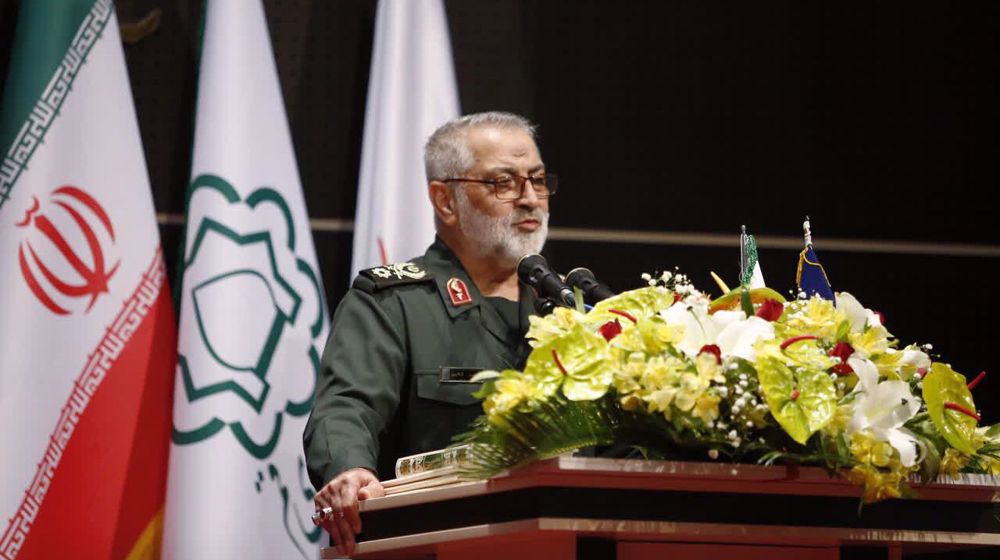
The senior spokesman for the Iranian Armed Forces says the enemy's extensive espionage network was dealt a severe blow during the 12-day Israeli-US aggression in June and largely dismantled, describing it as a major intelligence achievement.
Addressing an event in Tehran on Wednesday, Brigadier General Abolfazl Shekarchi highlighted the US-Israeli miscalculations during the war, saying they relied on their espionage networks and direct US command, and believed the Iranian system of governance would collapse under the initial strikes.
However, he said the reality on the ground proved the national will of Iranians to be unshakable.
The spokesman said that during the war, NATO’s full military capacity and its most advanced equipment were deployed as part of an all‑out hybrid warfare strategy against Iran.
"The enemy entered the field with a wrong assessment," Shekarchi stated.
"Despite the martyrdom of commanders and initial damages, the command vacuum was quickly filled. Within hours of defense, Iran's continuous offensive began, increasing in operational power day by day and leaving the enemy in absolute confusion," he added.
According to the general, the enemy's inability to achieve its strategic goals, including regime change and the disintegration of Iran, led them to a point where they "begged" for an end to the war, ultimately resulting in a unilateral ceasefire declaration.
General Shekarchi listed the increase in internal stability and the strengthening of national self-confidence as a brilliant outcome of this resistance. "Iran's power has now become an international belief," he said.
"For the first time, all components of hybrid warfare were used against us, and we proved that with national cohesion and reliance on the people, we can overcome any conspiracy."
He further noted that Iran has emerged stronger from the war, with its weapons production lines more active than ever.
Enemy shifting to cognitive warfare
While celebrating the military and intelligence victory, General Shekarchi warned that the enemy is shifting its focus from military confrontation to cognitive warfare and soft war.
He warned that capturing minds is more dangerous than a military attack, as its goal is to distort perceptions and calculations among the people. He urged the nation to maintain vigilance and not echo the enemy's rhetoric.
"The enemy seeks to weaken Iran, while Iran is not weak; the enemy only tries to hide its fundamental weaknesses with media posturing," he said.
General Shekarchi said the Islamic Republic possesses the science, experience, and capacity to manage soft warfare and turn these threats into opportunities. He expressed confidence that the Islamic Revolution will realize all its ideals while its enemies face eventual collapse.

Israeli court sentences man to over 13 years in prison for allegedly spying for Iran: Report

US trapped in Strait of Hormuz 'quagmire' after war on Iran: Libya’s Grand Mufti
Iran FM hails China consultations as ‘successful’



IRGC Navy strikes Togo-flagged tanker after illegal attempt to transit Strait of Hormuz
VIDEO | We salute the Palestinian woman
US lawmaker slams Trump’s $5 billion weapons sale to Saudi Arabia
VIDEO | Iran changing US war equations
Russia, China veto US backed anti-Iran resolution at UN Security Council
Araghchi welcomes Xi’s initiatives, hails China-Iran strategic partnership
VIDEO | Gaza transport crisis deepens as 70% of vehicles remain out of service
VIDEO | Press TV's news headlines



 PressTV NEWSLETTER
now
PressTV NEWSLETTER
now
 This makes it easy to access the Press TV website
