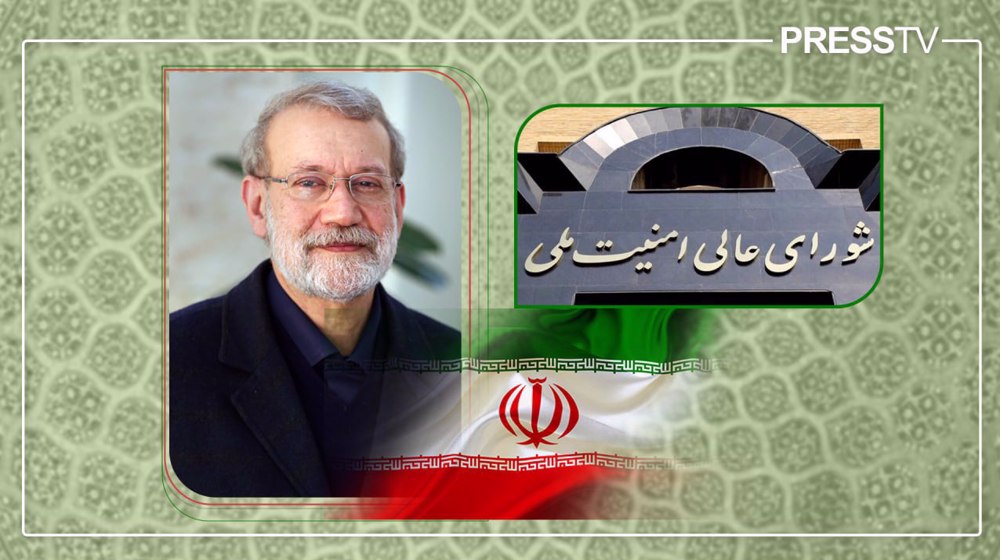
Profile: Ali Larijani, a seasoned political strategist, returns to Iran’s security helm
By Mohammadreza Mirzaei
Ali Larijani, one of the most seasoned figures in the Islamic Republic’s political and security establishment, has been appointed secretary of Iran’s Supreme National Security Council (SNSC), a role he previously held nearly two decades ago.
An appointment decree by President Masoud Pezeshkian on Tuesday emphasizes Larijani's expected role in "prudent and precise oversight," fostering synergy among institutions, and monitoring emerging technological threats while adopting "intelligent, people-centered approaches."
Larijani replaces General Ali Akbar Ahmadian, who held the post since 2023, in a major and important reshuffle following the 12-day Israeli-American aggression against Iran.
He was born in 1958 in Najaf, Iraq, to Iranian parents from a prominent religious family. His father, Ayatollah Mirza Hashem Amoli, was a distinguished cleric who moved to Najaf in 1931 due to persecution by Reza Shah but returned to Iran in 1961 when Larijani was three years old.
His academic journey reflects his intellectual depth and philosophical orientation.
He initially studied mathematics and computer science, earning a bachelor's degree from Sharif University of Technology. However, after consulting with renowned Islamic scholar Morteza Motahhari, who later became his father-in-law, Larijani shifted to Western philosophy for his graduate studies.
He completed both his master’s degree and PhD in philosophy at the University of Tehran, with his doctoral dissertation focusing on the 18th-century German philosopher Immanuel Kant.
Ali Larijani appointed new head of Iran’s Supreme National Security Council https://t.co/sLYQ7u0MGj
— Press TV 🔻 (@PressTV) August 5, 2025
A man for all seasons
Larijani brings to the post a formidable résumé spanning media, legislature, and national security. He began his career in the Islamic Revolution Guards Corps (IRGC), rising to the level of deputy commander during his decade of service in the 1980s amid imposed war.
He is well-known for his decade-long stewardship of the Islamic Republic of Iran Broadcasting (IRIB) from 1994 to 2004, a period remembered by many for expanding domestic programming.
In August 2005, President Mahmoud Ahmadinejad appointed Larijani as Secretary of the SNSC, replacing Hassan Rouhani, who later became Iran’s president.
In this role, Larijani also served as Iran’s chief nuclear negotiator, managing the country’s most sensitive foreign policy portfolio during a critical period of international tensions.
Under his leadership, Iran resumed uranium enrichment activities, which led to its referral to the UN Security Council by the International Atomic Energy Agency in 2006 and the subsequent imposition of illegal and unjustified sanctions.
In 2007, he resigned due to disagreements with then-President Mahmoud Ahmadinejad over nuclear policy. Following his resignation from the SNSC, Larijani won a parliamentary seat from the central Iranian city of Qom in the 2008 elections and was elected speaker of parliament, a position he held for three consecutive terms until 2020.
During his 12-year tenure as speaker, Larijani played a central role in shaping domestic legislation and foreign policy debates during a turbulent era marked by sanctions and nuclear negotiations. He was instrumental in securing parliamentary approval for the 2015 Joint Comprehensive Plan of Action (JCPOA), known as the Iran nuclear deal.
In May 2020, Leader of the Islamic Revolution, Ayatollah Seyyed Ali Khamenei, appointed Larijani as one of his senior advisers and a member of the Expediency Discernment Council, which mediates disputes between parliament and the Guardian Council.
"A threatening call from Netanyahu’s team! I sent back a reply worthy of him."
— Press TV 🔻 (@PressTV) June 29, 2025
Ali Larijani, an advisor to Ayatollah Khamenei, recounts how Israelis attempted to intimidate him and other officials in hopes of toppling the Islamic Republic.
Follow https://t.co/B3zXG73Jym pic.twitter.com/QfU6kKOKDb
Return to the big stage
Larijani also pursued the highest political office with mixed results. In 2005, he ran for president but finished sixth in the race, receiving 5.94% of the votes. More recently, he was disqualified by the Guardian Council from running in the presidential elections in both 2021 and 2024.
However, he remained in the spotlight and continued to contribute in different ways. Last month, Larijani made a surprise visit to Moscow, where he met with President Vladimir Putin to discuss Iran’s nuclear program and the escalating tensions in West Asia.
As the new secretary of Iran’s Supreme National Security Council, Larijani is now tasked with addressing critical domestic and international challenges facing Iran.
His appointment coincides with the establishment of a new defense council, which revives an institution from the Iraq war era to review defense plans and enhance the capabilities of the armed forces in a centralized manner.
Larijani’s return to a security leadership role could signal a potential openness to renewed diplomatic engagement, as he has favored diplomacy over confrontation in foreign policy matters, but his approach remains closely tied to national interests.
His philosophical background often informs his public speeches, where he frames Iran’s challenges in moral and historical terms. This scholarly perspective may influence his strategic thinking in the crucial security role he now occupies.
Grand Ayatollah Shobeiri Zanjani passes away at age of 98
Iran must fight US blockade with energy blockade: Deputy speaker
Iran’s president to attend UN General Assembly in New York



Iran, Pakistan push to finalize agreements, boost cooperation
VIDEO | Trump’s ICC sanctions prove US support for Israel: Analyst
Drawings of Minab children killed in US attack exhibited outside UN office in Geneva
Iranian engineers develop indigenous engine control units, advancing automotive electronics
VIDEO | Yemeni child survives Saudi airstrike that killed her entire family
VIDEO | News Review: Yemen’s top military officials warn Saudi Arabia of devastating response to its aggress
Iran’s Armed Forces vow to inflict further defeats on US, Israeli enemies
Child among two Palestinians abducted in Israeli West Bank raids



 PressTV NEWSLETTER
now
PressTV NEWSLETTER
now
 This makes it easy to access the Press TV website
