Iran-Pakistan ties in best phase since 1979, closer and cordial than ever: Ex-Senator
By Press TV Website Staff
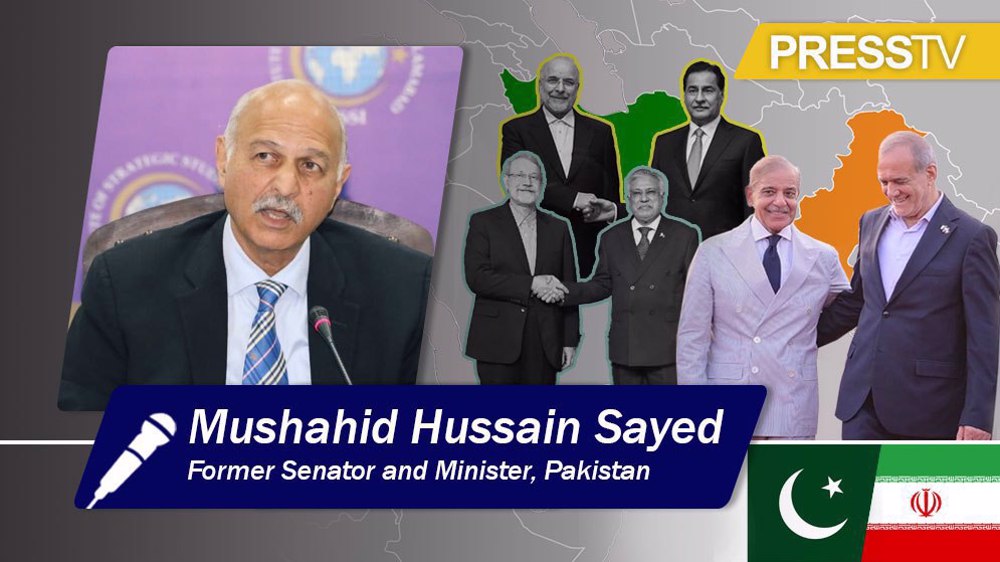
The recent series of visits by senior Iranian officials to Pakistan marks the beginning of a new chapter in Tehran-Islamabad relations, according to a former Pakistani minister and senator.
Mushahid Hussain Seyed, a senior Pakistani politician who previously served as Minister for Information and Broadcasting and as Chairman of the Foreign Relations Committee in the Pakistani Senate, said this new phase of ties is built on “mutual trust, mutual interest and a common vision for the region, based on peace and connectivity.”
“I think it’s the best phase in Pakistan-Iran camaraderie since the Islamic Revolution in 1979. Relations have never been that cordial and close,” he told the Press TV website.
President Masoud Pezeshkian’s visit to Pakistan in August was described as hugely successful, with the two neighboring countries signing 12 cooperation agreements spanning tourism, the judiciary, agriculture, culture, technology, transportation, and industry.
During the visit, both sides pledged to raise bilateral trade to $10 billion and revive key energy and connectivity projects. President Pezeshkian also attended the Pakistan-Iran business summit in Islamabad, where the draft of a free trade agreement was finalized.
In early November, Parliament Speaker Mohammad Baqer Qalibaf visited Pakistan to follow up on the implementation of previously signed agreements.
Ali Larijani, Secretary of Iran’s Supreme National Security Council, was warmly welcomed by Senator Muhammad Ishaq Dar, Deputy Prime Minister and Foreign Minister of Pakistan.
— Press TV 🔻 (@PressTV) November 25, 2025
Follow: https://t.co/mLGcUTSA3Q pic.twitter.com/wMyU0xZXXQ
Qalibaf emphasized Pakistan’s strategic importance to Iran, highlighting opportunities for expanded bilateral trade and cultural cooperation. He further noted that Pakistan’s geographical position could serve as a bridge linking Iran to East Asia and beyond.
Sardar Ayaz Sadiq, Speaker of Pakistan’s National Assembly, described the visit as a “significant milestone” in strengthening parliamentary and strategic ties between Tehran and Islamabad.
More recently, Secretary of Iran’s Supreme National Security Council Ali Larijani also visited Pakistan, holding wide-ranging talks with top political and military officials.
During the visit, Larijani described elevating Iran-Pakistan relations to the “strategic level” as a necessity and noted that the economic capacities of both countries could “operate far beyond the current level.”
He also thanked Pakistan’s civilian and military leadership for openly supporting Iran during the recent Israeli war of aggression against the country.
Seyed, who is also a veteran journalist and commentator, said there are multiple reasons behind Pakistan’s “unflinching solidarity” with Iran.
These include the realization that Pakistan and Iran face “common enemies,” the understanding that Israeli aggression was intended to bring about “regime change” in Iran — an outcome unacceptable to 250 million Pakistanis — and the fact that Pakistan’s worldview is rooted in strong solidarity with fellow Muslims.
“Be it Iranians or Palestinians, Pakistanis would always stand by fellow Muslims. Pakistanis felt very proud of Iran’s valour, heroism and victory over Israel under the Leader of the Islamic Revolution' superb leadership,” he said.
Assessing the broader potential of Iran-Pakistan relations across political, economic, and cultural spheres, as well as areas with the most untapped opportunities, Seyed said ties between Tehran and Islamabad have “yet to realize their true potential.”
✍️ Viewpoint - Building bridges of truth: Iran-Pakistan media pact to empower the voice of Ummah
— Press TV 🔻 (@PressTV) November 15, 2025
By Sheida Eslami
Read More: https://t.co/LKEeR2CDBx pic.twitter.com/2oZk1npp2S
“On all counts, plus defence and military cooperation, Pakistan-Iran relations have yet to realise their true potential, for which an historic opening now exists and must be seized by both sides through a sustained, strategic partnership,” he told the Press TV website.
Iran and Pakistan have also expanded cooperation in media and cultural fields, including recent MoUs signed between Iran’s state broadcaster, Islamic Republic of Iran Broadcasting (IRIB), and several Pakistani media outlets.
Seyed noted that during his tenure as Minister for Information and Culture (1997-1999), the two countries signed their first cultural and media agreements when then-Iranian culture minister Ataollah Mohajerani visited Pakistan.
On that occasion, both ministers extolled the role of Allama Iqbal Lahori as the “common cultural, intellectual and philosophical heritage” of Iran and Pakistan.
Meanwhile, the border region remains plagued by terrorist groups seeking to undermine ties between the two friendly Muslim-majority countries. Seyed said Pakistan and Iran have "common enemies."
“It’s no accident that the Zionist funded MEMRI in Washington, DC, announced in August 2025, to launch a Balochistan Centre to promote terrorism & separatism in both Pakistan & Iran, trying to exploit ethnic faultlines, which is a classic colonial playbook against Muslim countries, so CT (Counter Terror) cooperation is key to peace on our borders and security and stability in our volatile region,” he told the Press TV website.
“And then there’s the common threat of terror groups operating out of Afghanistan against both Pakistan and Iran. So joint operations against these common enemies are paramount for Pakistan and Iran.”
Press TV’s website can also be accessed at the following alternate addresses:
Dollar no longer safe haven, US economic fragilities erode trust in it: Economist
US military’s Venezuela push echoes old playbook for ‘regime change’ and oil grab: Expert

Trump’s admission of directing June Iran attack strengthens Tehran’s intl. legal case: Fmr. MP



 This makes it easy to access the Press TV website