

An Iranian researcher has developed advanced biodegradable magnesium-based scaffolds reinforced with graphene oxide, offering new potential for bone repair and regeneration.
The innovation could pave the way for next-generation orthopedic implants that gradually dissolve inside the body, reducing the need for additional surgery to remove conventional metal implants.
The research, conducted by Abbas Saberi at Arak University, focuses on developing porous, biodegradable scaffolds designed to support bone repair and regeneration while maintaining the mechanical strength required for orthopedic applications.
The project, titled “Fabrication and Characterization of Precipitation-Hardened ZK60/GO Composite Nanoscaffolds for Orthopedic Applications,” was carried out under the Distinguished Postdoctoral Researchers Program of the Iran National Science Foundation (INSF).
According to Saberi, unlike conventional metallic implants, which often remain permanently inside the body and may require additional surgery for removal, the newly developed scaffolds are designed to gradually degrade after fulfilling their function, potentially eliminating the need for a second operation.
“Bone repair and regeneration remain among the major challenges in medicine and biomedical engineering,” Saberi said, highlighting the medical and financial burdens associated with repeated surgical procedures.
The research team used ZK60 magnesium alloy as the base material and incorporated a controlled amount of graphene oxide (GO) to enhance the scaffold's mechanical properties and biocompatibility, Saberi explained.
Another key aspect of the project, he added, was the engineered porous structure of the scaffold.
“Carefully designed pores can facilitate cell migration and growth, blood vessel formation, and the natural regeneration of bone tissue,” Saberi highlighted.
“The structure was designed to establish an appropriate balance between mechanical strength, porosity and biocompatibility,” he explained.
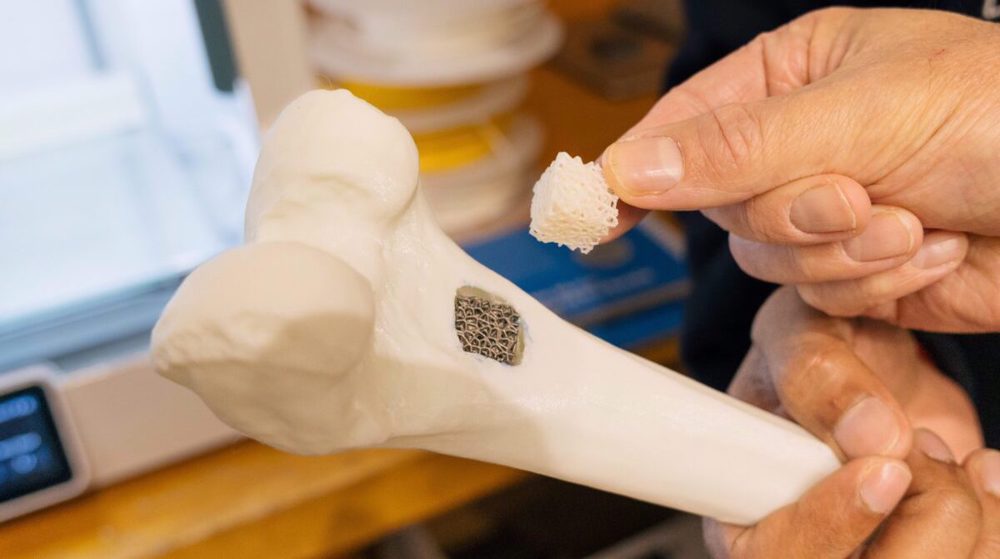
The findings indicated that incorporating an appropriate amount of graphene oxide, combined with an engineered porous architecture, helped maintain the scaffold's mechanical strength while allowing better control over its degradation rate, he noted.
The composite also demonstrated improved conditions for the formation of bone-like mineral compounds and the attachment and growth of bone cells, Saberi pointed out.
“One of the most important features of the developed scaffold is its ability to achieve a suitable balance between mechanical and biological properties,” Saberi said.
He noted that bone tissue engineering scaffolds must be strong enough to withstand mechanical loads inside the body while also providing a favorable environment for cellular interaction and the formation of new tissue.
“The key outcome of this research is the introduction of a simple, cost-effective and scalable method for producing biodegradable magnesium-based composite scaffolds with improved performance.”
He added that such materials could contribute to the development of a new generation of bone implants that gradually degrade and are absorbed by the body after completing their function.
The technology could potentially reduce the need for secondary surgeries, lower treatment costs and minimize complications associated with additional surgical interventions, Saberi added.
Saberi emphasized that magnesium-based composite scaffolds reinforced with graphene oxide hold considerable promise for repairing damaged bones, adding that further development of the technology could support domestic production of advanced biodegradable implants.
The research could also contribute to strengthening Iran's scientific and technological capabilities in biomaterials, tissue engineering and the manufacturing of advanced medical devices, while reducing reliance on imported technologies, he highlighted.
 This makes it easy to access the Press TV website